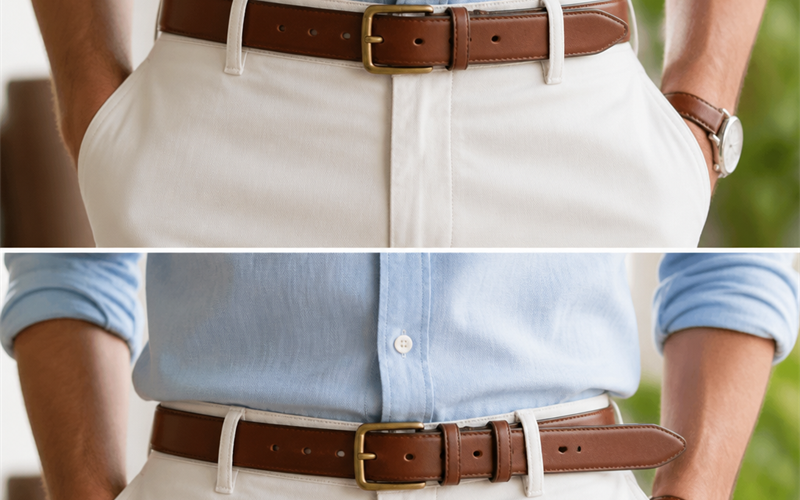
Belt for Military Officers in Civilian Wear
Quick answer: A military officer's civilian belt should signal what the uniform signals — precision, discipline, quality — without performing it. The right answer is a 1.25" smooth full-grain leather belt with a solid stainless or brass buckle, in matte black or deep espresso, with a clean unbranded finish. Skip novelty buckles, regimental colors used on civilian belts, and anything that "tells the room" you served.
Last updated: May 2026 • By BELTLEY Editorial
TL;DR:
- Officers in civilian dress signal the way they did in uniform: clean lines, quiet quality, nothing extra.
- Default: 1.25" smooth full-grain leather, matte black or deep espresso, solid metal prong buckle.
- Avoid: novelty buckles with rank/branch insignia, regimental colored belts in civilian contexts, anything tactical.
- Most officers settle on two belts for life: one black for formal/business, one espresso for casual.
A military officer in civilian dress is doing a specific job: signaling competence and discipline without leaning on the uniform that makes both legible. The civilian wardrobe is a translation problem — every accessory that was prescribed by regulation now has to be chosen, and the choices have to register the same way the regulation did. The belt is one of the easiest places to get it right: a quiet, well-built leather belt with solid metal hardware reads exactly like the disciplined civilian wardrobe an officer is trying to project. According to Wikipedia's reference on suits, business and semi-formal civilian dress in the West has been stable enough across decades that the right belt is genuinely a buy-once decision. Our dress belts and full-grain leather belts collections are the right baseline.
What belt should a military officer wear in civilian dress?
A military officer should wear a 1.25" (32mm) smooth full-grain leather belt in matte black or deep espresso with a solid stainless steel or solid brass buckle, finished cleanly without visible branding, decorative stitching, or rank-related insignia. The proportions match what the officer wore in dress uniform — the civilian belt is the translation, not a departure.

The reason 1.25" works across virtually every civilian context: it matches dress trouser belt loop interior widths (standard), carries the load of business and casual trousers cleanly, and reads correct under a buttoned jacket without bulking. We cover the underlying width logic in dress belts versus casual belts and what makes a formal belt for men.
Why does the civilian belt matter so much for an officer?
The civilian belt matters because it replaces the most visible piece of the uniform's discipline signaling — the regulation belt, polished hardware, exact fit — with a chosen object that has to do the same work. Civilian observers don't know the regulation existed, but they read the register. A quiet, well-made belt with solid metal hardware reads as someone who pays attention to detail. A flashy, branded, or sloppy belt reads as someone who doesn't.

This is also the reason most officers who transition to civilian wear settle on a buy-once approach: two quality belts (black and espresso) at the right width, worn until they actually wear out, replaced with the same thing. The strategy is documented in our breakdown of are full-grain leather belts worth the investment.
Key stat: A career military officer typically transitions through 3 to 5 civilian-dress phases over a career (junior officer leave, senior officer travel, post-command transition, retirement). A quality full-grain leather belt covers all five phases — roughly 20+ years — without replacement.
What color belt for which civilian context?
For officers in civilian dress, matte black smooth full-grain leather is the formal default (suits, business travel, official functions outside uniform); deep espresso is the casual default (chinos, sport coats, weekend wear). A third belt in oxblood or cognac is optional for civilian formal events that aren't black-tie. The two-belt minimum covers 95% of civilian contexts.
Officer civilian belt by context
| Civilian context | Belt | Width | Buckle |
|---|---|---|---|
| Business / official travel | Matte black smooth full-grain or calfskin | 1.25" | Slim stainless or brass plaque |
| Sport coat / chinos | Deep espresso full-grain | 1.25" | Brushed brass prong |
| Weekend casual | Espresso or saddle full-grain | 1.25"–1.5" | Solid brass prong |
| Civilian formal (cocktail) | Smooth black calfskin | 1.18"–1.25" | Slim polished dress prong |
| Civilian black-tie / wedding | None — braces only | N/A | N/A |
| Reunion or veterans' formal | Smooth black or espresso | 1.18"–1.25" | Slim polished, no branch insignia |
Should an officer's belt have a rank, branch, or regimental insignia?
No — in civilian dress contexts, a belt with rank insignia, branch device, or regimental colors reads as performing the service rather than embodying it. The exceptions are dedicated military-event wear (a regimental dinner where everyone is signaling affiliation) or memorial events where context makes the affiliation appropriate. In every other civilian setting, the belt should be unbranded and signal nothing more than quality.

This isn't about hiding service — it's about the difference between being an officer (which the wearer remains, civilian dress or not) and announcing it. The discipline of the uniform translated to civilian wear means the belt does its job without saying anything. Emily Post's general dress code framework treats civilian accessories as items that should support the outfit's formality tier, not introduce a new theme.
What buckle style should an officer wear in civilian dress?
For civilian dress, the right buckle is a slim plaque (modern, low-profile, reads sharp) or a dress prong (traditional, slightly more conservative). Both should be stainless steel or solid brass — same materials used in regulation belt hardware for durability and corrosion resistance, with the added civilian benefit of not tarnishing under daily wear. Avoid plated buckles, oversized hardware, and anything labeled "tactical" or "operator" in civilian settings.

The stainless choice mirrors the hardware standard officers are already familiar with from regulation gear. It's the same austenitic stainless used in service uniforms because it doesn't pit under sweat, salt air, or repeated polishing. Browse our plaque buckle belts and box & prong buckle belts for the right configurations.
What about retired or transitioning officers?
Retired officers and officers transitioning to civilian careers follow the same belt logic — sometimes with a slight upgrade to crocodile or alligator leather for senior corporate, board, or government-relations roles. The principle holds: quiet, quality, unbranded. A retired flag officer doing corporate-board work wears the same matte black calfskin or smooth black crocodile belt that any senior executive in the same role would wear.

For officers transitioning into finance or law specifically, the belt rules align with hedge fund and Wall Street conventions — see our belt for hedge fund analysts guide. The civilian dress code in those sectors is the most demanding civilian context an officer is likely to encounter.
The Bottom Line
A military officer's civilian belt is a translation problem with a clean answer: 1.25" smooth full-grain leather, matte black or deep espresso, solid stainless or brass buckle, no branding, no insignia, no statement. The belt should read the way the uniform read — precise, disciplined, quality — without performing it. Two belts cover an entire civilian career; both last decades. At BELTLEY, we handcraft full-grain leather belts with surgical-grade stainless or solid brass hardware, sealed edges, and a 10-year warranty. The right belt is the one nobody mentions, because everything about it is correct. Browse our men's belts, dress belts, and black leather belts collections.
Frequently Asked Questions
Q: Can an officer wear a tactical belt in civilian settings?
No — tactical/operator belts in civilian dress read as costume in most contexts. The exceptions are dedicated training, range, or backcountry use, where a tactical belt is functional. For business, formal, and casual civilian contexts, leather is the correct answer.
Q: Is a crocodile belt appropriate for senior officers in civilian dress?
Yes, especially for retired flag officers or officers in senior civilian roles (defense industry executive, government-relations, board work). A smooth black or espresso crocodile belt reads as quality, not luxury signaling. Our crocodile leather belts collection has dress-cut options.
Q: What belt for a civilian wedding while still serving?
Officers in civilian dress at a wedding follow the same rules as any other guest. Black-tie: no belt (braces only). Cocktail/semi-formal: slim black or espresso smooth calfskin. See our wedding guest belt rules guide.
Q: Should the buckle match a service watch or a civilian watch?
Match the buckle to whatever watch the officer is wearing in that context. Stainless field watch → stainless or silver buckle. Gold civilian dress watch → brass or gold buckle. The pairing rule is consistent across all professional contexts. See should your belt buckle match your jewelry.
Q: How does the rule differ across branches (Army, Navy, Air Force, Marines)?
It doesn't — civilian dress is civilian dress. Branch culture may influence the officer's broader wardrobe choices, but the belt logic (quiet, quality, unbranded leather) is identical across services.
Q: How long should an officer's civilian belt last?
A quality full-grain leather belt with solid metal hardware lasts 20+ years of normal civilian wear when conditioned annually. The 10-year warranty covers manufacturing and material defects; the actual service life typically exceeds the warranty significantly.