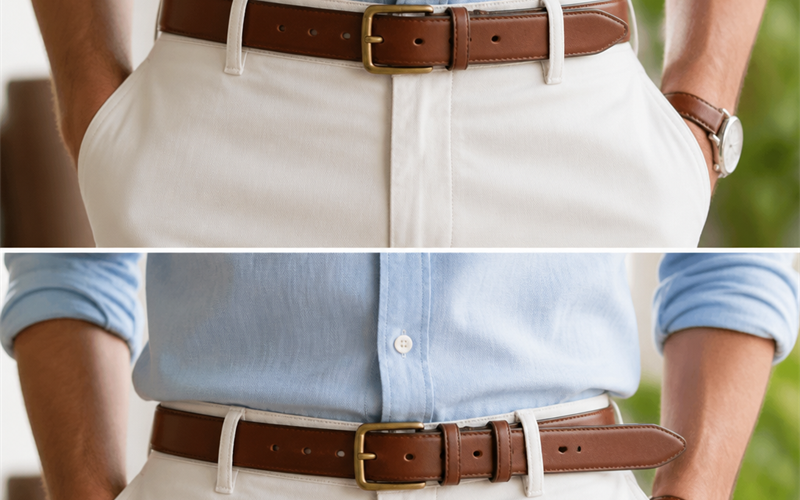
Belt for Men Who Just Lost 20+ Pounds (Without Replacing It Yet)
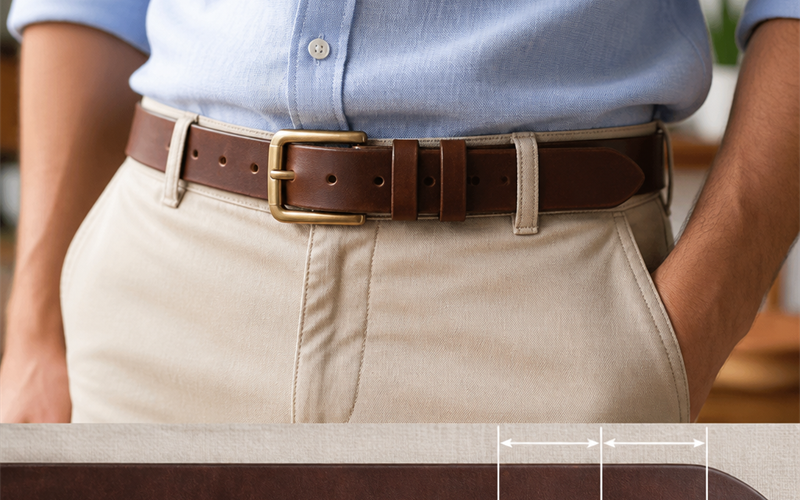
Quick answer: After losing 20+ pounds, your old belt is roughly 2-3 sizes too large. You can keep using it: 1) punch 2-3 extra holes (DIY for $10 or cobbler for $15), or 2) have a cobbler trim 2-4 inches off the buckle end and re-punch fresh holes ($15-$30). Trimming is the better fix if you've stabilized at the new weight; just adding holes is fine if you're still losing. Both approaches buy years of additional life on a quality belt.
Last updated: May 2026 • By BELTLEY Editorial
Why trust this guide: BELTLEY's customer service team helps customers adjust belts through weight changes weekly — both adding holes and full re-cuts. Our 10-year construction warranty often covers these adjustments. We know which approach works for which weight loss scenario and which belts are worth modifying versus replacing.
TL;DR:
- 20 pounds lost ≈ 2 belt sizes — your old belt is now too big.
- Adding 2-3 holes is the temporary fix; trimming is the permanent one.
- Don't fully resize until weight has stabilized for 4-6 weeks.
- Quality full-grain belts are worth resizing; bonded leather belts usually aren't.
At a glance:
- 1 pound lost ≈ roughly 0.1" waist reduction (varies by body type)
- 20 lbs lost ≈ 2"+ waist reduction = 2 belt sizes
- DIY hole punch cost: $0-$10
- Cobbler resize cost: $15-$30
- Updated — May 2026 · By BELTLEY Editorial
You dropped 20 pounds. The pants are starting to slide. The belt now reaches into territory it wasn't designed to reach — past the last hole, the tail flopping past the keeper. Congratulations on the loss. Now let's keep the belt working. Below: the math of weight-to-belt-size conversion, the two repair approaches and when to use each, and why patience pays off before committing to the permanent fix.
Stabilized or Still Losing? Pick Your Fix
The 20-pounds-down decision:
| Your situation | Go with |
|---|---|
| Still losing weight | Punch 2–3 holes and ride it out — cheap, reversible, no commitment. |
| Stabilized at the new weight | Cobbler-trim the buckle end ($15–$30) — clean re-punch, belt looks original. |
| Belt now wraps past your hip | Replace — past 4" of excess, the proportions are gone. New size: new waist + 2". |
| Treating yourself for the milestone | Fair — a fitted full-grain or croc belt at the new size is the wearable trophy. From $58. |
The milestone option: BELTLEY's men's collection, sized right via the size guide.
How much smaller is my waist after losing 20 pounds?
A 20-pound loss typically reduces waist size by 1.5-2.5" depending on body composition and where the weight came from. The conversion ratio is roughly 1 inch of waist per 10 pounds of weight loss, varying with starting size, body fat percentage, and individual fat distribution. Men losing weight primarily through abdominal reduction (most common pattern) see slightly more waist change per pound than men losing weight uniformly.

This is why a 20-pound loss usually moves you down 2 belt sizes — a 36" waist becomes 32-34", a 40" becomes 36-38". Your old belt's last hole is now too loose; you've moved into territory the belt wasn't designed for.
Should I add holes or trim the belt?
The answer depends on whether your weight has stabilized. If you're still actively losing, just add holes — quick, cheap, reversible if needed. If you've stabilized at the new weight for 4-6+ weeks, trim the belt — cleaner aesthetic and the belt will fit properly indefinitely. Trimming a belt at the wrong moment (still mid-loss) means re-cutting again in 3 months; adding holes is the right move during transition periods.
The rule: don't make permanent modifications during active change. The cobbler will be there in two months; the belt can absorb 2-3 extra holes in the meantime.
How many holes can you add before damaging the belt?
You can add 2-3 holes beyond the original set on most quality belts without structural concern — total of 7-8 working holes. Beyond that, the belt's structural integrity at the buckle end starts to suffer (the area near the buckle thins as more holes weaken the leather). At that point, the belt has effectively reached its sizing range limit and should be either trimmed (recapture lost space) or replaced.

Position the new holes at the standard 1" spacing maintained on the original belt. Random spacing creates a sloppy look and disrupts the rotation pattern that protects leather wear. Use a rotary leather punch for clean holes; freehand drilling or hot-poking destroys the leather. Full DIY walkthrough in our guide on how to add an extra hole to a leather belt.
Key stat: Roughly 1" of waist per 10 lbs lost is the population average — but individual variation runs ±50%. Some men lose 1.5" per 10 lbs (high abdominal fat starting point); others lose only 0.5" per 10 lbs (lean starting point losing weight elsewhere). Measure before assuming.
Belt adjustment by weight loss amount
| Weight Lost | Approx Waist Change | Belt Sizes Down | Recommended Fix |
|---|---|---|---|
| 5-10 lbs | 0.5-1" | 0-1 size | Use next-tighter hole; no modification |
| 10-20 lbs | 1-2" | 1-2 sizes | Add 1-2 holes during transition |
| 20-30 lbs | 2-3" | 2-3 sizes | Add holes, then trim at stable weight |
| 30-50 lbs | 3-5" | 3-4 sizes | Trim belt or replace; many holes won't suit |
| 50+ lbs | 5"+ | 4+ sizes | Replace belt entirely — modification doesn't suit |
How does a cobbler trim a belt for weight loss?
The cobbler removes the buckle, measures and marks the new total length (new waist + 2"), cuts off excess from the buckle end (preserving the original tip taper at the tail), re-shapes the new cut edge, back-burnishes it, re-punches a fresh set of holes at proper spacing, and re-attaches the original buckle. The trimmed belt looks identical to a factory belt that was sized correctly to begin with.

This works perfectly on quality full-grain belts. It works less well on bonded leather, where the cut edge often delaminates because the polyurethane backing doesn't hold a clean cut. If your belt was under $40 retail, replacement may be the better path.
When should you replace the belt instead of adjusting?
Replace the belt when: 1) the loss is over 50 lbs and the belt would need extensive recutting that affects proportions, 2) the belt is bonded leather and won't hold a clean trim, 3) the original buckle attachment is sewn (mono-piece) and not easily removable, or 4) the belt is showing other signs of wear — cracking, dye fading, hole stretching — that make modification not worthwhile.

A full-grain belt that's still in excellent condition can absorb a 2-3 size adjustment and serve for another decade. A worn-out belt past the point of structural confidence isn't worth the cobbler cost.
What's the trick to not punching crooked holes yourself?
Three steps for clean DIY holes: 1) Mark the location with a ruler — measure from the existing nearest hole at exactly the same spacing (typically 1" apart). 2) Use a rotary leather punch ($8-$15 on Amazon) at the same diameter as the existing holes (typically 3.5mm or 1/8"). 3) Place the leather on a hard, smooth surface — a piece of scrap wood or a cutting board — and press the punch through with steady pressure.
Avoid: power drills (tear the leather), hot screwdrivers/awls (burn the leather), or freehand punching without a measurement guide. Rotary punches produce clean, factory-like holes; everything else looks amateur.
Will the original holes still be useful after losing weight?
The original holes become "reserve" positions — useful if you regain some weight, or as visual reference for hole spacing. Don't fill them in (filling holes is the worst belt repair mistake — see our stretched hole repair guide). Leave them as-is; quality belts often have 5+ holes naturally, and 2-3 unused ones look completely normal.

If you regain weight in the future, the old holes are right there waiting. Adjustable doesn't have to mean one-way.
Related BELTLEY guides
- Belt for Men Who Just Gained Weight (Quick Adjustments) — the reverse problem
- How to Add an Extra Hole to a Leather Belt (Without Ruining It) — DIY hole walkthrough
- How to Shorten a Belt That's Too Long (Step-by-Step) — full trimming guide
- Skinny Guys & Belts: Why Yours Always Looks Too Long — related sizing topic
- The Belt Hole That Stretched: Should You Replace or Repair? — hole-side repair primer
The Bottom Line
Losing 20+ pounds means your belt is now 2-3 sizes too big — but you don't have to replace it if it's quality leather. Add holes during active loss; trim properly once your weight stabilizes. Both fixes are inexpensive and preserve the belt you already own. At BELTLEY, we'll re-punch or trim belts under our 10-year warranty when weight changes shift fit out of range. Browse the men's belt collection for belts built to absorb these adjustments cleanly — and congratulations on the loss.
Frequently Asked Questions
Q: How many pounds equal one belt size?
Roughly 10 pounds lost per 1 belt size dropped — though individual variation is wide (5-15 lbs per size depending on body composition). Measure your actual waist rather than estimating; it's the only reliable number.
Q: Can I shorten my belt myself?
Yes, with the right tools — a sharp leather knife or rotary cutter, edge paint for back-burnishing, and patience. The cobbler approach ($15-$30) produces cleaner results and is recommended for belts over $100 retail. See how to shorten a belt that's too long for the full walkthrough.
Q: Should I wait until I reach my goal weight before adjusting?
Wait until you've stabilized — not necessarily at goal, but at any plateau lasting 4-6+ weeks. Permanent adjustments at unstable weights mean repeating the work. Add holes for ongoing transitions; trim for stable weights.
Q: Will adding holes weaken my belt?
Marginally — 2-3 extra holes don't structurally compromise a quality full-grain belt. Adding 5+ holes starts to thin the leather at the buckle end. Back-burnishing the new holes (sealing the interior with edge paint) prevents fraying and extends life.
Q: Are there belts designed to handle weight fluctuations better?
Yes — micro-adjustable ratchet belts allow size changes in 1/4" increments without punching holes. They're particularly useful during active weight changes. Quality full-grain ratchet belts give the same craft and durability as traditional belts with built-in adjustability.

%20punch%202-3%20extra%20holes%20(DIY%20for%20$10%20or%20cobbler%20for%20$15),%20or%202)%20have%20a%20cobbler%20trim%202-4...)