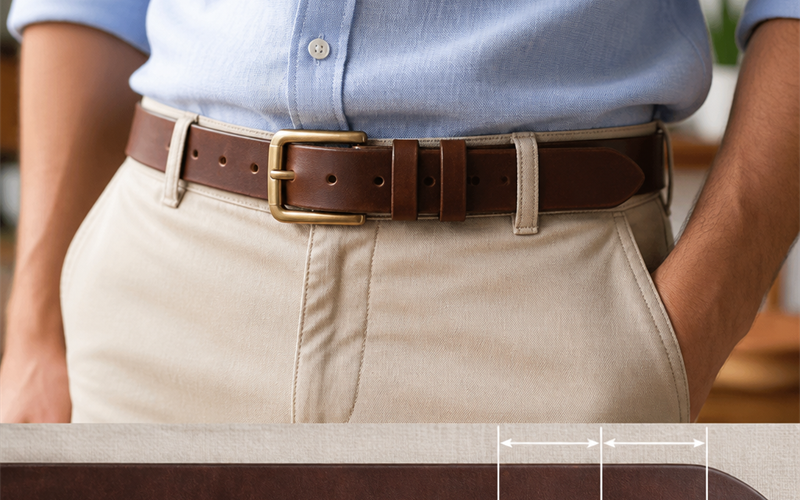
Belt for Men Who Just Gained Weight (Quick Adjustments)
Quick answer: Add 2-3 extra holes at the loose end (tail) of the belt — DIY with a $10 rotary leather punch or at a cobbler for $10-$20. Don't force the prong into too-tight existing holes (this stretches them permanently). If your weight gain exceeds the new holes' reach, it's time for a new belt sized 2-4 inches larger than your current piece. Quality full-grain belts handle this adjustment cleanly; bonded leather often tears at the new holes.
Last updated: May 2026 • By BELTLEY Editorial
Why trust this guide: BELTLEY's customer service team handles belt re-sizing requests in both directions — and our 10-year construction warranty covers re-punching for weight changes on most belts. We know which leathers can absorb the extra holes cleanly and which ones can't. This guide reflects practical adjustment, not theoretical advice.
TL;DR:
- Add holes at the tail end, not the buckle end — extend, don't shrink.
- 2-3 added holes handle a 1-3" waist increase cleanly.
- Don't force the prong into too-tight holes; you'll stretch them permanently.
- For increases over 4", buying a new belt is usually the right call.
At a glance:
- 1" waist gain ≈ 1 belt hole needed at standard 1" spacing
- Add holes cost: $0-$10 (DIY) or $10-$20 (cobbler)
- Hole spacing: 1" between centers (standard)
- Replacement threshold: 4"+ gain past existing holes
- Updated — May 2026 · By BELTLEY Editorial
You buckle your belt and it's tight. Yesterday it was fine; today the prong barely reaches the first hole. Welcome to one of the most common — and most fixable — wardrobe pivots in a man's life. Below: how to add the holes you actually need, why you should never force the prong, and the math for deciding whether to extend the belt or buy new.
How Much Room Do You Need? Start Here
Quick triage by gap size:
| Your situation | Go with |
|---|---|
| One hole short of comfortable | Punch 2–3 new tail holes — $10 rotary punch or any cobbler; clean fix on full-grain. |
| Forcing the prong daily | Stop — forced holes stretch permanently and the belt dies twice as fast. |
| Gain beyond 3–4 inches | New belt, sized to your real waist + 2" — adjustment math stops working past the belt's design range. |
| Old belt is bonded leather | Don't bother punching — bonded tears at new holes. Replace with full-grain (from $58) that takes adjustment gracefully. |
Honest sizing for the new measurement: BELTLEY's size guide and men's collection.
How do you add holes to a belt for a bigger waist?
Add holes at the tail end of the belt (past the existing holes) using a rotary leather punch ($8-$15 on Amazon). Mark the new hole location 1" past the last existing hole using a ruler; punch with the same diameter as the existing holes (typically 3.5mm or 1/8"); back-burnish the interior with a drop of edge paint to prevent fraying. Repeat for 1-3 more holes as needed for current and near-future fit.

Always extend at the tail, never at the buckle end — adding holes between the buckle and existing holes weakens the buckle attachment area. The tail end can absorb 2-3 extra holes without structural concern. Full walkthrough in our guide on how to add an extra hole to a leather belt.
Why shouldn't you force the prong into a too-tight hole?
Forcing the prong into a too-tight hole stretches the leather fibers around the hole permanently — turning a round, healthy hole into an oval, weakened one within a few weeks. The damage is cumulative: every forced insertion expands the stretch slightly. Within 1-2 months, the over-forced hole loses its grip and the belt starts slipping during wear.
This is the most common "self-inflicted" belt damage we see in customer service photos. The right move is always to add a new hole sized correctly, not to wrestle the prong into an existing hole that doesn't fit. The new hole takes 5 minutes; recovering from a stretched hole takes a cobbler visit.
Key stat: A forced-prong insertion into a too-tight hole produces measurable hole stretch within 3-5 insertions. Within 30-60 days of forced use, the hole typically becomes too loose to hold the prong securely — exactly the opposite of the initial "too tight" problem.
When should you size up instead of adding holes?
Size up (buy a new belt 2-4" larger) when: 1) you've gained more than 4 inches at the waist and the existing belt can't accommodate without structural damage, 2) you've already added 2-3 holes and need more space, 3) the belt is bonded or split leather and the new holes are fraying or tearing within weeks, or 4) the belt is showing other wear that makes investment in modification not worthwhile.

Quality full-grain belts can handle 2-3 added holes (covering 2-3" of waist gain) without trouble. Beyond that, the belt was designed for a different waist range and you're stretching it past its engineering range.
Belt extension matrix by weight gain
| Waist Increase | Recommended Approach | Cost | Effort |
|---|---|---|---|
| 0.5-1" | Use the loosest existing hole | $0 | None |
| 1-2" | Add 1-2 holes at tail end | $0-$20 | 5-15 min |
| 2-3" | Add 2-3 holes at tail end | $0-$20 | 15-30 min |
| 3-4" | Add holes + consider sizing up | $0-$150+ | Belt + cobbler decision |
| 4"+ | Buy new belt sized for new waist | $90-$300 | Shopping time |
| 6"+ (rapid gain) | Buy new belt + consider micro-adjustable | $90-$300 | Shopping + measurement |
How do you know what new size to order?
Measure your current actual waist with a soft tape at the level you wear belts. Add 2 inches to that number — that's your belt size. So a current actual waist of 36" = Size 38 belt. The "+2" rule lands you at the middle hole of a 5-hole belt, which is where the belt is engineered to be worn for optimal fit and rotation.

If you're between sizes, round up rather than down — a slightly loose belt is far easier to manage (extra hole, tighter cinch) than a slightly tight one. Quality DTC brands like BELTLEY stock sizes in 2" increments from 28" through 50" so finding your size is usually straightforward.
Should you use a belt extender or just add holes?
Belt extenders (small leather pieces with a prong and bar that attach to the existing buckle to add 1-2" of length) work as emergency solutions but rarely look polished. They're functional but visually obvious — there's an extra metal-and-leather piece between the buckle and the strap. For temporary or occasional needs (one specific event with rented suit pants, for example), they're fine. For daily wear, adding holes or sizing up is cleaner.

The exception: dress occasion with a pant whose belt loops are tight and an existing belt that just barely doesn't reach — a discreet extender can hide under the trouser closure and save the night.
Will adding holes weaken my belt?
Marginally for the first 2-3 added holes; significantly past that. Quality full-grain leather handles 2-3 extra punched holes without structural concern — the leather fiber network is dense enough to absorb the additional perforations. Bonded leather often fails at new hole sites because the polyurethane backing tears around the cut.
Back-burnishing each new hole (sealing the interior with edge paint or beeswax) doubles or triples the hole's resistance to fraying. This is the same finish quality that our men's belt collection ships with from the factory — every hole is back-burnished as standard.
Can a cobbler add holes without me?
Yes — most cobblers add holes for $5-$10 per hole (sometimes free as a courtesy on belts under repair for other issues). The cobbler approach uses a properly sized punch, includes back-burnishing, and produces hole positioning that matches factory spacing perfectly. For belts over $200 retail, the cobbler approach is usually worth it; for sub-$50 belts, DIY is fine.

If the belt is from a quality maker with a service warranty, contact the maker directly first. Many DTC brands re-punch or re-cut belts for original customers as part of their warranty service.
Related BELTLEY guides
- Belt for Men Who Just Lost 20+ Pounds (Without Replacing It Yet) — the reverse problem
- How to Add an Extra Hole to a Leather Belt (Without Ruining It) — DIY hole walkthrough
- Why Are My Belt Holes Wearing Out So Fast? — preventing new holes from stretching
- The Belt Hole That Stretched: Should You Replace or Repair? — fixing damage from forced prongs
- Belt Won't Hold Up My Pants — Is It the Belt or the Pants? — companion fit diagnostic
The Bottom Line
A belt that's suddenly too tight is solving a quick math problem — you need 1-3 inches more reach at the tail. Add holes the right way (rotary punch, 1" spacing, back-burnished) and the belt absorbs the change cleanly. For larger weight increases past 4", a new size is the right call — and DTC brands make finding your true size easy. At BELTLEY, the men's belt collection is stocked in 2" increments through Size 50, so the right size is always available without compromise.
Frequently Asked Questions
Q: How many holes can I add to my belt before damaging it?
2-3 holes added at the tail end of a quality full-grain belt is structurally safe. Beyond that, the leather thins enough at the tail to risk eventual tearing. Bonded leather belts often fail at the first added hole.
Q: Will the new holes I add look uniform with the original ones?
Yes if you use a rotary leather punch at the same diameter as the original holes and maintain the standard 1" spacing. Use a ruler to mark positions — eyeballing produces visibly uneven results.
Q: Can I add holes to a belt with no existing holes for guidance (like a brand-new belt)?
Yes — measure the strap, mark the desired hole positions (typically starting 2-3" from the tip and continuing at 1" intervals), and punch. Many DTC belts ship with limited initial holes specifically because customers prefer to position them for their own measurements.
Q: Why not just buy a bigger belt right away?
If the gain is permanent (1+ year stable), buying the correct size is the cleanest long-term solution. If the gain might be temporary or you're still changing, adding holes preserves your current belt while you stabilize.
Q: Are micro-adjustable ratchet belts better for fluctuating weight?
Often yes — ratchet belts adjust in 1/4" increments without punched holes, accommodating gradual changes seamlessly. Quality full-grain ratchet belts give the same craft and durability as traditional belts with built-in adjustability.
%20of%20the%20belt%20%E2%80%94%20DIY%20with%20a%20$10%20rotary%20leather%20punch%20or%20at%20a%20cobbler%20for%20$10-$20.%20Don't%20force%20the%20prong%20into%20too-tight%20existing%20holes%20(this%20s...)