Belt for Journalists & Reporters in the Field
Quick answer: Field journalists need a belt that handles 16-hour days, climate extremes, and the occasional press-vest load — the right answer is a 1.25"–1.5" full-grain leather belt with a solid brass or stainless prong buckle, in espresso, saddle brown, or matte black. Skip dress belts in the field, and skip braided or distressed belts that snag on gear.
Last updated: May 2026 • By BELTLEY Editorial
TL;DR:
- A field journalist's belt has to anchor trousers loaded with notebook, phone, radio, water, and sometimes a press vest — width matters more than style.
- Default: 1.25"–1.5" full-grain leather with a solid brass or stainless prong buckle.
- Espresso or saddle brown for daytime field work; matte black for studio handoffs and city assignments.
- Avoid braided belts (snag on gear), dress belts (too narrow under load), and patent or shiny finishes (catch lighting on camera).
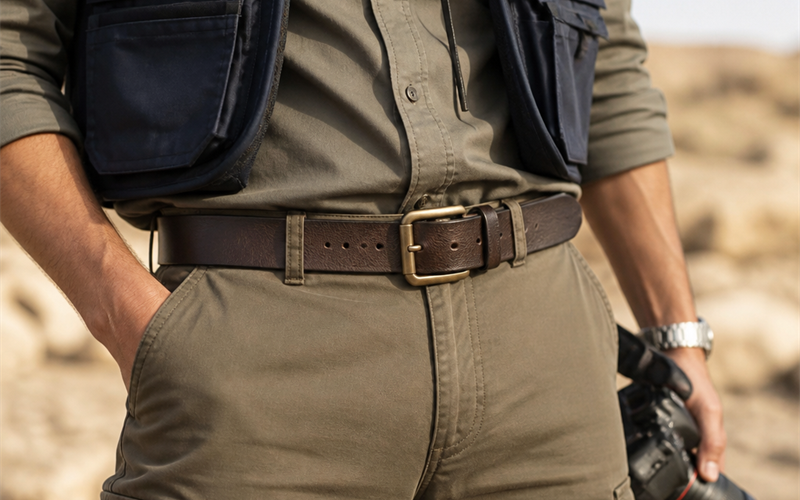
A field journalist's outfit lives in two worlds — outdoor reporting and on-camera presentation — and the belt has to bridge both. Reporters covering disasters, conflict zones, sports events, or political rallies wear gear-loaded trousers and weather-appropriate layers for 12 to 16 hours straight, then might appear on camera or hand off to studio within the same shift. The belt is part of the load-bearing system, not just an accessory. Wikipedia's journalism entry covers the broader categories (photojournalism, broadcast, investigative, war reporting), and each subdivides the belt question slightly differently. Our full-grain leather belts collection is the right baseline for field durability.
What belt should a field journalist wear?
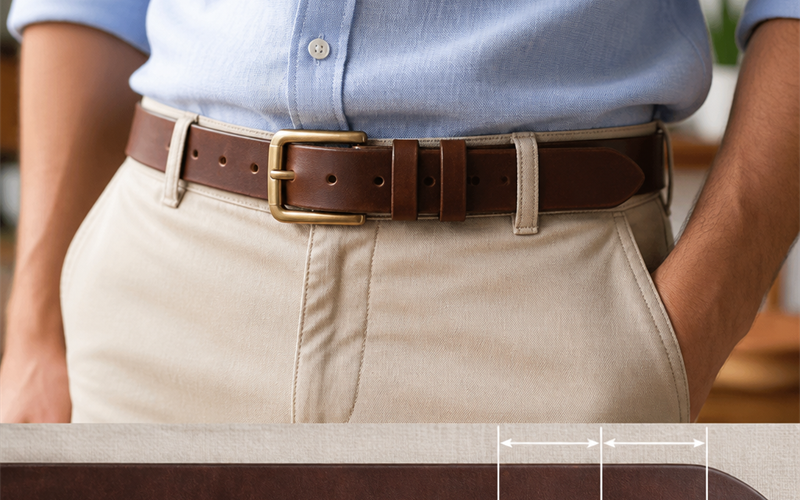
A field journalist should wear a 1.25" to 1.5" (32–38mm) full-grain leather belt with a solid metal prong buckle — brass for warmer tones, stainless for cooler tones. The belt should be smooth or lightly distressed, never braided or raw-edge, and never narrower than 1.18" because narrow belts can't carry gear-loaded trouser weight without folding. Color: espresso, saddle, or matte black depending on the assignment context.

The distinction from a dress belt is functional. A field belt has to anchor trousers carrying a notebook, two phones, radio, water bottle, and on conflict assignments a body armor liner or vest — load that a 1" dress belt can't manage. The dimension we recommend is in our breakdown of thin vs. thick belts for men and dress belt vs casual belt.
BELTLEY 3-Material Rule
The 3-Material Rule = full-grain leather + stainless or solid brass buckle + sealed (painted or burnished) edges. It's the framework for any belt that has to survive years of outdoor field use. Full-grain handles humidity, salt air, dust, and abrasion without cracking. stainless or solid brass doesn't corrode in coastal or tropical assignments. Sealed edges keep the leather from absorbing moisture at the cut line — the failure point that takes out cheaper belts inside a single rainy-season assignment.
Why does field reporting break cheap belts so fast?
Field reporting breaks cheap belts because the load conditions exceed what dress and fashion belts are engineered for. Gear-loaded trousers pull continuously on the belt; outdoor humidity and sweat saturate the leather; long days of bending, kneeling, and sitting cycle the buckle hundreds of times. Bonded leather and split-leather belts crack at the prong holes within a single 30-day deployment. Full-grain leather with sealed edges handles the same load for years.

The Wikipedia belt clothing reference describes the grading distinction in passing — full-grain is the top hide layer with the natural grain intact, and it's the only grade that survives field use across multi-year careers. Splits and bondeds are made for cost, not service.
Key stat: A field journalist on a multi-week conflict-zone or disaster assignment averages 18–22 buckle cycles per day (mid-shift load adjustments, vest fittings, repositioning) — roughly 600 cycles a month. Bonded-leather belts fail inside 3 months under that load.
What color belt for a field journalist?
For a field journalist, the most versatile belt color is espresso or saddle brown full-grain leather — works with cargo trousers, tactical pants, jeans, and chinos, doesn't show dust the way black does, and reads professional on camera in natural light. A second belt in matte black handles indoor studio handoffs, city assignments, and formal interview settings (government buildings, courts, embassies).
Field journalist belt by assignment
| Assignment type | Belt | Width | Buckle |
|---|---|---|---|
| Field outdoor (default) | Espresso or saddle full-grain | 1.25"–1.5" | Solid brass prong |
| Conflict / war reporting | Matte black or espresso, reinforced | 1.5" | stainless prong |
| Disaster / weather | Saddle, sealed edges | 1.5" | Solid brass |
| Sports / event coverage | Espresso | 1.25" | Brushed brass or copper |
| Studio handoff / on-camera city | Matte black calfskin or full-grain | 1.18"–1.25" | Slim polished |
| Formal interview (embassy, court) | Black smooth calfskin | 1.18"–1.25" | Slim plaque or dress prong |
Should a field belt match what you wear on camera?
A field journalist's belt should be the same belt on camera as in the field, because shifting belts mid-assignment is friction the day doesn't allow. The right baseline belt — espresso full-grain, 1.25", solid brass buckle — reads correct in both contexts: outdoor footage and on-camera stand-ups. For studio interviews or formal sit-downs (presidential press briefings, embassy interviews), a separate slim black dress belt is the upgrade.

This dual-context durability is exactly why most professional field reporters carry two belts in their kit: one heavy-duty leather for daily wear, one dress belt for indoor formal appearances. The kit math is in our breakdown of are full-grain leather belts worth the investment. Browse brown leather belts for the field default and dress belts for the studio belt.
Does a press vest change the belt requirements?
Yes — when wearing a press vest, body armor, or any chest/torso load-bearing gear, the belt should be 1.5" wide (not 1.25") to handle the additional load transferred to the waist. The belt should also have a solid metal buckle (not plated) because plated buckles deform under sustained vest-induced waist pressure. Avoid plastic-frame buckles entirely.

For reporters who wear plate carriers or full body armor (war correspondents, hostile environment coverage), a dedicated 1.5"–1.75" reinforced field belt is often paired with the armor system. For most field journalists wearing just a press vest or photographer's harness, a quality 1.5" full-grain leather belt with a solid brass prong buckle is sufficient. The Wikipedia journalism reference covers war journalism as a distinct category — the belt requirements track accordingly.
What buckle style is right for field work?
For field work, the right buckle is a simple metal prong buckle in solid brass or stainless steel — uncomplicated, fast to adjust, and replaceable if damaged. Avoid plaque buckles (slow to adjust under time pressure), ratchet buckles (mechanism fails in dust and sand), and oversized Western buckles (catch on gear, vest straps, and door frames).

The prong buckle's advantage in the field is operator speed. A field journalist might need to remove or refit a vest in 30 seconds; a prong buckle is the only mechanism that supports that timing reliably. Browse our box & prong buckle belts for the right configuration.
The Bottom Line
A field journalist's belt is field equipment first, accessory second. The right answer is a 1.25"–1.5" full-grain leather belt with a solid brass or stainless prong buckle and sealed edges — built to outlast every assignment in the rotation. Espresso or saddle for daytime field work, matte black for studio and formal contexts. Most professional reporters carry one of each in their kit. At BELTLEY, we apply the 3-Material Rule (full-grain leather + solid metal buckle + sealed edges) to every belt, with a 10-year warranty that covers normal field wear. Browse our full-grain leather belts and brown leather belts collections for the field default.
Frequently Asked Questions
Q: Can a journalist wear a tactical nylon belt instead of leather?
For pure field operations (especially with a sidearm or heavy gear), tactical nylon is a legitimate alternative — but it doesn't transition to on-camera or formal contexts. Most working journalists prefer one quality full-grain leather belt that bridges both worlds.
Q: How heavy can a gear-loaded waist get before the belt needs upgrading?
A 1.25" quality full-grain leather belt handles roughly 8–10 lbs of loaded trouser weight cleanly. Beyond that — full kit, vest load, holstered radio — step up to 1.5" or add a tactical belt system over the leather one.
Q: Should war correspondents wear a different belt than domestic reporters?
War correspondents and conflict-zone reporters typically wear 1.5" reinforced full-grain leather or dedicated tactical belts. The buckle should be stainless or solid brass (not plated) for corrosion resistance in extreme environments.
Q: Are exotic leather belts (crocodile, alligator) appropriate for field journalism?
For daily field work, no — exotic leathers are too dressy and the textured surface catches on gear. For formal assignment contexts (embassy events, presidential pool), a smooth black crocodile or alligator dress belt reads correct. See our crocodile leather belts collection.
Q: How do female field reporters approach the belt question?
The same principles apply with adjusted width — 1"–1.25" full-grain leather, solid metal prong buckle, espresso or matte black. Browse our women's belts collection for sized options.
Q: What's the right way to break in a new field belt?
Wear it for two weeks of normal daily activity before taking it on assignment. Condition once with a small amount of leather balm before the first long field day. Avoid soaking it (leather absorbs slowly; air-dry away from direct heat).