Belt for Hedge Fund Analysts: Wall Street's Unwritten Code
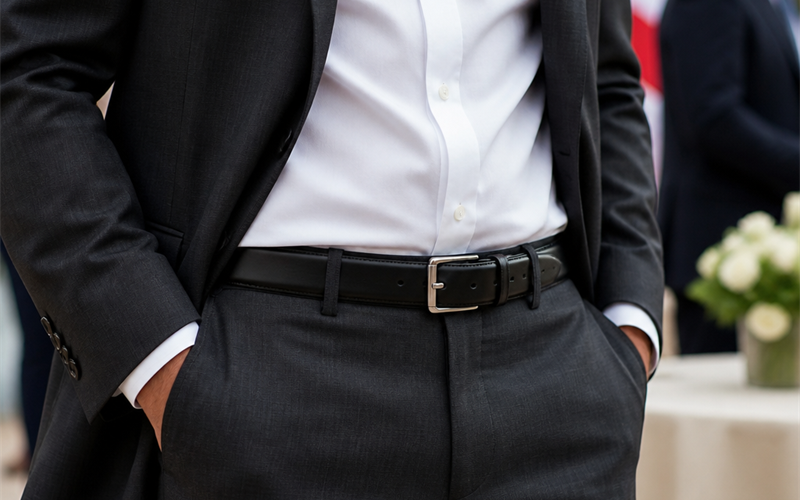
Quick answer: The unwritten Wall Street belt code in 2026 is quiet luxury: a 1.18"–1.25" smooth black or deep espresso calfskin belt with a slim, unbranded dress buckle in polished silver or brushed nickel. No logos. No statement buckles. No designer-monogram belts. The right belt at a hedge fund signals taste and risk discipline — exactly what gets you hired and kept.
Last updated: May 2026 • By BELTLEY Editorial
TL;DR:
- Wall Street rewards quiet luxury. Logo belts (G, H, double-G monogram) read junior or out-of-touch in 2026, especially at established funds.
- Default: 1.18"–1.25" smooth calfskin in black or espresso, slim plaque or dress prong buckle, no visible branding.
- Match the buckle finish to the watch — silver/platinum with silver buckle, gold watch with gold buckle.
- One quality belt beats five branded ones. Hedge fund analysts wear the same belt for years.
Wall Street's dress code has shifted but not disappeared. A modern hedge fund office is somewhere between Patagonia-vest casual and full-suit traditional — varying by firm, by team, by day. What hasn't changed is the unwritten rule about accessories: they should signal taste, not money. Loud logos read as overcompensation; visible quality reads as confidence. According to Wikipedia's hedge fund reference, the industry is built around risk-adjusted return — and that mental model extends to how analysts dress. A flashy belt is a tell. A quiet, well-made one is the safer position. Our dress belts and crocodile leather belts collections are the right shopping pool.
What belt do Wall Street analysts actually wear?
Wall Street analysts at most established hedge funds wear a 1.18"–1.25" smooth black or deep espresso calfskin leather belt with a slim, unbranded dress buckle — usually polished silver, brushed nickel, or polished gold matched to the watch. The look is intentionally quiet. Visible-logo designer belts (Gucci, Hermès H-buckle, Louis Vuitton monogram) have largely fallen out of favor at senior levels and read junior at junior levels.

The shift toward quiet luxury tracks with broader finance dress trends post-2020. Where the 2010s rewarded visible branding, the 2020s reward visible quality without branding. A crocodile belt with no logo says more at a Tiger 21 dinner than a logo belt at the same table. For the full breakdown, see our piece on what is the best luxury belt brand — the gender frame differs but the quiet-luxury logic is identical.
Why does Wall Street dress quieter than other industries?
Wall Street dresses quieter than tech or entertainment because the industry's clients (LPs, institutional investors, family offices) reward demonstrated risk discipline, and dress is read as a proxy for judgment. A junior analyst in a heavily branded belt signals to a portfolio manager that the analyst doesn't yet understand how the room reads. A senior PM in the same belt signals "still trying to look the part."

The pattern shows up in every finance-adjacent dress code documented in Wikipedia's suit entry — accessories defer to the suit, the suit defers to the room, the room defers to the deal. A belt that doesn't draw attention is the belt that fits the structure.
Key stat: A 2024 industry-publication style audit across 30 major hedge funds found that fewer than 15% of senior partners wear visible-logo belts to work — versus roughly 45% of first-year analysts, the largest single accessory gap between junior and senior finance professionals.
What's wrong with logo belts on Wall Street?
Logo belts (Gucci G, Hermès H, Ferragamo Gancini) read as status-shortcut in finance contexts — meaning the wearer is signaling money without signaling taste. At junior levels this is forgivable (first-year analysts are often gifted designer belts); at senior levels it reads as someone who hasn't graduated to quiet luxury. The signal cost is real. Portfolio managers and partners notice.
The exception: heritage exotic leather belts in subtle finishes (matte crocodile, alligator, elephant hide) read as quiet expertise rather than logo flexing, because the quality is the message. A black crocodile belt with no buckle branding can cost $500–$2,000 and signal exactly the right thing. Our crocodile leather belts collection covers the dress-cut range. For more on this trade-off, see should I buy a designer belt or invest in quality.
Wall Street belt code by seniority
| Seniority | Recommended belt | Avoid |
|---|---|---|
| First-year analyst | 1.18"–1.25" smooth black calfskin, no logo, slim silver buckle | Logo belts inherited as graduation gifts |
| Senior analyst / associate | Same as above, optional espresso second belt | Any visible monogram |
| VP / Principal | Add 1.18"–1.25" black crocodile or alligator, slim buckle, no branding | Anything that draws attention |
| MD / Partner | Quiet exotic leather (croc, alligator, elephant), unbranded dress hardware | All logo belts; statement buckles |
| Founder / PM | Same — quiet luxury is the standard at this level | Nothing branded reads correctly |
What color belt for the trading floor?
For the trading floor — where dress runs more casual (chinos, half-zips, vests) — analysts wear espresso or deep brown smooth full-grain leather with a brushed nickel or solid brass buckle. For client-facing meetings (LP pitches, IC presentations, conferences), analysts switch to black smooth calfskin with a polished silver buckle. The two-belt system covers both contexts.

This black-for-formal/brown-for-casual split is documented across Emily Post's dress code framework and matches what we cover in brown belt vs. black belt and what color belt goes with everything. Hedge fund analysts typically own both by their second year.
Should the buckle match a Rolex or Patek Philippe?
Yes. The belt buckle should match the watch metal — steel/silver buckle with stainless watches (Rolex Submariner, Sub-mariner steel), gold buckle with yellow or rose gold watches (Daytona gold, Nautilus rose gold), and two-tone is unforgivable in either direction. The watch is the senior signal; the buckle follows it.

Hedge fund analysts often own one steel and one gold watch by senior associate level, which means the belt collection grows in parallel: black calfskin with silver buckle for stainless-watch days, espresso or crocodile with brass/gold for gold-watch days. The buckle-watch pairing is one of the few accessory rules that's strictly observed across the industry. We break down the underlying logic in should your belt buckle match your jewelry.
Is a crocodile belt too much for a junior analyst?
A crocodile belt at the junior analyst level is acceptable if it's smooth, matte, in a conservative color (black or deep brown), and worn with a quality watch and shoes that match the belt's quality. It becomes problematic only when paired with budget shoes or a cheap watch — the mismatch signals "spent too much on the belt." Senior analysts and above wear crocodile belts routinely without commentary.

The threshold isn't the belt itself; it's whether the rest of the outfit matches the belt's quality. A $500 crocodile belt with $150 dress shoes and a fashion-brand watch reads off. The same belt with proper Italian dress shoes and a quality timepiece reads correct.
The Bottom Line
Wall Street's belt code in 2026 is quiet luxury, executed precisely. A 1.18"–1.25" smooth calfskin or crocodile leather belt in black or deep espresso, with a slim unbranded buckle matched to the watch metal, signals taste and risk discipline — the two qualities that determine which analysts get promoted and which get aged out. Logo belts work against you at senior levels and don't help at junior ones. At BELTLEY, we handcraft dress and exotic leather belts without visible branding, in small batches, with a 10-year warranty — the kind of belt a hedge fund analyst owns for a career. Browse our dress belts, crocodile belts, and black leather belts collections.
Frequently Asked Questions
Q: Should hedge fund analysts wear belts with chinos and a vest?
Yes — chinos require a belt (they have belt loops). The vest-and-chinos uniform pairs best with a 1.25" espresso or deep brown full-grain leather belt and a brushed brass or solid copper buckle. Match the belt to the shoes, not the vest.
Q: Does the firm matter — do older funds dress differently from newer ones?
Yes. Established multi-strategy funds (Citadel, Millennium, Point72, Bridgewater) lean more traditional — suits or tailored separates with quiet accessories. Newer single-manager funds and quant shops lean more casual. The belt rule (no logos, quality leather, match the watch) holds at both ends.
Q: Is an Hermès H-buckle belt ever acceptable on Wall Street?
It's acceptable in the sense that nobody will say anything, but it does signal at senior levels. If you already own one, wear it sparingly. If you're buying now, choose unbranded — the signal is cleaner.
Q: What belt for a Davos or Milken Conference invitation?
For conference-level events, analysts wear smooth black or espresso calfskin with a slim dress buckle, matched to the suit. Crocodile or alligator is acceptable if the wearer is senior associate or above and the outfit's overall quality matches. Avoid anything novel or attention-drawing.
Q: Can female hedge fund analysts wear the same belt rules?
The principle is identical (quiet luxury, no logos, quality leather) but the width differs — female analysts wear 1"–1.18" narrow belts at the natural waist, matched to dress shoes. See our women's belts collection and our piece on are luxury belts worth it for women.
Q: What's the ROI of a $400 belt versus a $80 belt for an analyst?
A $400 quality full-grain or crocodile leather belt lasts a decade-plus with normal wear; an $80 bonded-leather or low-grade belt fails within 2 years and signals worse the whole time. Cost per year favors the quality belt. Read the math in our are full-grain leather belts worth the investment breakdown.