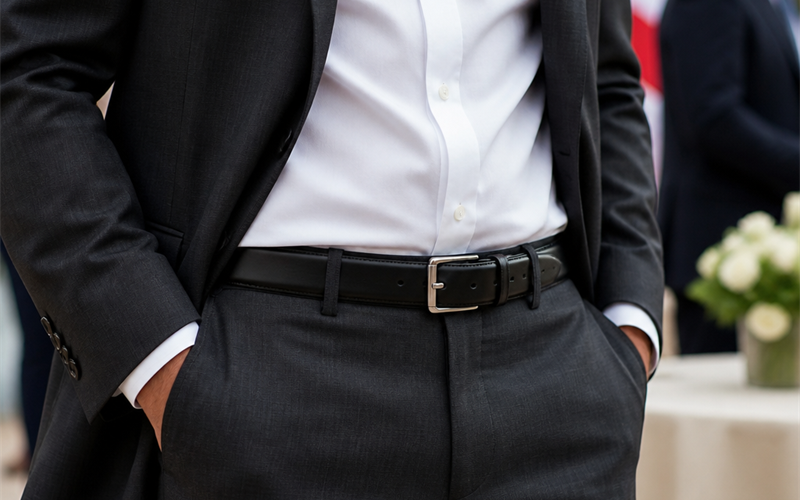
Belt for Diplomats and Consular Officers
Quick answer: Diplomats and consular officers should wear a 1.18"–1.25" smooth black calfskin or full-grain leather belt with a slim, unbranded polished silver or brushed nickel buckle. The look is intentional invisibility — diplomatic protocol rewards accessories that read precise and culturally neutral, never national-signaling or designer-branded. One quality black belt covers virtually every diplomatic context.
Last updated: May 2026 • By BELTLEY Editorial
TL;DR:
- Diplomatic dress is about cultural neutrality — the belt should not signal nationality, brand, or fashion era.
- Default: 1.18"–1.25" smooth black calfskin or full-grain leather, slim polished silver or brushed nickel buckle.
- Skip novelty buckles, regimental colors, designer monograms, and anything with national flags or insignia.
- For host-country traditional dress events, follow the host's protocol — the belt either matches the traditional outfit or is removed entirely.
A diplomat's wardrobe is built around a specific principle: don't be the story. Embassy events, bilateral meetings, credential presentations, and consular receptions are all contexts where the diplomat's job is to represent the sending state without performing it personally. The belt sits inside that dress philosophy — precise, quality, intentionally unremarkable. Wikipedia's diplomatic uniform reference documents the formal regalia some countries still issue for credential presentations and state occasions, but day-to-day diplomatic dress relies on civilian business attire with strict accessory discipline. Our dress belts and black leather belts collections are the right baseline.
What belt should a diplomat wear?
A diplomat or consular officer should wear a 1.18"–1.25" smooth black calfskin or full-grain leather belt with a slim, unbranded polished silver or brushed nickel buckle — paired with a tailored dark suit, dress shirt, and conservative tie or pocket square. The belt should disappear under a buttoned jacket and read cleanly when the diplomat is seated at a negotiation table or standing in a receiving line.

The choice of black over brown is deliberate for most diplomatic contexts: black is the universal formal color across virtually every culture, while brown carries regional and historical associations that vary by country. A diplomat working across multiple cultures defaults to black for the simplicity of cultural neutrality. We cover the underlying color logic in what is a formal belt for men and brown belt vs. black belt.
Why is diplomatic dress so conservative?
Diplomatic dress is conservative because the diplomat's role is institutional rather than personal — the wardrobe represents the sending state's professionalism and avoids any signal that could be read as personal preference taking precedence over institutional duty. Conservative dress is the safest position across the widest range of host cultures and counterparty expectations.
This isn't unique to diplomacy; it tracks closely with judicial dress, central-banker dress, and other institutional contexts where the wearer's individual style is intentionally suppressed in service of the role. Wikipedia's suit entry covers the broader category of business and semi-formal dress that diplomatic civilian wear sits inside.
Key stat: A career diplomat typically rotates through 6 to 10 postings across as many distinct cultures over a 30-year career — meaning the wardrobe (and the belt) needs to read culturally appropriate across an unusually wide range of host countries. Quiet, conservative, unbranded leather is the only consistent answer.
What buckle finish is right for diplomatic contexts?
For diplomatic contexts, the right buckle finish is polished silver or brushed nickel as the default — these read formal across virtually every culture and match the silver or steel watches diplomats typically wear in professional contexts. Polished gold is acceptable when the diplomat wears a yellow-gold dress watch in evening contexts. Brass and copper finishes read too casual for most diplomatic functions and should be reserved for off-hours.

The matching rule (buckle to watch metal) holds strictly in diplomatic contexts because senior counterparties — foreign ministers, ambassadors, heads of mission — read the matching the same way they're trained to read every other protocol detail. See should your belt buckle match your jewelry.
Diplomat belt by function
| Function | Belt | Width | Buckle |
|---|---|---|---|
| Embassy office / daily | Smooth black calfskin or full-grain | 1.18"–1.25" | Slim polished silver |
| Consular interview | Same | 1.18"–1.25" | Same |
| Bilateral meeting | Smooth black calfskin | 1.18"–1.25" | Slim polished plaque |
| Credential presentation (where belt applies) | Smooth black calfskin | 1.18"–1.25" | Slim polished plaque |
| Embassy reception (afternoon) | Smooth black or deep espresso | 1.18"–1.25" | Slim polished |
| State dinner / black-tie | None — braces only | N/A | N/A |
| Host-country traditional dress event | Follow host protocol | Varies | Varies |
Should a diplomat ever wear a belt with national insignia or flag motifs?
No — belts with national flags, government seals, or regimental insignia are inappropriate for diplomatic civilian dress. The role of the diplomat is to represent the sending state through the institution they serve, not through accessories that announce affiliation. Belt-buckle nationalism reads as undisciplined and undercuts the institutional signal the diplomat is meant to project.

The exception is dedicated ceremonial dress (military attaché uniform, regulation diplomatic uniform where still issued) — those have their own prescribed accessories. In civilian business attire, the belt is institution-neutral. Emily Post's dress code framework treats civilian formal wear as a category where personal/national signaling is suppressed in favor of universal formality.
What about logo belts and luxury branding?
Logo belts and visibly branded luxury accessories are particularly inappropriate in diplomatic contexts because they signal personal wealth and brand affiliation in a setting designed to suppress both. The signal mismatch is large — diplomats are paid civil-service salaries representing public institutions, and accessories that announce private luxury read as protocol-naive at best and unprofessional at worst.
The cleanest move is unbranded quality leather. A senior ambassador wearing an unbranded crocodile belt with a slim polished silver buckle reads as quality without flash; the same ambassador wearing an Hermès H-buckle reads inappropriate for the room. The quiet-luxury logic we cover in our hedge fund analyst belt guide applies even more strictly to diplomatic settings.
What about host-country traditional dress events?
For host-country traditional dress events (where the diplomat wears local traditional attire as a gesture of respect — common in Gulf states, South Asia, parts of Africa and East Asia), the belt is determined by the local protocol. Traditional dress often has its own waist treatment (sash, sarong tie, embroidered cummerbund) that replaces the belt entirely, or specifies a belt type as part of the outfit.

The diplomat's role in these contexts is to follow the host protocol exactly — not to add personal accessories. Defer to the host country's protocol officer or your own mission's cultural advisor before the event. The Western dress belt typically does not apply.
What about female diplomats and consular officers?
Female diplomats and consular officers follow the same principles with adjusted widths. Default: 1"–1.18" smooth black or deep espresso leather, narrow polished silver buckle, paired with tailored separates or a business dress. Formal evening receptions: switch to a slim leather belt with a small jeweled buckle, or skip the belt entirely if the dress is structured at the waist.

See our women's belts collection for sized options. The principle (cultural neutrality, quiet quality, no branding) is identical across genders in diplomatic contexts.
The Bottom Line
A diplomat's belt is an exercise in intentional invisibility — 1.18"–1.25" smooth black calfskin or full-grain leather, slim polished silver buckle, no branding, no national insignia, no statement. The belt does its job and signals nothing more than precision. Across a 30-year career spanning multiple postings and cultures, the same belt works — quality, conservative, culturally neutral. At BELTLEY, we handcraft dress belts in full-grain and calfskin without visible branding, with sealed edges and solid metal hardware, with a 10-year warranty. One quality black belt covers virtually every diplomatic context. Browse our dress belts and black leather belts collections.
Frequently Asked Questions
Q: Can a diplomat wear a crocodile or exotic leather belt?
Yes — a smooth black or matte espresso crocodile leather belt with an unbranded slim buckle is appropriate for senior diplomats (head of mission, ambassador, deputy chief of mission) at formal embassy events and bilateral meetings. The quality reads as institutional polish, not personal luxury. Our crocodile belts collection has dress-cut options.
Q: What belt for a credential presentation?
Where civilian dress applies (no issued uniform), a slim smooth black calfskin dress belt with a slim polished silver plaque buckle, paired with a tailored dark suit. Where the sending state issues diplomatic uniform for credential presentations, follow the issued protocol exactly — the uniform's belt or sash is prescribed.
Q: Should the belt match the watch the diplomat wears for dignitary meetings?
Yes — strictly. Buckle metal and watch metal must match in diplomatic settings. The pairing is observed by sophisticated counterparties at every level. See should your belt buckle match your jewelry.
Q: How does the belt rule differ across services (US Foreign Service, EU diplomats, Asian consular)?
The underlying principle (quiet, quality, unbranded) is consistent across diplomatic services worldwide. Regional variations show up in slight differences in color palette (warmer browns in some traditions, stricter black in others) and watch metal conventions. The structural answer holds.
Q: Can a diplomat wear a belt with denim on weekends?
Yes — off-duty, the diplomat is a civilian and any quality leather belt is fine. The principle suspends outside duty hours and reactivates the moment the diplomat is back in a representational context.
Q: How often should a diplomatic belt be replaced?
A quality full-grain or calfskin dress belt lasts 8–10+ years of normal diplomatic wear. Inspect annually for wear at the prong holes, cracking at the buckle attachment, and edge sealing. Replace when wear becomes visible — protocol-grade accessories should not look used.


