Are Handmade Leather Belts Worth It? An Honest Look
Quick answer: Yes — for most people who wear a belt regularly, a handmade leather belt is worth it. Handcrafted belts use better leather (usually full-grain), get careful edge finishing, and are often saddle-stitched by hand, a method that won't fully unravel if one thread breaks. They cost more upfront because a saddle-stitched belt takes 45–60 minutes of skilled work versus under a minute by machine — but they last decades, age beautifully, and can be repaired, making them better value over time.
Last updated: June 2026 • By BELTLEY
TL;DR:
- Better materials: handmade belts typically use full-grain leather and solid hardware.
- Saddle stitching (hand-sewn) won't fully unravel if one thread is cut — machine stitch can.
- More labor: ~45–60 minutes by hand vs under a minute by machine.
- Longer life: a quality handmade belt can last decades and be repaired.
- Costs more upfront — but lower cost-per-wear over its lifetime.
- Worth it if you wear a belt often and value durability over the lowest price.
"Handmade" gets used a lot in marketing, so it's fair to ask whether a handcrafted belt actually justifies its price — or whether you're paying for a story. The honest answer is that real handwork changes the belt in specific, measurable ways, especially in how it's stitched and finished. This guide separates the genuine advantages from the romance, so you can decide if it's worth it for you. For the broader value question, see is it worth buying an expensive belt.
Is a Handmade Belt Worth It for You?
Match your situation to the verdict.

| Your situation | Is handmade worth it? |
|---|---|
| You wear a belt most days | Yes — durability pays off in cost-per-wear |
| You want it to last decades | Yes — better leather and repairable stitching |
| You value clean finishing | Yes — hand edge-work and consistent details |
| You need the cheapest option now | No — a factory belt costs less upfront |
| You rarely wear a belt | Maybe — the longevity matters less |
For most regular wearers, the math favors handmade. For the materials side, see are full-grain leather belts worth it.
What makes a handmade belt different from a factory belt?
A handmade belt differs in materials, stitching, and finishing. Artisans typically select better leather (usually full-grain), control the details like edge dressing and stitch tension, and often hand-sew with a saddle stitch. Factory belts prioritize speed and cost, frequently using lesser leather and machine stitching that can unravel if a thread breaks.

The gap shows up in the parts you don't see at first. Handmade belts start with higher-grade leather and get meticulous attention where it counts. As one belt maker explains, "handmade belts tend to have more consistent finishing because the maker controls the details: edge dressing, stitching tension, and leather selection." Factory belts, by contrast, are optimized to come off the line fast and cheap — they can look similar on day one but rarely match a handmade belt's finishing or longevity. The leather grade matters most: a handmade belt built on full-grain ages into a patina, while a cheap belt on bonded leather peels and cracks. To spot the grade, see how to tell if a belt is full-grain leather.
Why does saddle stitching matter so much?
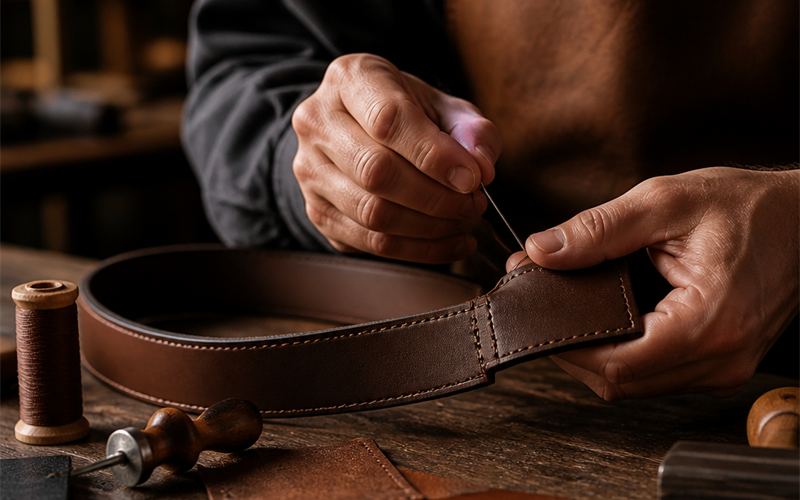
Saddle stitching is the hallmark of a quality handmade belt. It uses two needles and waxed thread to lock each stitch independently, so if one thread is cut, the seam doesn't unravel — unlike a machine lockstitch, which can run loose from a single break. It's stronger, more durable, and repairable, which is why hand-sewn belts last.

This is the single biggest construction advantage, and it's worth understanding. With a saddle stitch, every stitch is essentially tied off on its own. As one stitching guide describes it, "if a sharp object cuts the thread on the top side of the belt, the bottom thread remains tightly anchored in place" — so the seam holds. A machine stitch, by contrast, is a single continuous thread that can unravel along its length if it's nicked. The trade-off is time and skill: hand-saddle-stitching "can take an artisan 45 to 60 minutes of continuous, intense labor," versus under a minute by machine. That labor is a big part of the price — and a big part of why the belt outlasts cheaper ones. For more on durability, see the truth about leather belt durability.
Key stat: A hand saddle-stitched belt takes 45–60 minutes of skilled labor; a machine sews the same line in under a minute. That's the cost difference in a nutshell — and the durability difference too, since a saddle stitch's independently-locked stitches won't unravel from a single cut thread.
Do handmade belts actually last longer?
Yes. The combination of better leather, solid hardware, and saddle stitching means a well-made handmade belt can last decades and even be passed down, while a cheap factory belt often fails within a year or two. Hand-sewn seams are also repairable, so a broken stitch can be fixed without losing the whole belt.

Longevity is where the value case is won. A quality handmade belt is built from full-grain or top-grain leather that resists wear and develops character rather than cracking, paired with solid brass or stainless hardware that won't rust or deform. As one maker puts it, "a well-cared-for handmade belt can last decades, maybe even a lifetime." Add repairability — a saddle-stitched seam can be mended without redoing the whole thing — and the belt becomes a long-term keeper. Spread the cost over that lifespan and a handmade belt's cost-per-wear drops below that of cheap belts you replace repeatedly. For that math, see one good belt or several cheap ones.
When is a handmade belt NOT worth it?
A handmade belt may not be worth it if you rarely wear a belt, need the lowest possible price right now, or only want a short-term, trend-driven piece. In those cases the durability premium matters less. It's also not worth it if "handmade" is just a label on poor materials — handwork only adds value when the leather and hardware are genuinely good.

Honesty cuts both ways. If a belt is a once-in-a-while accessory, the decades-long lifespan you're paying for won't get used, and a decent factory belt may be the sensible call. Likewise, a tight budget is a real constraint — buying one quality belt later can beat overspending now. And be skeptical of the word itself: "handmade" on top of bonded leather and a plated buckle isn't worth a premium, because the handwork can't fix bad materials. The value formula is handwork plus quality materials — full-grain leather, solid hardware, sealed edges, and saddle stitching together. When all of those are present, it's worth it; when they're not, the label is just marketing. For choosing well, see how to choose a good leather belt.
The Bottom Line
Are handmade leather belts worth it? For anyone who wears a belt regularly and wants it to last, yes. Genuine handwork shows up in better leather, careful finishing, and saddle stitching that won't unravel from a single cut — advantages that translate into a belt lasting decades, aging into a patina, and being repairable instead of disposable. You pay more upfront because hand-sewing takes 45–60 minutes of skilled labor, but the cost-per-wear comes out lower over a long life. The key is that handwork only adds value atop quality materials. That's exactly how we build at BELTLEY — handcrafted by master artisans from full-grain leather with solid hardware, fairly priced and backed by a 10-year warranty. See the difference in our handmade belts or a classic full-grain leather belt.
Frequently Asked Questions
Q: Are handmade leather belts worth the money?
For regular belt-wearers, yes. Handmade belts use better leather, get careful finishing, and are often saddle-stitched, so they last decades and can be repaired. They cost more upfront because hand-sewing takes far longer than machine work, but the long lifespan gives a lower cost-per-wear than cheap belts you replace often.
Q: What is saddle stitching and why is it better?
Saddle stitching is a hand-sewing method using two needles and waxed thread to lock each stitch independently. If one thread breaks, the seam stays intact — unlike a machine lockstitch, which can unravel from a single break. It's stronger, more durable, and repairable, which is why it's the mark of a quality handmade belt.
Q: How long does a handmade leather belt last?
A well-made, well-cared-for handmade belt can last decades, and some are passed down for generations. The mix of full-grain leather, solid hardware, and repairable saddle stitching is what enables that lifespan, compared with cheap factory belts that often crack or fail within a year or two.
Q: Why are handmade belts more expensive?
Mainly labor and materials. Hand saddle-stitching alone can take 45–60 minutes of skilled work versus under a minute by machine, and handmade belts use higher-grade leather and solid hardware. You're paying for construction and materials that make the belt last far longer, not just for the "handmade" label.
Q: Is a handmade belt always better than a factory belt?
Only when it's made from quality materials. Handwork adds real value on full-grain leather with solid hardware and saddle stitching. But "handmade" stamped on bonded leather and a plated buckle isn't worth a premium — the handwork can't compensate for poor materials. Judge the leather and hardware, not just the label.
,%20get%20careful%20edge%20finishing,%20and%20are%20o...)