What Is Bridle Leather? (And Is It Good for Belts?)
Quick answer: Bridle leather is a premium full-grain, vegetable-tanned cowhide that's been "hot stuffed" — impregnated through with oils, tallows, and waxes on both the grain and flesh sides. Originally made strong enough to control a horse (hence the name), it's smooth on both faces, highly water-resistant, and extremely durable. Belt makers prize it because it's strong, takes dye and stamping beautifully, and ages into a rich patina. Yes — it makes an excellent, long-lasting belt, though it starts stiff and needs a break-in period.
Last updated: June 2026 • By BELTLEY
TL;DR:
- What it is: full-grain, vegetable-tanned leather, hot-stuffed with oils and waxes.
- The name: it was built strong enough for horse bridles and tack.
- Key traits: smooth both sides, water-resistant, very strong, ages to a patina.
- For belts: excellent and long-lasting — a belt-maker favorite.
- The catch: it starts stiff and needs a break-in period to soften.
- vs full-grain: bridle is full-grain, just with extra wax/grease stuffing and finishing.
If you've shopped for a high-end belt, you've probably seen "English bridle leather" on the label and wondered what makes it special — and whether it's worth more. It's one of the most respected leathers in the craft, with a centuries-old pedigree in horse tack. This guide explains what bridle leather actually is, how it's made, and how it stacks up against regular full-grain for a belt. For the wider material picture, see what type of leather is best for belts.
Is Bridle Leather Right for You?
Match what you want to whether bridle leather fits.

| What you want | Is bridle leather a good pick? |
|---|---|
| A buy-it-for-life belt | Yes — exceptional strength and longevity |
| Smooth finish front and back | Yes — both sides are stuffed and finished |
| Water resistance | Yes — the wax stuffing repels moisture |
| Soft right out of the box | No — it breaks in over time, starts stiff |
| Lowest price possible | No — it's a premium leather at a premium |
If you value durability and a refined finish, bridle leather delivers. For an alternative top-tier choice, see are full-grain leather belts worth it.
What is bridle leather, exactly?
Bridle leather is full-grain cowhide that's been vegetable-tanned and then "hot stuffed" — saturated through with a blend of natural oils, tallows, and waxes worked into both sides of the hide under heat. The result is a smooth, strong, water-resistant leather, finished on both the grain and flesh sides, originally made for horse bridles and tack.

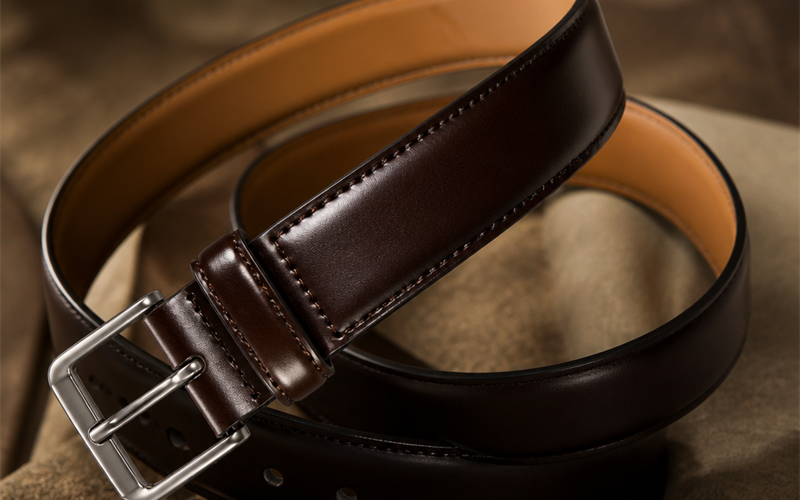
The name is literal: this leather was developed to be strong enough to control a horse. As one leather-education source explains, bridle leather has "both the flesh and grain side of the leather stuffed with greases and finished with wax," which gives it that ultra-smooth look front and back — unusual, since most leathers finish only the grain side. It starts as a quality vegetable-tanned full-grain hide, then the hot-stuffing impregnates it with fats and waxes for strength, flexibility, and weather resistance. Its heritage is equestrian — a bridle being "a piece of equipment used to direct a horse" — and the leather built for that job turned out to be ideal for belts and boots too. For grade basics, see full grain leather vs top grain leather.
How is bridle leather made?
Bridle leather starts as full-grain cowhide that's vegetable-tanned with natural plant tannins (often oak bark), traditionally over months in tanning pits. It's then drum-dyed for deep color and "hot stuffed" — saturated with heated oils, tallows, and waxes until they penetrate the core. This produces its strength, water resistance, and waxy surface bloom.

The process is slow and traditional, which is part of why it's prized. Vegetable tanning uses natural tannins rather than chemicals, and the finest bridle is pit-tanned over months for a dense, stable hide. After dyeing, the defining step is hot stuffing — as one belt maker describes it, "after the dying process, the leather is then hot stuffed with pre determined amounts of spew on the grain and flesh," driving waxes and fats deep into the hide. That impregnation gives bridle its weather resistance, flexibility, and the characteristic "bloom" — a waxy surface haze you can buff to a shine. The payoff is tensile strength well beyond what a belt needs. For how veg-tanning differs, see is full grain leather good for belts.
Key stat: Bridle leather is stuffed on both sides — grain and flesh — with oils and waxes, where ordinary leather is usually finished on just the grain. That double-sided hot-stuffing is what makes it smooth front and back, water-resistant, and strong enough that it was originally built to control a horse.
Is bridle leather good for belts?
Yes — bridle leather makes an outstanding belt. Its dense, hot-stuffed full-grain structure gives tensile strength far beyond belt-making demands, it resists water and sweat, and it ages into a beautiful patina. Belt makers favor it because it's strong and also takes dye, stamping, and burnishing cleanly. The only trade-off is that it starts stiff and needs breaking in.

For a belt, bridle leather hits nearly every mark. The combination of full-grain hide and deep fat-and-wax stuffing produces one of the strongest, most water-resistant leathers made — ideal for a belt meant to last decades. It's also a craftsman's favorite: as The Leather Guy notes, "it is a favorite amongst belt makers, not only because of its strength, but that it can be stamped and painted like natural veg tan." That means clean edges, crisp stamping, and rich, even color. The one thing to expect is a break-in period — like any dense veg-tanned leather, bridle starts firm and softens with wear into a supple, characterful belt. For how to ease that in, see how to soften a stiff leather belt.
Bridle leather vs full-grain: what's the difference?
Bridle leather is full-grain — the difference is finishing. Both use the intact top grain of the hide and are typically vegetable-tanned, but bridle leather adds heavy hot-stuffing with oils and waxes on both sides for extra water resistance, a smooth back, and that waxy bloom. Plain full-grain keeps a more natural surface and feel.

It helps to see them as overlapping, not opposed. Full-grain refers to the grade — the strongest, intact top layer of the hide — and it's the gold standard for belts because it's firm, thick, and durable, aging into a unique patina. Bridle leather is a type of full-grain that's been further processed: vegetable-tanned, then hot-stuffed and finished on both faces. So bridle gives you full-grain strength plus added wax-driven water resistance and a finished flesh side, at a premium price. Both make excellent belts. This is exactly the thinking behind the BELTLEY 3-Material Rule — full-grain leather, a solid brass or stainless buckle, and sealed edges — the three specs that make any belt, bridle or otherwise, last for years. To shop the grade, see full-grain leather belts.
The Bottom Line
Bridle leather is premium full-grain cowhide, vegetable-tanned and hot-stuffed through with oils and waxes on both sides — a leather built strong enough for horse tack and ideal for belts that last decades. It's smooth front and back, water-resistant, and ages into a rich patina, which is why belt makers prize it; the only trade-off is a stiff start that softens with break-in. Against plain full-grain, bridle is essentially full-grain-plus: the same top-tier grade with extra wax stuffing and finishing. Whichever you choose, the principle is the same one we build on at BELTLEY — full-grain leather, solid hardware, sealed edges, fairly priced and backed by a 10-year warranty. Explore the gold standard in our full-grain leather belts or browse handmade belts.
Frequently Asked Questions
Q: What is bridle leather?
Bridle leather is full-grain, vegetable-tanned cowhide that's been hot-stuffed — saturated through with oils, tallows, and waxes on both the grain and flesh sides. This makes it smooth on both faces, water-resistant, and very strong. It's named for its original use in horse bridles and tack, and it's a favorite for belts and boots.
Q: Is bridle leather better than full-grain leather?
Bridle leather is a type of full-grain leather, so it isn't strictly "better" — it's full-grain with extra processing. The hot-stuffing adds water resistance, a smooth finished back, and a waxy bloom, at a premium price. Plain full-grain keeps a more natural surface. Both are top-tier choices for a durable, long-lasting belt.
Q: Is bridle leather good for belts?
Yes, it's excellent. Its dense, hot-stuffed full-grain structure is extremely strong and water-resistant, ages into a rich patina, and takes dye and stamping cleanly — all reasons belt makers love it. The main thing to expect is a break-in period, since bridle leather starts stiff and softens with regular wear.
Q: Why is it called bridle leather?
Because it was originally made strong enough to control a horse, for use in bridles and other horse tack. The vegetable-tanning and hot-stuffing produced a leather tough enough to handle the force, sweat, and weather of equestrian use — qualities that also make it ideal for hard-wearing belts and boots.
Q: Does bridle leather need a break-in period?
Yes. Like other dense, vegetable-tanned full-grain leathers, bridle leather starts firm and stiff. With regular wear and a bit of conditioning, it softens and becomes supple over time while keeping its strength. That break-in is normal and a sign of a quality, long-lasting leather rather than a flaw.