Why Your Belt Buckle Scratches Your Phone (and the Fix)
Quick answer: Your belt buckle scratches your phone when both share a pocket and the buckle's hard edge or grit trapped on it drags across the screen or back. Modern phone glass resists most metals, but hardened steel edges, embedded sand, and the buckle's sharp corners can still scratch it. The fix is simple: don't pocket your phone next to your buckle, use a case and screen protector, and choose a smooth, low-profile buckle.
Last updated: June 2026 • By BELTLEY Editorial
TL;DR:
- Scratches happen when phone and buckle share a pocket and rub together.
- Phone glass is hard, but hardened steel edges and trapped grit can still scratch it.
- The real fix is separation — different pocket — plus a case and screen protector.
- A smooth, low-profile, softer-metal buckle is far less likely to mark a phone.
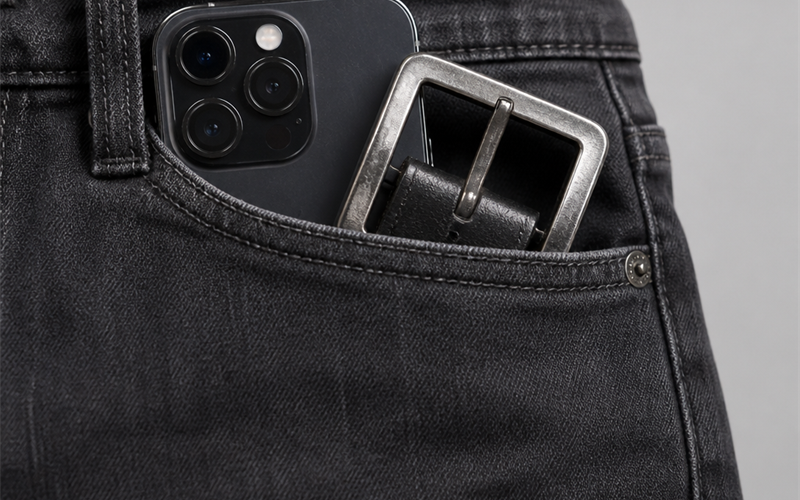
It's a familiar gut-punch: you pull out your phone and there's a fresh scratch across the screen or a scuff on the back. The usual suspect is your belt buckle, especially if you tuck your phone into the same front pocket. The truth is a mix of physics and habit — phone glass is genuinely tough, but it's not invincible, and the hard edges of a buckle (plus any grit clinging to it) can leave marks. Understanding what actually causes the scratch points straight to the fix. This guide explains the real mechanism and the simple changes that keep your screen clean. It pairs with our guide on belt buckles that don't scratch leather and car surfaces.

Why does my belt buckle scratch my phone?
Because they share a pocket and rub together as you move. Walking and sitting press the phone against the buckle hundreds of times, and the buckle's hard edge — or grit trapped on its surface — drags across the glass or back. Even tough phone glass can be marked by hardened steel edges and embedded particles harder than the glass itself.

The science is about relative hardness. Phone cover glass like Gorilla Glass is marketed for "high scratch-resistance" with a high hardness rating, which is why most everyday metals can't scratch it directly. But sand and quartz grit (very hard minerals) cling to a buckle, and a hard steel edge under pressure can still leave marks. As the Mohs scale explains, only material as hard or harder than the glass will scratch it — and pocket grit often qualifies. Tech writers at How-To Geek make the same point: phone glass shrugs off keys and coins but not sand, which is hard enough to scratch it. For buckle metal differences, see types of belt buckles.
Is it the buckle or the grit on it that scratches?
Often the grit. Phone glass resists most clean metals, but fine sand, dust, and quartz particles that collect on a buckle are harder than the glass and act like sandpaper when pressed against it. So a scratch blamed on the buckle is frequently caused by the abrasive grit riding on the buckle's surface — which is why keeping the buckle clean helps.

Key stat: Smartphone cover glass carries a Vickers hardness rating of roughly 622–701, hard enough to shrug off soft brass — but ordinary sand contains quartz, which is harder than the glass and is the real culprit behind most "metal" pocket scratches.
This distinction matters for the fix. If grit is the true abrasive, then wiping your buckle and pocket clean reduces scratching, and a smooth buckle with fewer crevices traps less grit in the first place. A glossy hard-chrome buckle with sharp edges is the worst case — hard, sharp, and grit-collecting. A smooth solid-brass buckle is softer and gentler if contact does happen — and keeping any buckle free of grit and smoothly finished reduces the risk further.
How do you stop a belt buckle from scratching your phone?
Separate them. Keep your phone in a different pocket from your buckle so they never rub — this single change prevents most scratches. Add a quality case and a glass or film screen protector so any contact hits the sacrificial layer, not the phone. And choose a smooth, low-profile buckle that traps less grit and has no sharp edges.

Here's the fix ranked by effectiveness:
| Fix | Effort | Effectiveness |
|---|---|---|
| Phone in a separate pocket | Free, instant | Highest — eliminates contact |
| Screen protector + case | Low cost | High — sacrificial layer |
| Keep buckle & pocket grit-free | Habit | Medium — removes abrasive |
| Smooth, low-profile buckle | Buy once | Medium — less grit, no sharp edge |
| Hard chrome sharp-edged buckle | — | Worst case — avoid |
The highest-impact fix costs nothing: stop carrying your phone against your buckle. For everything else, a clean, smooth, softer buckle is the supporting move.
Does the type of belt buckle make a difference?
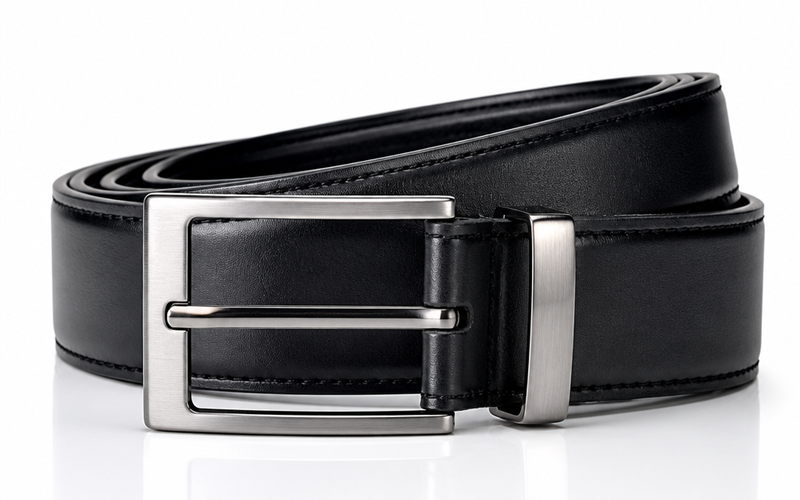
Yes. A smooth, rounded, low-profile buckle in a softer metal like solid brass is far less likely to scratch a phone than a hard chrome-plated buckle with sharp corners and a glossy surface. Softer metal is gentler on glass, rounded edges spread contact, and a clean surface holds less abrasive grit. Buckle choice won't beat keeping the phone separate, but it helps.

The combination of softer metal, smooth finish, and clean profile is the buckle's contribution to a scratch-free phone. BELTLEY's solid brass buckle belts and flat plaque buckle belts are smooth and rounded by design — gentle on whatever they touch. Pair the right buckle with the simple habit of separating your phone, and pocket scratches become a non-issue.
The Bottom Line
Your belt buckle scratches your phone when the two share a pocket and rub together — but the real abrasive is often the hard grit clinging to the buckle, since modern phone glass resists clean soft metals on its own. That points to an easy, free fix: keep your phone in a separate pocket so it never contacts the buckle, back it up with a case and screen protector, and keep your buckle smooth and clean. A low-profile, softer-metal buckle helps as a supporting measure. BELTLEY's smooth, rounded solid-brass and plaque buckles are gentle on the surfaces they meet. Choose a phone-friendly buckle in the solid brass and plaque buckle collections.
Frequently Asked Questions
Q: Can a belt buckle really scratch a phone screen?
It can, though clean phone glass resists most metals. The usual cause is hard grit (like sand or quartz dust) trapped on the buckle acting as an abrasive, or a hard steel edge pressed against the glass under pocket pressure. Keeping the phone separate prevents it.
Q: Why does my phone get scratched in my pocket even with tough glass?
Because tough glass still isn't harder than quartz sand and similar grit, which collect in pockets and on buckles. Under the pressure of walking and sitting, that grit drags across the glass like fine sandpaper. A screen protector takes the damage instead.
Q: Does a screen protector stop belt buckle scratches?
Largely yes — a glass or film screen protector is a sacrificial layer that absorbs scratches meant for the screen. Combined with keeping your phone in a separate pocket from your buckle, it virtually eliminates buckle-related screen damage.
Q: What's the best way to carry my phone to avoid buckle scratches?
Carry it in a different pocket from your belt buckle so they never touch — ideally a back or jacket pocket if your buckle sits front-center. Add a case and screen protector for insurance. This combination prevents nearly all buckle-caused scratches.