How to Polish a Stainless Steel Belt Buckle Without Scratching
Quick answer: To polish a stainless steel belt buckle without scratching it, clean it with warm soapy water, dry it, then buff with a clean microfiber cloth and a drop of stainless steel polish — always rubbing with the grain, never in circles. Skip baking soda, toothpaste, and paper towels on a mirror finish; their grit leaves fine swirl marks.
Last updated: June 2026 • By BELTLEY Editorial
TL;DR:
- Match your method to the finish: mirror-polished buckles scratch easily; brushed/satin finishes hide marks.
- Always polish with the grain, using only microfiber — never paper towels, which contain wood fibers harder than the polish layer.
- Most "scratches" on stainless are just haze or transferred metal that wipes off.
- Real scratches need fine progressive abrasion; deep ones may not fully come out of hardened steel.
A stainless steel belt buckle should be the lowest-maintenance piece of hardware you own. Stainless gets its toughness from a chromium content of 10.5% or more, which forms an invisible self-healing layer that resists rust and corrosion. But "rust-resistant" isn't "scratch-proof" — and the most common way people damage a buckle is by trying to clean it with the wrong materials. The good news: surgical-grade 316L stainless steel, the alloy BELTLEY uses, is genuinely hard, so most marks are surface haze rather than gouges. This guide shows how to bring back the shine without adding the swirl marks that cheap polishing creates — and pairs with our broader leather care routine.
Why do stainless steel buckles scratch even though they're tough?
Because polish level matters more than hardness. A mirror-polished surface shows every micro-scratch, while a brushed or satin finish hides them. Stainless resists corrosion thanks to its chromium oxide layer, but that thin layer is soft enough that abrasive cleaners — or even paper towels — leave visible swirl marks on a high-shine buckle.

The chromium is what makes stainless special. The reference on stainless steel notes its resistance "comes from its chromium content of 10.5% or more," forming "a passive film that protects the material and can self-heal when exposed to oxygen." That passive film, described in detail under passivation, is excellent against rust but is only microns thick — so anything harder than it drags lines across the surface. Understanding finish type is half the battle, which is why our types of belt buckles guide is worth a read before you start — as are our companions on removing rust from a buckle and cleaning a tarnished brass buckle, since each metal needs a different touch.
How do you polish a stainless steel buckle without scratching it?
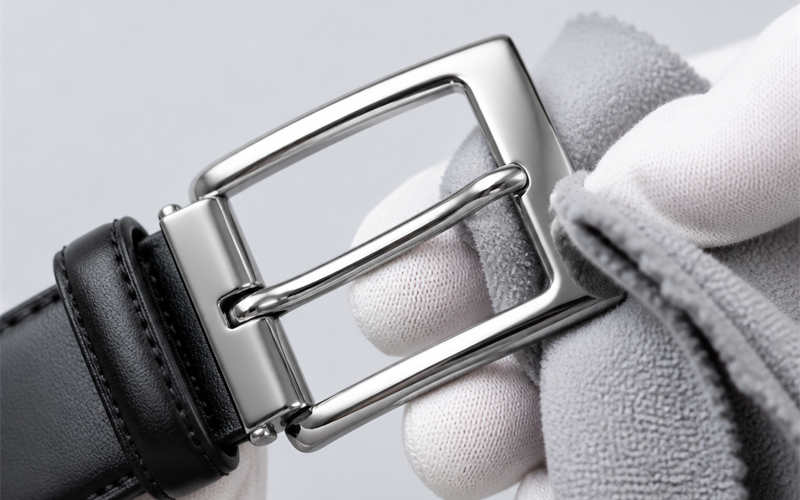
Use the gentlest method that works. Start with warm water and a drop of dish soap on a microfiber cloth to lift oils and grit. Dry fully, then add a small amount of dedicated stainless or metal polish and buff in straight lines following the grain. Finish with a clean dry microfiber pass. No circles, no pressure, no household abrasives.

Direction is everything on brushed steel. Brushed and satin buckles have a visible grain — rubbing across it or in circles fights that pattern and creates haze. Rubbing along it blends any marks into the existing lines. For a mirror finish, even lighter pressure and a brand-new cloth are essential. BELTLEY's stainless steel buckle belts ship with a brushed or lightly polished 316L finish chosen specifically because it stays good-looking with minimal fuss.
What should you never use on a stainless steel buckle?
Avoid anything gritty or fibrous: baking soda, toothpaste, scouring pads, steel wool, and ordinary paper towels. These contain particles harder than the soft chromium-oxide surface, so they cut fine scratches even when the buckle "feels" smooth. Strong acids and chlorine bleach can also pit the surface and break down the protective layer.

The hardness math explains why. The Mohs scale ranks scratch resistance from 1 to 10, and "harder material scratches softer material." Many cleaning grits and even the wood fibers in paper towels are hard enough to mark a polished surface. Chlorides are the other enemy — like all stainless, buckles can corrode "in the presence of chlorides," so keep bleach and pool water away. Here's a quick reference:
| Material | Safe on stainless buckle? | Why |
|---|---|---|
| Microfiber cloth | ✅ Yes | Softer than the surface |
| Dish soap + water | ✅ Yes | No abrasion, lifts oils |
| Dedicated metal polish | ✅ Yes (sparingly) | Engineered for soft buffing |
| Toothpaste / baking soda | ⚠️ Risky | Mild grit can swirl mirror finish |
| Paper towels | ❌ No | Wood fibers scratch shine |
| Steel wool / scouring pad | ❌ No | Cuts deep scratches |
| Bleach / chlorine | ❌ No | Attacks chromium layer, pits metal |
How do you remove a real scratch from a stainless buckle?
For a fine scratch on a brushed finish, rub gently along the grain with the buckle's own texture using a non-scratch pad or fine polishing cloth, blending the mark into the surrounding lines. On a mirror finish, use progressively finer metal polish and a microfiber cloth. Deep scratches in hardened steel may lighten but won't fully disappear.

Key stat: 316L stainless steel contains roughly 16–18% chromium and 10–14% nickel, making it one of the most corrosion- and wear-resistant alloys used in jewelry and watch cases — which is exactly why it shrugs off the everyday knocks that dent softer zinc buckles.
The distinction between brushed and mirror finishes matters here. A brushed finish is forgiving because you can simply re-blend the grain; a mirror finish demands patience and the finest products. Home-care specialists agree on technique — Bob Vila's guide to removing scratches from stainless steel stresses working only in the direction of the grain and finishing with the finest abrasive. If you've ever wondered how high-end hardware handles wear, our piece on whether Hermès belt buckles scratch easily covers the same physics from the luxury angle.
How does this fit BELTLEY's 3-Material Rule?
Buckle metal is one leg of the BELTLEY 3-Material Rule: full-grain leather + 316L stainless or solid brass buckle + sealed (painted or burnished) edges. We specify 316L rather than cheaper 304 or zinc alloy because the higher chromium and nickel content resists both corrosion and the everyday scuffing that ruins lesser hardware. A buckle that polishes back to clean is a buckle built to last.

That durability is the whole point — a BELTLEY full-grain belt with a 316L stainless buckle is engineered so the hardware outlives the trends, all backed by a 10-year warranty.
The Bottom Line
Polishing a stainless steel belt buckle without scratching it comes down to three habits: identify your finish, use only microfiber and gentle polish, and always work with the grain. Skip the baking soda, toothpaste, and paper towels that quietly swirl a mirror surface, and remember that most "scratches" are really haze that wipes away. Real damage in hardened 316L is rare, which is exactly why we build with it. If your current buckle is soft zinc that scratches if you look at it wrong, it might be time for hardware that holds up — browse the stainless steel buckle belts and keep the whole belt sharp with our leather care guide.
Frequently Asked Questions
Q: Can I use a Magic Eraser on a stainless steel buckle?
Not on a mirror finish. Melamine foam (Magic Eraser) is a very fine abrasive — it cleans well but can dull a high-shine surface over time. On a brushed buckle it's lower-risk, but a microfiber cloth and soap are safer for both.
Q: Why does my stainless buckle have tiny swirl marks?
Almost always from cleaning with paper towels, a dry shirt, or a circular rubbing motion. The fibers and grit are harder than the surface layer. Switch to microfiber and polish in straight lines along the grain to blend them out.
Q: Will stainless steel buckles rust?
Quality stainless like 316L is highly rust-resistant thanks to its chromium oxide layer, which self-heals with oxygen exposure. It can still spot if exposed to chlorine, salt, or prolonged moisture, so dry it after heavy sweating or rain.
Q: What's the best cloth for polishing a buckle?
A clean microfiber cloth, the same type used for eyeglasses and screens. It's softer than the steel surface, lint-free, and grabs oils without scratching. Keep one cloth for cleaning and a separate dry one for the final buff.