Salvatore Ferragamo Gancini Buckle — History & Meaning
Quick answer: The Ferragamo Gancini buckle is named after the Italian word for "little hooks." Its shape — a curved, backwards-horseshoe hook — was inspired by the wrought-iron hooks and gate ironwork of Palazzo Spini Feroni, Ferragamo's 13th-century Florence headquarters. First used as a handbag clasp in 1969, the Gancino (singular) became the house's signature hardware emblem, blending Florentine architectural heritage with functional elegance.
Last updated: June 2026 • By BELTLEY Editorial
TL;DR:
- Gancini = Italian for "little hooks"; the singular clasp is the Gancino.
- The shape was inspired by the wrought-iron hooks and gate of Palazzo Spini Feroni, Ferragamo's Florence HQ.
- First appeared as a handbag clasp in 1969, later becoming the signature buckle emblem.
- It signals understated Florentine heritage rather than loud branding.
Among luxury buckle emblems, the Ferragamo Gancini stands out for being rooted in architecture rather than initials or animals. Founded in Florence in 1927, Salvatore Ferragamo built a house famous first for shoes, then for leather goods marked by a distinctive curved-hook clasp. That hook — the Gancino — isn't an abstract logo; it's a direct tribute to the iron hardware of the brand's storied Florentine palazzo. Understanding its origin turns a simple buckle into a piece of design history you can wear. This guide covers where the Gancini came from, what it means, how it evolved, and how to wear it well. It builds on our broader look at top luxury belt brands.

What does Gancini mean on a Ferragamo buckle?
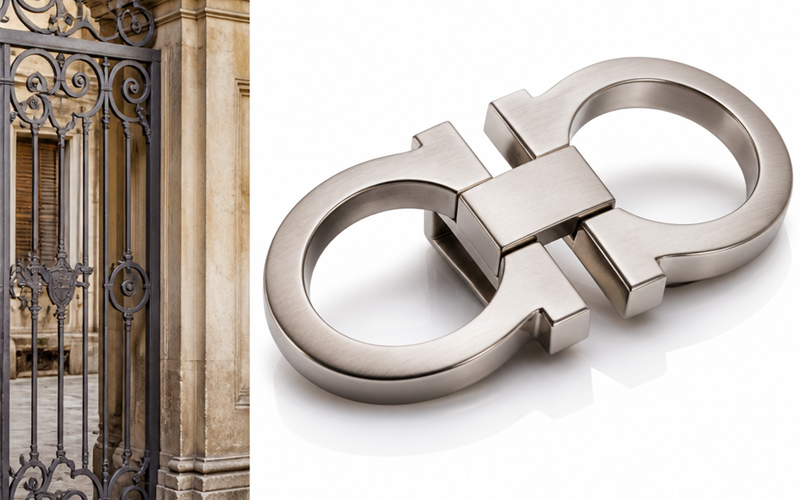
Gancini means "little hooks" in Italian — the plural of gancino, itself a diminutive of gancio (hook). The buckle takes the form of a curved, hook-like clasp shaped roughly like a backwards horseshoe. So the name is literal: the Gancini emblem is a stylized little hook, a clasp that fastens and decorates at once.

The name tells you the design intent. As the reference on Salvatore Ferragamo confirms, the brand's leather goods "often feature the distinctive and signature 'Gancino' clasp, which was originally designed as a handbag fastening." That dual role — functional clasp and recognizable emblem — is what makes the Gancini elegant rather than purely decorative. It does a job while signaling the house, the opposite of a flat logo plate. For more on how buckle form follows function, see our types of belt buckles guide.
Where did the Gancini design come from?
From the ironwork of Palazzo Spini Feroni, Ferragamo's Florence headquarters. Salvatore Ferragamo drew the hook's shape from the ornate wrought-iron gate of the 13th-century palazzo and the articulated iron hooks set into its walls — originally used for tethering horses. The Gancini is, in effect, a piece of Florentine architecture distilled into a clasp.

Key stat: The Gancini first appeared as a handbag clasp in 1969, though house legend traces its inspiration to the 1950s, the final years of founder Salvatore Ferragamo — making it one of fashion's rare logos born from a building rather than a name.
This architectural lineage is what gives the Gancini its quiet sophistication. Rather than stamping initials on a plate, Ferragamo encoded its Florentine home into the hardware — the horse-tethering hooks and gate scrollwork of a centuries-old palazzo. Highsnobiety confirms the lineage, noting the Gancini hook and double-hook monogram were inspired by the palazzo's iron gates. It's heritage worn discreetly, which is why the Gancini reads as refined rather than flashy. That restraint connects to the broader quiet-luxury sensibility we explore in why minimalist no-logo buckles are the new flex and the understated Brunello Cucinelli buckles.
How has the Gancini buckle evolved?
It grew from a single handbag clasp into a full hardware language. After debuting as a bag fastening in 1969, the Gancino was scaled and restyled across belts, shoes, jewelry, and accessories — from a single discreet hook to interlocking and mosaic-style arrangements. Today it ranges from understated polished clasps to bolder logo-forward buckles, depending on the collection.

The emblem's flexibility is its strength. On a belt, the Gancini can appear as a clean single-hook buckle for dress wear or a larger statement clasp for casual looks. Here's how it spans the range:
| Gancini buckle style | Look | Best for |
|---|---|---|
| Single polished hook | Understated, dressy | Formal, business |
| Interlocking double Gancini | Balanced, recognizable | Smart casual |
| Mosaic / oversized logo | Bold, statement | Fashion-forward casual |
| Reversible Gancini | Versatile | Two-in-one wardrobe |
For Ferragamo-specific sizing and styling, see our guides on what size Ferragamo belt to get and whether Ferragamo belts are reversible.
How do you wear a Gancini buckle well?
Treat it as refined hardware, not a loud logo. The single-hook Gancini pairs beautifully with tailoring and dress trousers, where its polished restraint shines. Larger interlocking versions suit smart-casual outfits. Keep the rest of your look clean so the buckle's Florentine elegance reads, and match the metal tone to your shoes and watch.

The Gancini's appeal is that it's recognizable without shouting — a connoisseur's emblem more than a billboard. That makes it versatile across dress and casual settings, provided you let it lead quietly. For occasion styling, our guide on whether Ferragamo belts are still in style covers current relevance. And if you love the understated-heritage feel but want it without the brand premium, BELTLEY's clean buckles on full-grain leather deliver similar refinement — explore the dress belts and plaque buckle belts collections.
The Bottom Line
The Ferragamo Gancini buckle is one of fashion's most elegant origin stories: a clasp named for "little hooks," shaped after the wrought-iron gate and horse-tethering hooks of Palazzo Spini Feroni, the house's 13th-century Florence home. Debuting as a handbag fastening in 1969, it grew into a versatile hardware language spanning discreet single hooks to bold interlocking logos. Its enduring appeal is heritage worn quietly — recognizable to those who know, refined rather than loud. If that understated-craft sensibility is what draws you, you can have it without the logo premium: BELTLEY pairs clean, solid buckles with full-grain leather at fair direct prices. Explore the dress belts and full-grain leather belts collections.
Frequently Asked Questions
Q: What does the Ferragamo Gancini symbol mean?
Gancini means "little hooks" in Italian. The emblem is a stylized hook-shaped clasp, designed by Salvatore Ferragamo after the wrought-iron hooks and gate of Palazzo Spini Feroni, the brand's Florence headquarters. It functions as both a fastening and the house's signature mark.
Q: When was the Ferragamo Gancini created?
The Gancini first appeared as a handbag clasp in 1969, though Ferragamo lore traces its inspiration to the 1950s, the final years of founder Salvatore Ferragamo. It later expanded across belts, shoes, jewelry, and accessories as the brand's signature hardware emblem.
Q: Is the Gancini the same as the Gancino?
Essentially yes — Gancino is the singular ("little hook") and Gancini is the plural ("little hooks"). The terms are used interchangeably for the brand's hook-shaped clasp emblem, with "Gancini" being the more common name for the overall motif and collection.
Q: How can you tell a real Ferragamo Gancini buckle?
Look for solid, well-finished metal with crisp, clean hook detailing and proper Ferragamo engravings and hallmarks. Authentic Gancini hardware feels substantial and is precisely sculpted, while fakes show shallow detail, lightweight metal, and sloppy or misspelled engravings.