Why Do Belt Holes Tear? Causes and How to Fix Them
Quick answer: Belt holes tear because the buckle prong puts the same lateral stress on the same spot thousands of times — a process engineers call cyclic fatigue. Each wear, tighten, and sit-down tugs the fibers at the hole edge, so the round hole slowly elongates into an oval and eventually rips. Sweat speeds it up by softening the leather. To fix a torn hole, glue a leather backing patch behind it and re-punch a clean hole; to prevent it, fasten at the middle hole, rotate belts, and don't cinch too tight.
Last updated: June 2026 • By BELTLEY
TL;DR:
- Cause: repeated prong stress on one spot — cyclic fatigue — elongates the hole.
- Sweat makes it worse by softening the leather fibers so they stretch permanently.
- Cheap leather tears faster; dense full-grain resists hole fatigue far better.
- Quick fix: glue a backing patch behind the torn hole, then re-punch cleanly.
- Prevent it: buckle at the middle hole, don't over-tighten, rotate your belts.
- Take the belt off when you're not wearing it to let the fibers recover.
A belt hole that's gone oval — or ripped clean through — is one of the most common ways a belt dies, and it usually happens at exactly one hole. It isn't random or bad luck; it's predictable mechanics, which means it's both fixable and preventable. This guide explains why holes fail, how to repair a torn one, and the simple habits that keep your other holes from following. For the related question of overall stretch, see why do leather belts stretch.
Torn or Stretched Hole? Find Your Fix
Match the damage to the right move.

| Your situation | What to do |
|---|---|
| One hole gone oval | Re-punch a clean hole nearby; back it if loose |
| A hole ripped through | Glue a backing patch, then re-punch |
| Several holes worn | Reinforce or shorten from the buckle end |
| Holes fraying from sweat | Dry the belt after wear; condition it |
| Cheap belt, repeated tears | Replace with full-grain — it resists fatigue |
For a clean punch and repair, a little leather adhesive goes a long way. For sizing context, see how far should a belt extend past the buckle.
Why do belt holes stretch into ovals and tear?
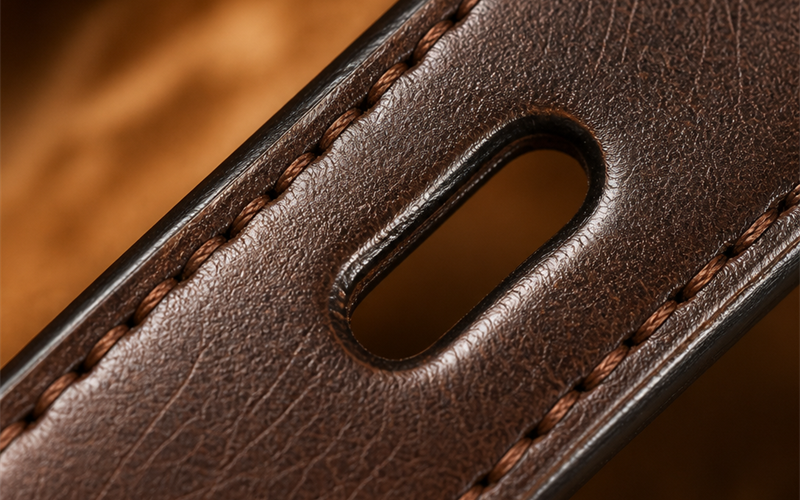
Belt holes tear because the buckle prong applies stress to the same hole edge over and over — every time you fasten, sit, or walk. The leather fibers at that edge gradually separate and reorient in the direction of pull, so the round hole elongates into an oval and finally rips. It's repetitive stress, not a single event.

This is a textbook case of material fatigue. Engineers define fatigue as "the initiation and propagation of cracks in a material due to cyclic loading" — damage that builds from repeated stress well below what would break the material in one go. Your belt hole lives that every day: the prong tugs the same fibers thousands of times a year, and sitting down spikes the tension right at that point. Over months the fibers give way directionally, turning the circle into an oval and then a tear. As one belt guide puts it, "tight pulling stretches the leather again and again. This leads to cracks and belt hole fraying." Knowing the cause points straight to the fixes. For why quality leather lasts, see the truth about leather belt durability.
Does sweat make belt holes wear out faster?
Yes. Sweat introduces moisture into the leather, and moisture softens the collagen fibers, making them more pliable and more likely to elongate permanently under the prong's tension. A belt worn in heat or during activity wears its holes faster than a dry one, which is why drying the belt after use matters.

Moisture is the hidden accelerator. Dry leather fibers resist deformation; damp ones stretch and stay stretched. Because the belt sits against your body all day, sweat soaks straight into the high-stress hole area, so the same tension that would slowly oval a dry hole does it faster on a wet one. This is also why a single sweaty, over-tightened belt worn every day fails so quickly at one hole. The remedy is simple: wipe the belt down and let it air-dry after sweaty wear, condition it occasionally to keep the fibers healthy, and avoid storing it damp. For the full routine, see how to keep a leather belt in good condition.
How do you fix a torn or stretched belt hole?
For a torn hole, glue a thin leather backing patch behind the damaged area with strong contact or polyurethane cement, clamp it until dry, then re-punch a clean hole through both layers. For a hole that's just gone oval but not ripped, simply punch a fresh hole nearby and seal the edge. A rotary punch gives the cleanest result.

The repair is straightforward with the right adhesive. For a real tear, cut a backing strip a couple of centimeters wide, apply a strong leather glue to both surfaces — as one repair guide instructs, "apply a small amount of your leather adhesive to the leather belt on both sides of the pre-cut holes" — press firmly, and clamp it for 8–12 hours. Avoid white school glue, which won't flex or hold. Once cured, re-punch a clean round hole through the reinforced section. If the hole is merely enlarged, skip the patch and just punch a new hole a bit away from the worn one, then dab the edge with adhesive to stop further fraying. For a clean cut, oval punches exist specifically for belt holes. If multiple holes are shot, consider shortening the belt from the buckle end instead — see how to fix a belt that is too big.
Key stat: A belt hole doesn't fail from one hard tug — it fails from cyclic fatigue, the same stress that fractures metal over thousands of cycles. The prong loads one spot thousands of times a year, so the round hole ovals and tears. Spread that load — fasten at the middle hole and rotate belts — and the fatigue clock resets.
How do you stop belt holes from tearing again?
Prevent it by reducing and spreading the stress. Fasten at the middle hole so tension isn't concentrated at an end hole, don't cinch the belt too tight, take it off when you're not wearing it, and rotate between a couple of belts so no single hole takes daily abuse. Quality, dense leather also resists hole fatigue far better than cheap leather.

Prevention is mostly about habits plus materials. Buy or size your belt so you fasten near the middle hole — that centers the load and leaves room on both sides, instead of hammering one end hole. Loosen up: an over-tight belt multiplies the prong force on the hole every time you sit. Give the leather recovery time by taking the belt off at the end of the day rather than leaving it cinched. And rotate two or three belts so the wear is shared. Finally, the leather itself matters enormously — dense full-grain leather has tightly packed fibers that resist the directional stretching that ovals a hole, while bonded or thin "genuine leather" gives out fast. Investing in a full-grain belt is the most durable prevention of all. To shop the grade, see full-grain leather belts.
The Bottom Line
Belt holes tear for a predictable reason: the prong loads the same spot thousands of times, and that cyclic fatigue — sped up by sweat — slowly ovals the hole until it rips. The fix is easy: glue a backing patch behind a torn hole and re-punch, or simply punch a fresh hole for one that's only stretched. The lasting answer is prevention — fasten at the middle hole, ease off the tightness, rest and rotate your belts, and start with dense full-grain leather that resists fatigue in the first place. That's why we build with full-grain hides and solid hardware at BELTLEY: belts engineered to outlast the stress, backed by a 10-year warranty. Upgrade to a belt that holds its holes — browse full-grain leather belts or a rugged double-layer belt.
Frequently Asked Questions
Q: Why do my belt holes keep tearing?
Because the buckle prong stresses the same hole edge thousands of times a year — a fatigue process that gradually elongates the round hole into an oval until it rips. Sweat accelerates it by softening the leather. Fastening at an end hole, over-tightening, and cheap leather all make it worse and faster.
Q: How do you fix a ripped belt hole?
Glue a thin leather backing patch behind the torn area with strong contact or polyurethane cement, clamp it for 8–12 hours, then re-punch a clean hole through both layers with a rotary punch. For a hole that's only stretched, just punch a fresh hole nearby and seal the edge with a dab of adhesive.
Q: Can a stretched belt hole be repaired or only re-punched?
Both. A mildly stretched (oval) hole usually just needs a fresh hole punched nearby. A hole that has actually torn needs reinforcement first — a glued backing patch — before re-punching, so the new hole has solid material around it. Avoid white glue; use a flexible leather adhesive that holds under stress.
Q: Does pulling a belt too tight cause holes to tear?
Yes. Over-tightening multiplies the lateral force the prong applies to the hole edge, especially when you sit, accelerating the fatigue that ovals and tears the hole. Fastening at a comfortable middle hole and easing the tension spreads the load and makes the holes last much longer.
Q: Why do cheap belt holes tear faster than expensive ones?
Because the leather quality differs. Dense full-grain leather has tightly packed, intact fibers that resist the directional stretching that elongates a hole. Bonded or thin "genuine leather" has weaker, glued, or split fibers that give way quickly under the same prong stress, so the holes oval and tear far sooner.