White Crocodile Belt: Golf, Summer & Formal Wear Guide
TL;DR:
- A white crocodile belt is the most demanding exotic to style, but unmatched when paired correctly — think golf course, resort terrace, or cream tuxedo.
- Three legitimate use cases: golf (with khaki shorts or white pants), summer resort (linen and navy), and formal black tie (rare, but striking).
- Surface-dyed white croc yellows over time — drum-dyed off-white or cream lasts decades.
- Avoid pairing white croc with black shoes, dark winter wools, or anything past Labor Day if you respect the old American convention.
- BELTLEY white and cream crocodile belts are handcrafted in small batches, in stock, and ship in 2-3 days with a 10-year warranty.
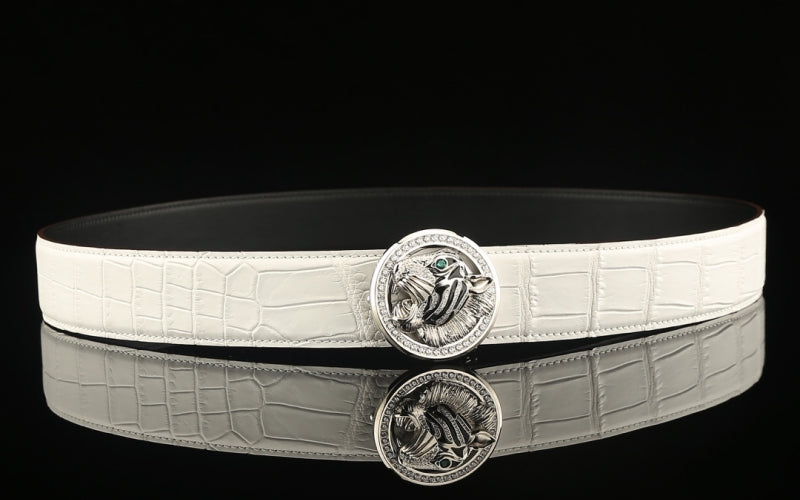
A white crocodile belt is the high-wire act of menswear accessories. Done wrong, it screams costume. Done right, it's the single most memorable piece in your wardrobe — the one a fellow golfer compliments on the 4th tee, or the detail that makes a cream linen suit look couture. After 25 years working exotic hides, I've seen this belt work miracles on golfers and grooms alike. Below is everything you need to wear it well.
Quick Facts
| Fact | Detail |
|---|---|
| Best seasons | Late spring through early fall (Memorial Day to Labor Day, traditionally) |
| Best leather grade | Drum-dyed off-white Porosus or Niloticus — avoids yellowing |
| Top use cases | Golf, summer resort, formal cream/ivory black tie |
| Worst pairings | Black shoes, charcoal wool, dark denim |
| BELTLEY price range | $189 - $299 |
| Care frequency | Wipe down after every wear; condition every 3 months |

Why is a white crocodile belt the hardest color to wear?
A white crocodile belt is the hardest color because white shows every smudge, demands warm-weather context, and clashes with most fall/winter wardrobes. It also requires drum-dyed leather to avoid yellowing, since cheaper surface-dyed white croc turns ivory within two summers. That narrow window is exactly why it reads as expensive when it works.
White is uncompromising. A black croc forgives a wrinkled shirt; a white croc broadcasts every styling decision around it. Authority on color theory at Wikipedia's entry on white notes that the color carries strong associations with formality, summer, and ceremonial dress — meaning your belt is making a loud statement before you've said a word. The fix is simple: only wear it in contexts that earn it.
Use Case 1: Why do golfers wear white belts?
Golfers wear white belts because they brighten the silhouette against khaki, navy, and grass-green pants, and they read as "club-correct" — a tradition rooted in 1960s pro tour style. A white crocodile belt elevates this further, signaling craftsmanship without breaking the dress code. It's the most accepted setting for white leather in modern menswear.

On the course, a white crocodile belt pairs effortlessly with white pants on Sunday final rounds, khaki shorts at the member-guest, or navy trousers in the clubhouse. The visual logic: white at the waist mirrors white at the shoes (your spikes), creating balance. For deeper context on how exotic belts elevate sportswear, see our guide on why crocodile belts cost $500 vs $5,000 — the difference shows on a sunlit fairway. Skip the woven nylon and let the crocodile pattern catch the light.
Use Case 2: How do you style a white crocodile belt for summer?
For summer, pair a white crocodile belt with cream linen trousers, a navy blazer, and tan espadrilles or brown suede loafers. The belt acts as the bridge between the linen's softness and the blazer's structure, anchoring an otherwise breezy outfit. Stay in warm, sandy tones — never cool greys.
This is resort-territory: Capri, the Hamptons, Palm Beach, the south of France. The combination works because white croc reads as intentional luxury in those settings, not flashy. Business of Fashion has documented the resurgence of artisanal exotic leathers in resort collections — a market that prizes restrained, hand-finished pieces over logo-stamped accessories. Pair with a black crocodile belt for evenings so you have day-to-night coverage on a long trip.
A few summer rules:
- Shoes must be brown, tan, cream, or white — never black
- Match metals: gold buckle with gold watch (consider our Rolex pairing guide)
- Skip the tie — white croc reads best with open collars
- Linen, cotton, seersucker only — no wool, no synthetics
Use Case 3: Can you wear a white crocodile belt with formal attire?
Yes — a white or cream crocodile belt works beautifully with cream tuxedos, ivory dinner jackets, and warm-weather black tie. It's rare, intentional, and reads as old-money confidence. Avoid it with traditional black tuxedos, where a black silk cummerbund or formal black croc belt remains correct.

This is the rarest and most rewarding context. Think Monte Carlo casino, summer wedding in Tuscany, or a private yacht event. The belt should be barely visible under a properly cut jacket — but when you remove the jacket for dancing, it completes the silhouette. For these occasions, choose a thinner profile (1.18" or 1.25") in a cream or off-white drum-dyed hide. Browse our exotic leather belt collection for evening-appropriate widths.
Why does white crocodile leather yellow — and how do you prevent it?
White crocodile yellows when surface-dyed pigments oxidize from UV light, sweat, and lotions. The fix is drum-dyed leather, where the dye penetrates the full thickness of the hide. Drum-dyed off-white and cream tones age gracefully for decades, while surface-dyed pure white can shift to ivory within 18-24 months.
This is the single most important purchasing decision for white croc. Most "white" crocodile belts on the market are surface-dyed because pure brilliant white is nearly impossible to achieve through full drum-dyeing. We dive deeper into this distinction in our breakdown of dyed-through vs surface-dyed crocodile leather. The smarter buy is a drum-dyed cream or off-white — it'll look intentional from day one and gain character over time, rather than fighting a losing battle against oxidation.
If you do choose pure white, commit to the maintenance: wipe with a damp microfiber after every wear, store in a cotton dust bag away from sunlight, and condition every 90 days with a colorless cream.
How is white crocodile different from white cowhide?
White crocodile has a deeper natural creaminess due to the keratin scales catching light differently than smooth cowhide. Cowhide reads as flat optical white; crocodile reads as warm, dimensional ivory with subtle shadow play across each scale. The difference is immediate in person and far more flattering against skin.

White cowhide tends to look plastic in photos and chalky in person. Crocodile's three-dimensional surface — particularly Porosus vs Niloticus species, each with distinct scale patterns — refracts light, giving the leather a luminous, almost pearlescent quality. This is why every serious white belt in luxury menswear is exotic, not bovine.
What about the "Memorial Day to Labor Day" rule?
The rule traditionally restricted white accessories to summer (late May through early September) in American menswear. Today it's relaxed — particularly in warm climates and resort settings — but still useful as a guideline. Outside summer, white crocodile reads as out-of-season unless you're traveling somewhere hot.
GQ and other modern style authorities have largely retired the rule for casual contexts, but it persists at conservative country clubs and traditional formal events. My honest advice: if you live in Florida, Arizona, or Southern California, ignore it. Everywhere else, treat May through September as your white croc window and pivot to brown, espresso, or black for the cooler months.
Key Takeaways
- White croc thrives in three contexts: golf, summer resort, and warm-weather formal — never in winter or with dark, heavy fabrics.
- Choose drum-dyed off-white over surface-dyed pure white to prevent yellowing.
- Pair only with warm-toned shoes (brown, tan, cream, white) and warm metals (gold).
- Crocodile's scale dimension makes white look luxurious where cowhide looks chalky.
- BELTLEY white crocodile belts are handcrafted, in stock, and protected by a 10-year warranty.
The Bottom Line
A white crocodile belt is a confidence piece. It's not a starter belt, and it's not a workhorse — it's the third or fourth crocodile belt you buy, after you've mastered black and brown. But once you place it in the right context (a Sunday at the club, a wedding in Mallorca, a yacht-club dinner), nothing else in your wardrobe quite measures up. At BELTLEY, we hand-cut our white and cream crocodile belts in small batches from drum-dyed Porosus and Niloticus hides — no Brand Tax, just 25 years of exotic-leather craftsmanship and a 10-year warranty. Browse our men's belt collection or our full crocodile belt collection to find your match. Belts ship in 2-3 days. Learn more about our story on the About Us page.

Frequently Asked Questions
Q: Are white belts still in style for men in 2026? A: Yes — particularly in golf, resort, and summer formal contexts. The trend has shifted from pure brilliant white to warmer cream and off-white tones, especially in exotic leathers like crocodile.
Q: Can I wear a white crocodile belt year-round? A: Only if you live in a consistently warm climate. In four-season regions, restrict white croc to May through September and switch to brown or black crocodile for fall and winter.
Q: What shoes go with a white crocodile belt? A: Brown suede loafers, tan derbies, cream sneakers, white spectators, or natural-color espadrilles. Avoid black shoes entirely — the contrast is too harsh and breaks the warm-tone palette.
Q: How do I clean a white crocodile belt? A: Wipe with a slightly damp microfiber cloth after every wear, condition every 90 days with a colorless leather cream, and store in a cotton dust bag away from direct sunlight.
Q: Is white or cream crocodile better? A: Cream is more practical — it hides minor smudges, ages more gracefully, and pairs with a wider range of outfits. Choose pure white only if you'll commit to careful maintenance.
Q: What's the difference between alligator and crocodile in white? A: Alligator has tighter, more uniform scales; Nile crocodile has slightly larger, more varied scales. Both look exceptional in white — alligator reads more formal, crocodile reads more relaxed-luxury.