Navy Crocodile Belt: The Rule-Breaker's Guide to Sprezzatura
TL;DR
- A navy crocodile belt breaks the old "match your belt to your shoes" rule, and that is exactly the point.
- It works beautifully with grey suits + brown shoes, denim + tan boots, and cream/white in summer.
- It fails with full navy suits, black shoes, or strict black-tie dress codes.
- Choose deep midnight navy for versatility; reserve royal blue for off-duty looks.
- Silver or palladium hardware reads more refined than gold on this color.
- Built to order in 2-3 days, then shipped worldwide — backed by a 10-year warranty.
Quick Facts
| Detail | Spec |
|---|---|
| Color family | Deep midnight navy (most versatile) |
| Best leather | Crocodile, polished or matte finish |
| Hardware | stainless steel, silver or palladium tone |
| Best pairings | Grey, charcoal, tan, denim, cream, white |
| Avoid with | Full navy suit, black shoes, formal black tie |
| Lead time | 2-3 day handcraft, then ship; in stock now |
A Quick Word from the Workshop
I still remember the first navy crocodile belt we cut on the bench. The hide had been resting in the climate room for three days, and when our master leatherworker turned it under the lamp, the scales shifted from ink to something close to wet slate. He smiled, shrugged, and said, "Black is safe. This is a man with an opinion." That is the whole thesis of this guide. If you want a belt that signals taste rather than budget, navy is the most quietly confident choice on the bench. Browse the deeper crocodile and alligator collection to see how the color reads in real light.

Why is a navy crocodile belt considered the rule-breaker?
A navy crocodile belt breaks the long-standing menswear rule that your belt must match your shoes. Roughly 90% of dress belts sold are black or brown, so navy reads as a deliberate stylistic choice rather than a default. It signals taste, not status, which is precisely why stylists love it.

For decades, the shoes-belt-match doctrine was treated as gospel. It made sense in an era when most men owned two pairs of shoes — black for work, brown for weekend — and one belt for each. Today, wardrobes are more flexible, and rigid color-matching looks dated. The Italians figured this out first; their concept of sprezzatura (studied carelessness) treats a slightly mismatched belt as evidence of confidence, not error. A navy crocodile belt is the cleanest expression of that idea — see how it sits next to the black crocodile staple for contrast.
When does a navy crocodile belt actually work?
Navy crocodile works best with grey or charcoal suits and brown shoes, with raw denim and tan boots, and with cream or white trousers in summer. The color creates a third tonal note that breaks up the outfit without screaming for attention. It is the sweet spot between safe and showy.
Three pairings worth memorizing:
- Grey suit + brown derbies + navy croc. This is the executive's secret handshake. The belt links the cool suit to the warm shoe without forcing a match.
- Raw denim + tan suede boots + navy croc. Add a white oxford and a navy unstructured blazer, and you have the modern American uniform.
- Cream linen trousers + white shirt + navy croc + tan loafers. Riviera-coded, no passport required.
You will also see navy paired with cognac crocodile accessories — a wallet or watch strap in cognac plus a navy belt is a confident, layered look.
When does navy crocodile fail?
Navy crocodile fails in three predictable scenarios: paired with a full navy suit (too matchy and slightly off-tone), worn with black shoes (the contrast reads accidental), or attempted at strict black-tie events. Outside those cases, the belt has more range than most people assume.
The full-navy-suit problem is the most common trap. Two navies almost never match exactly, and the eye reads the near-miss as a mistake rather than a choice — much like the warning we issue in the oxblood-and-burgundy guide about pairing wine tones with red accessories. With black shoes, the issue is hierarchy: black is the most formal color in menswear, and navy reads as a step down, so the belt looks like an afterthought. For black tie, stick to the rules; it is the one place sprezzatura goes to die.
Which navy shade should you actually buy?
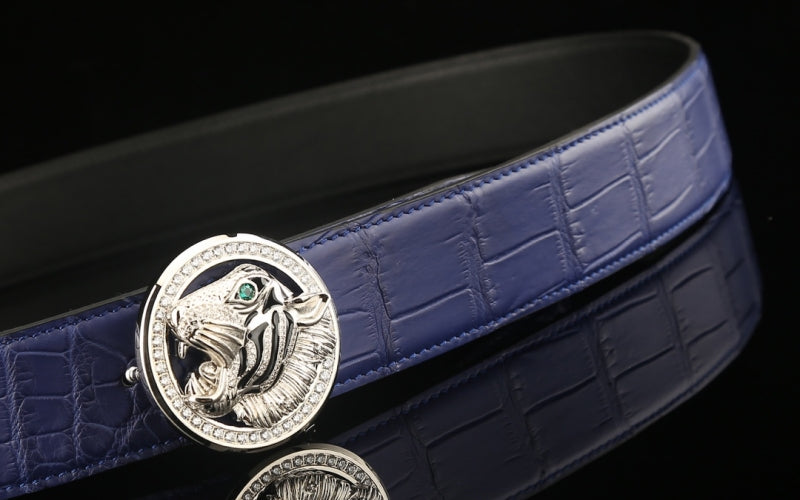
Buy deep midnight navy if you only own one. It reads almost-black under low light, navy in daylight, and pairs with everything from charcoal to denim. Royal or bright blue is a niche second belt — striking, but limited to weekend and resort wear. Avoid muddy or greenish navies entirely.

The reason midnight navy wins is simple: it behaves like a chameleon. Indoors at a restaurant, it reads as a sophisticated near-black. Outside in sunlight, the blue undertone reveals itself. According to the color reference on Wikipedia's navy blue entry, the original British naval shade was deliberately dark for exactly this reason — practical by day, formal by night. That is the shade you want on a belt you will wear three times a week.
Silver or gold hardware on a navy belt?
Silver, palladium, or brushed nickel hardware is the right call on a navy crocodile belt about 80% of the time. Cool-toned metals echo navy's blue undertone and keep the belt looking modern. Gold can work with cognac shoes and warm-toned outfits, but it is the harder choice to pull off.
At BELTLEY, we machine our buckles from stainless steel surgical-grade stainless steel and finish them by hand. On a navy hide, a brushed-silver or polished-palladium buckle reads like a watch case — quiet, expensive, intentional. If you wear a stainless Rolex or two-tone dive watch, match the belt hardware to the watch case. Gold buckles can work, but they push the look toward the 1980s power-broker aesthetic. Beautiful in context, dated out of it.
Why does a navy crocodile belt cost the same as black?
Navy crocodile costs the same as black because the hide, the labor, and the hardware are identical — only the dye changes. The price difference some retailers charge is a Brand Tax, not a material cost. At BELTLEY, every color in a leather family sits at one transparent price.

Crocodile hides are graded and sorted before dyeing, so the cost is set long before the color is chosen. A skilled tannery can dye a hide navy as easily as black; the dye itself is a rounding error in the total cost. The reason boutique brands charge more for "rare" colors is simply that demand is lower, so they extract a premium from the customers who want them. We refuse to play that game — read the full breakdown in why crocodile belts cost $500 vs $5,000 and the founder note on the About BELTLEY page. Industry coverage from outlets like Business of Fashion has tracked this DTC pricing shift for years.
The "second-life" argument for navy
Navy crocodile ages into one of the most beautiful patinas in menswear — a soft, faded indigo reminiscent of well-worn raw denim. Where black hides darken and brown hides warm up, navy fades sideways into a gentler, lived-in color. A 10-year-old navy belt looks better than a new one.
This is the quiet reason collectors choose navy. With our 10-year warranty covering construction defects, you get a belt that is engineered to outlast the trend cycle. Condition the leather twice a year, rotate it with two or three other belts, and a decade from now you will have something that looks intentionally vintage rather than accidentally tired. That patina is uncopyable.
Key Takeaways
- Navy crocodile is the rule-breaking belt that signals taste, not status.
- Pair it with grey, tan, denim, and cream — never with full navy or black shoes.
- Deep midnight navy is the only shade you need if you buy one.
- Silver-tone hardware is the safer, more modern choice.
- Color does not justify a price premium; demand it from your maker.
- Patina is the long-game payoff — navy ages better than any other shade.
The Bottom Line
A navy crocodile belt is the most elegant rule-break in menswear. It rewards a man who understands that real style is the considered violation of a doctrine, not the slavish observance of one. Worn with grey flannel and brown calf shoes, with raw denim and tan boots, or with cream linen on a summer evening, it does the work of three belts while looking like the most quietly expensive thing on the body. Skip the full navy suits and black-shoe pairings, choose deep midnight over royal, lean cool on the hardware, and you have a belt that earns its place for the next decade.

Ready to break the rule properly? Explore the BELTLEY men's belt collection — every piece is built to order in 2-3 days, then shipped worldwide with our 10-year warranty.
Frequently Asked Questions
Q: Can I wear a navy crocodile belt with a black suit? A: Generally no. Black suits call for a black belt; the navy will read as a mistake rather than a stylistic choice. Save the navy belt for grey, charcoal, tan, denim, and cream outfits.
Q: Is a navy crocodile belt formal enough for the office? A: Yes, in any business-casual or modern business-formal setting. The only exceptions are strict black-tie events or workplaces with conservative formal dress codes that mandate black belts with black shoes.
Q: Does navy crocodile leather fade in sunlight? A: All dyed leather will lighten with prolonged UV exposure, but quality crocodile fades into a desirable patina rather than blotching. Conditioning the belt twice a year preserves both color and suppleness.
Q: What color shoes go best with a navy crocodile belt? A: Brown in every shade — chestnut, cognac, mid-brown, dark brown — plus tan suede and oxblood. Avoid black shoes; the contrast looks unintentional rather than considered.
Q: How long does a BELTLEY navy crocodile belt take to ship? A: Belts are handcrafted in 2-3 days from stock hides and then shipped worldwide. US delivery typically lands within 4-8 days total; international within 4-10 days. Every belt is backed by our 10-year warranty.