What Are Studded Belts Made Of? The Full Materials Breakdown
TL;DR: Quick Answer
- A studded belt has three components: the leather base, the metal studs, and the attachment system — and each one determines whether the belt lasts months or decades
- Full-grain leather + stainless steel studs + rivet attachment is the quality benchmark; bonded leather + zinc alloy + glue is the fast-fashion floor
- The stud metal matters more than most buyers realize — zinc alloy tarnishes within months, while 316L stainless steel keeps its finish for years
A studded belt looks simple — leather with metal on it. But the gap between a $15 studded belt that falls apart in three months and a $150 studded belt that lasts a decade comes down to exactly what those materials are and how they're assembled. Here's every component broken down, from the leather base to the last rivet, so you know what you're actually paying for.

What Leather Is Used in Studded Belts?
Studded belts use four main leather types: full-grain cowhide (best), top-grain cowhide (good), bonded leather (poor), and faux leather/PU (lowest). The leather base is the single most important material in the belt because it determines both longevity and how securely the studs hold over time.
Here's the full leather tier breakdown:
| Leather Type | Description | Stud Retention | Lifespan | Price Tier |
|---|---|---|---|---|
| Full-grain cowhide | Top layer of hide, natural grain intact, dense fiber structure | Excellent — fibers grip prongs/rivets tightly | 10-20+ years | $$-$$$ |
| Top-grain cowhide | Sanded/buffed surface, slightly thinner | Good — adequate grip if thick enough | 5-10 years | $$ |
| Bonded leather | Shredded hide scraps pressed with polyurethane | Poor — fibers too loose, studs pull free | 6-18 months | $ |
| Faux leather (PU/PVC) | Synthetic plastic layer on fabric backing | Very poor — material tears around stud holes | 3-12 months | $ |
The critical detail most guides miss: leather thickness matters as much as leather type for studded belts. A stud needs at least 3-4mm of dense material to grip properly. According to Lowlife's component guide, thin leather allows prongs to push through and scratch skin, while overly rigid leather prevents clean stud seating. Full-grain cowhide at 3.5-4mm strikes the ideal balance — thick enough to anchor studs permanently, flexible enough to bend comfortably at the waist.
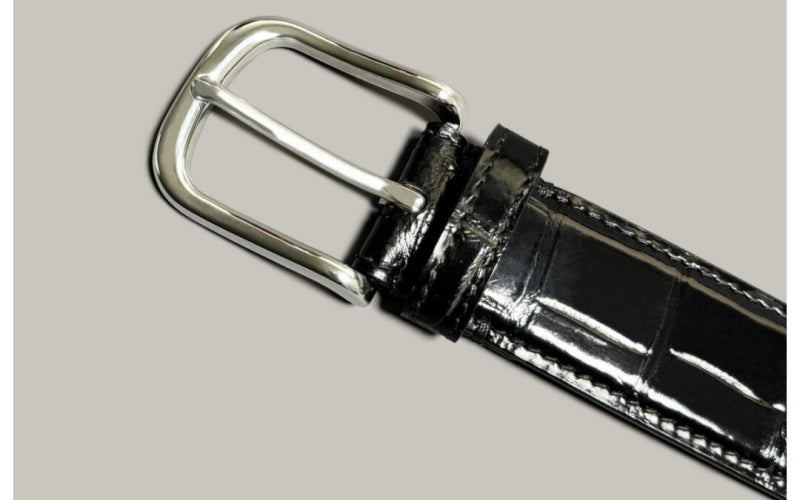
For premium studded belts, exotic leathers like crocodile and python add another dimension entirely. A full-grain leather studded belt is the quality baseline; an exotic leather base with hand-set hardware enters a different category. For more on how leather grades affect belt quality, see our guide on full-grain leather vs. genuine leather.

What Metal Are Belt Studs Made Of?
Belt studs are made from four primary metals: stainless steel (best durability), brass (best patina), nickel-plated steel (mid-range), and zinc alloy (budget). The metal determines whether your studs keep their shine or turn green within a season.
| Metal | Tarnish Resistance | Hypoallergenic | Weight/Feel | Lifespan |
|---|---|---|---|---|
| 316L stainless steel | Excellent — virtually corrosion-proof | Yes | Solid, substantial | 15+ years |
| Solid brass | Good — develops warm patina | Generally yes | Heavy, premium feel | 10+ years with care |
| Nickel-plated steel | Moderate — plating chips over time | No — common allergen | Medium | 3-5 years |
| Zinc alloy | Poor — tarnishes, flakes, corrodes | No | Light, hollow feel | 6-18 months |
The difference isn't subtle. StudsAndSpikes, one of the largest stud suppliers in the industry, notes that zinc alloy is the cheapest casting metal available — it's what fills the $10-$25 price bracket. Zinc studs feel hollow when you tap them, develop a dull gray-green patina from body chemistry and humidity, and eventually flake.
Stainless steel studs cost roughly 3-5x more than zinc at wholesale, but they're effectively permanent. At BELTLEY, we use 316L surgical-grade stainless steel for all hardware — the same alloy used in watches and medical implants — because a belt built on full-grain leather deserves hardware that won't fail before the leather does.
Quick identification test: hold a magnet to the studs. Stainless steel is weakly magnetic or non-magnetic. Zinc alloy and nickel-plated steel are strongly magnetic. Solid brass is non-magnetic and has a warmer yellow tone.

What Types of Studs Are Used on Belts?
The six most common stud shapes are pyramid, cone, dome, flat spot, spike, and novelty (skulls, stars, crosses). Each shape creates a different visual effect — from classic punk to refined modern edge.
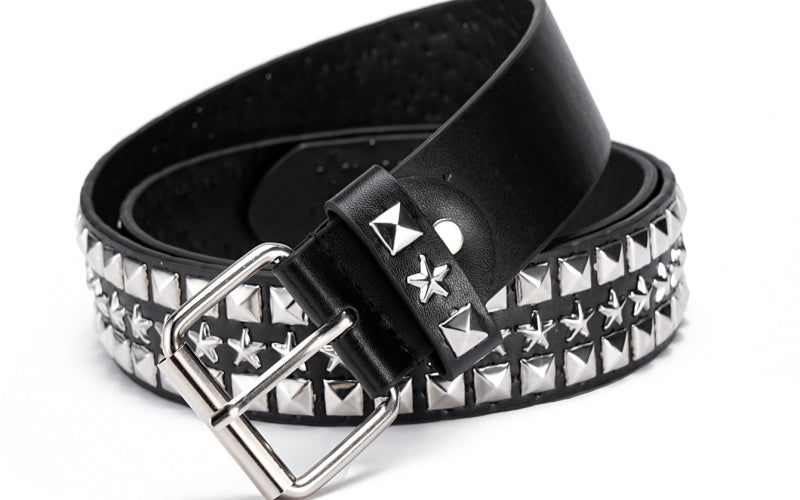
- Pyramid studs — Four-sided pyramid, the most iconic studded belt shape. Available in single-row, double-row, and three-row configurations. The default choice for both punk heritage and modern styling.
- Cone studs — Pointed cone shape, more aggressive than pyramid. Common on heavier metal and hardcore-influenced designs.
- Dome studs — Rounded half-sphere, softer aesthetic. Works in both casual and semi-formal contexts.
- Flat/spot studs — Low-profile circular discs. The most subtle option — adds texture without the dimensional edge of pyramids or cones.
- Spike studs — Extended pointed cones. Pure statement — not for office wear or anywhere you'll be sitting close to others.
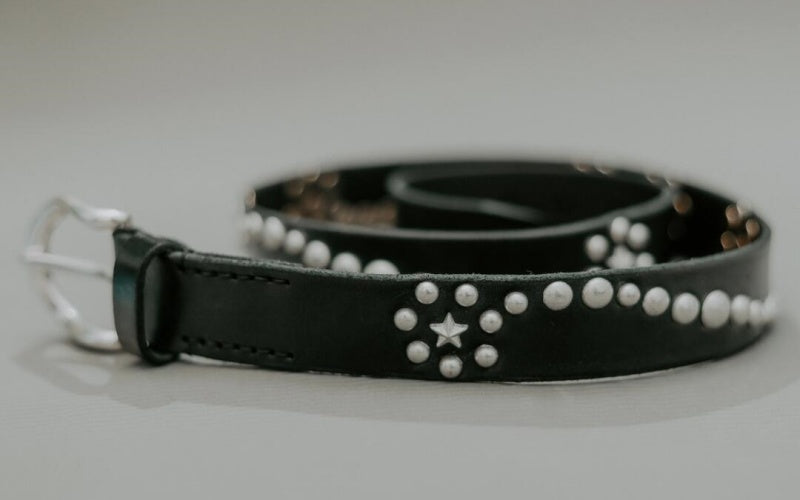
- Novelty studs — Skulls, stars, hearts, crosses. Typically cast zinc alloy. Fun for themed styling but rarely available in premium metals.
According to Who What Wear's studded belt roundup, pyramid studs in mixed metals (silver and gold on the same belt) are the dominant 2026 trend — replacing the single-metal uniformity of earlier seasons.

How Are Studs Attached to Leather Belts?
Studs are attached using one of four methods: prong setting (most common), rivet attachment (most durable), screw-back (most secure), or adhesive (avoid entirely). The attachment method is the most overlooked quality indicator on a studded belt — and the first thing to fail on cheap ones.
Prong Setting
Each stud has two to four sharp metal prongs on its base. The prongs are pushed through the leather and bent flat on the reverse side. This is the industry-standard method — fast and effective on quality leather. The risk: on thin or synthetic materials, prongs can work loose over time and scratch skin. Lowlife's manufacturing guide notes they're transitioning away from prongs to rivets for this reason.
Rivet Attachment
A separate rivet secures the stud through the leather with a mushroomed metal cap on the reverse side. Rivets create a smoother interior surface and distribute force more evenly than prongs. This is the premium method for machine-set studs.
Screw-Back
A threaded post passes through the leather and receives a screw-on backing. This is the most secure attachment and the smoothest against skin — common on hand-set studs in artisan belts. It's also the only method that allows easy stud replacement if one is damaged.
Adhesive (Glue-Only)
Studs are glued directly to the surface with no mechanical fastener. This is a red flag. Glued studs begin detaching within weeks of regular wear. If you can wiggle a stud with your fingers on a new belt, it's glued.

How to Tell If a Studded Belt Is Quality
Check five things: leather grain, stud weight, attachment method, edge finishing, and buckle construction. A two-minute inspection tells you more than any product description.
- Leather grain — Look at the surface. Natural grain variation means full-grain leather. Perfectly uniform, plastic-looking surface means bonded or faux. For detailed identification tips, see our guide on how to tell if a belt is full-grain leather.
- Stud weight — Pick the belt up by one end. Quality metal studs add noticeable heft. If the belt feels light and hollow, the studs are thin zinc alloy.
- Attachment method — Flip the belt over. You should see visible prong tips or rivet caps on the reverse. A smooth, unbroken back means the studs are glued.
- Edge finishing — Run your finger along the edge. Burnished or hand-painted edges signal craft. Raw, rough, or peeling edges signal corners cut.
- Buckle quality — The buckle is the fastest quality indicator on any belt. A solid stainless steel buckle with clean casting and smooth action means the maker invested in every component. A lightweight, rough-edged buckle with visible seams means they didn't.
Price sanity check: Under $25, expect faux leather and zinc. $25-$60, you'll find split-grain or top-grain with mixed hardware. Above $60, you should be getting full-grain leather, solid metal hardware, and reinforced construction. Above $100 with exotic leather and hand-set studs, you're in artisan territory.

The Bottom Line
What are studded belts made of? Three components — leather, studs, and the system holding them together — and the quality of each determines whether you own the belt for a season or a decade.
Full-grain leather provides the dense fiber structure studs need to hold permanently. Stainless steel or solid brass studs resist the tarnishing that kills zinc alloy within months. Rivet or screw-back attachment outperforms prongs and eliminates glue-only construction entirely.
At BELTLEY, every studded and embellished belt is built on full-grain or exotic leather with 316L stainless steel hardware, hand-finished edges, and a 10-year warranty — because the studs should last as long as the leather underneath them. Browse the full belt collection and feel the difference materials make.
Frequently Asked Questions
Q: What are the studs on belts called?
The metal decorations on studded belts are called "studs" or "spots" in the leather goods industry. Specific shapes have their own names: pyramid studs, cone studs, dome studs, and spike studs. "Rivets" technically refers to the attachment hardware, not the decorative element — though the terms are often used interchangeably in retail listings.
Q: Are studded belts still in style in 2026?
Yes. Studded belts are firmly on-trend in 2026, with runway appearances from major brands and trend reports from Who What Wear and The Zoe Report confirming statement belts as a defining accessory. The 2026 version leans toward mixed metals and refined pyramid patterns over the heavy punk aesthetic of earlier eras.
Q: How do you keep studs from tarnishing?
Use stainless steel or solid brass studs — both resist tarnishing naturally. For nickel-plated or zinc alloy studs, wipe with a dry cloth after wear to remove body oils and moisture. Avoid storing studded belts in humid environments or sealed plastic bags. Once zinc alloy studs begin tarnishing, the process is largely irreversible.
Q: Are studded belts unisex?
Yes. Studded belts are among the most gender-fluid accessories in fashion. The same pyramid-studded belt works across men's, women's, and non-binary styling. Width is the main fit variable: 1.25"-1.38" for dress-pant loops, 1.5" for jeans. See our guide on whether studded belts are unisex for styling details.
Q: Can you take a studded belt on an airplane?
Yes. TSA permits studded belts in both carry-on and checked luggage. The studs are classified as decorative elements, not prohibited items. You may be asked to remove the belt at security screening, which is standard for any metal-bearing accessory. For the full breakdown, see our guide on studded belts and air travel.
Q: What is the difference between rivets and studs on belts?
Studs are the visible decorative elements on the belt's surface — the pyramids, cones, or domes you see. Rivets are the fasteners that hold studs (or other components) to the leather. A rivet passes through the leather and is capped on the reverse side. Some belts use studs with built-in prongs instead of separate rivets, but rivet-attached studs are considered the more durable construction method.