Are Studded Belts Unisex? Yes — and Here's the Proof
TL;DR: Quick Answer
- Studded belts are fully unisex — they've been gender-neutral since bikers started studding their own leather in the 1950s
- The gender-neutral fashion market is projected to reach $209 billion by 2032, and studded belts sit at the intersection of two 2026 mega-trends: statement accessories and fluid fashion
- The only real variables are width and length — not gender. A 1.38" studded belt in black works identically across men's, women's, and non-binary styling
You're looking at a studded belt and wondering: is this a men's accessory or a women's accessory? Neither. A strip of leather with metal studs has no gender — and it never did. What it has is a 70-year history of being worn across every gender identity, from 1950s biker culture to 2026 runways. Here's why studded belts are one of the most naturally unisex accessories in fashion, plus a practical guide for choosing one based on your body — not a gendered label.

Have Studded Belts Always Been Unisex?
Studded belts have been gender-neutral since their origin in 1950s biker culture, where the aesthetic was about rebellion and identity — not gender. The style passed through greasers, punk rockers, and pop-punk scenes without ever being coded exclusively for one gender.
The timeline tells the story:
- 1950s-60s — Bikers and greasers studded their own leather belts and jackets as a DIY statement of nonconformity
- 1970s — The punk movement adopted studded leather as its uniform. As Lowlife's studded belt history documents, bands like the Ramones and Sex Pistols made studs a symbol of anti-establishment identity — worn identically by male and female punks
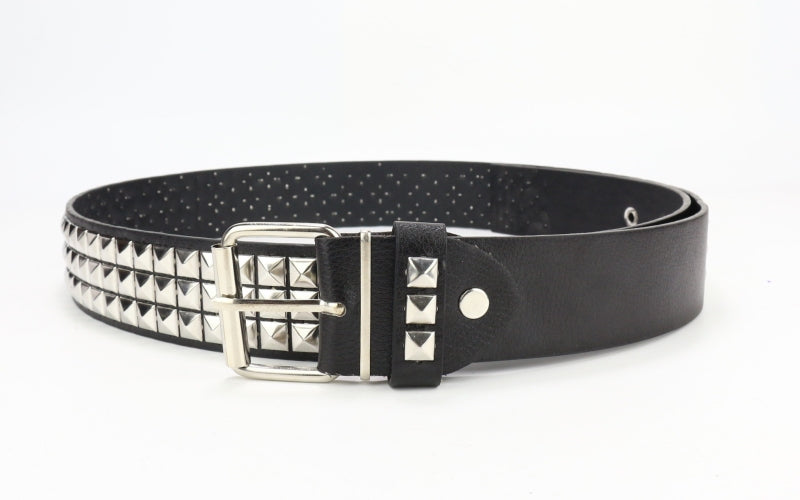
- 2000s — Pop-punk and emo subcultures brought studded belts to mainstream youth fashion. Billie Joe Armstrong of Green Day made the three-row pyramid belt iconic — and fans of all genders replicated the look
- 2020s — Fashion houses and DTC brands now market studded belts as explicitly gender-neutral, reflecting broader cultural shifts in how we categorize accessories
The through-line is clear: studded belts were never designed for a specific gender. They were designed for a specific attitude. That attitude — confident, expressive, slightly defiant — doesn't belong to any one demographic.

Why Are Studded Belts Trending as Gender-Neutral in 2026?
Studded belts align with two of 2026's defining fashion movements: the statement belt trend and the gender-fluid accessory shift. Both movements reward accessories that express personality through material and texture rather than gendered design cues.
The numbers back it up. According to Verified Market Research, the global gender-neutral clothing market reached $98.2 billion in 2024 and is projected to hit $209.7 billion by 2032 at a 6.2% CAGR. Consumer behavior data shows that 56% of Gen Z shoppers don't consider the gender designation of clothing when purchasing — they buy what fits and what they like.
On the runway side, Editorialist's 2026 accessory report identifies statement belts — championed by Celine and Dior — as a top trend. Who What Wear's 2026 styling guide features studded and embellished belts styled across gender presentations. The fashion industry isn't just tolerating gender-neutral studded belts — it's actively pushing them.

Is There a Difference Between Men's and Women's Studded Belts?
The only functional differences between men's and women's studded belts are width, length, and sometimes buckle direction — not the studs themselves. The leather base, stud pattern, and hardware are identical. Any studded belt fits any body if you choose the right size.
Here's what actually varies:
| Dimension | Traditionally "Men's" | Traditionally "Women's" | Unisex Sweet Spot |
|---|---|---|---|
| Width | 1.38"-1.5" | 0.75"-1.5" | 1.25"-1.5" |
| Length range | 30"-48" | 24"-38" | 28"-42" |
| Hole spacing | 1" apart, 5-7 holes | Closer together, 7-10 holes | 7 holes, 1" apart |
| Buckle direction | Prong points left | Prong points right | Either — no functional difference |
| Stud type | Pyramid, cone, spike | Dome, flat, mixed | Pyramid — universally flattering |
According to Hoplok Leather's belt comparison guide, the width and buckle direction differences are legacy conventions — not structural requirements. A 1.38" pyramid-studded belt works through every standard jean and trouser loop regardless of the wearer's gender. For a broader look at how men's and women's belts differ (and don't), see our guide on male vs. female belt differences.

How to Choose a Unisex Studded Belt That Fits
Choose by waist measurement and intended wear position — not by the "men's" or "women's" label on the listing. The label tells you nothing about whether the belt fits your body.
Step 1: Measure Your Waist (Not Your Pant Size)
Wrap a flexible tape measure around your body at the point where you'll wear the belt — natural waist, hip level, or wherever your pants sit. Add 2 inches to that number. That's your belt size. If your measured waist is 32", order a 34" belt. BELTLEY's size guide covers the full measurement process with illustrations.
Step 2: Choose Your Width
- 1.25" (32mm) — Fits dress pants and slimmer jean loops. More refined, works in professional settings.
- 1.38" (35mm) — The universal width. Fits virtually every belt loop and works across formal, casual, and everything between. This is the safest unisex choice.
- 1.5" (38mm) — Best for casual jeans, statement looks, and wider belt loops. The most common width for triple-row stud patterns.
Step 3: Pick Your Stud Pattern
- Single-row pyramid — Subtle, clean, works in professional and casual contexts. The most versatile unisex option.
- Double-row pyramid — More visual presence without being aggressive. Strong everyday choice.
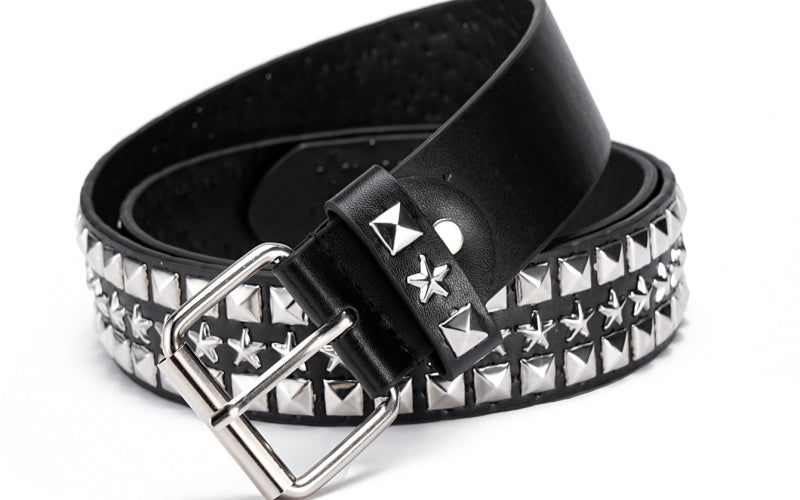
- Triple-row pyramid — Full punk heritage look. Best for casual and statement styling.
- Mixed metals — Silver and gold studs on the same belt. Who What Wear flags this as the dominant 2026 stud trend.

How to Style a Studded Belt for Any Gender
The styling principle is the same regardless of gender: let the studded belt be the outfit's focal point and keep everything else relatively simple. One textured, embellished accessory per outfit. The belt does the talking.
With Jeans (Universal)
Black or brown studded belt, 1.38"-1.5", pyramid studs. Thread through standard jean loops and let 4-5 inches of tail hang through the first loop. This is the classic look — works on every body type and gender presentation. For more denim pairing ideas, see our guide on studded belt ideas for guys (which works for everyone despite the title).
Over a Blazer or Coat (Women's/Non-Binary Trending)
A 1.25"-1.38" studded belt cinched over an oversized blazer or shirt dress defines the waist and adds edge to an otherwise soft silhouette. This is one of the strongest women's belt trends of 2026 — but it works on anyone with the proportions for it.
With Tailored Trousers (Men's/Non-Binary Trending)
A single-row studded belt at 1.25" with a slim buckle reads as polished-with-edge in business casual settings. Pair with a tucked shirt and leather shoes. The studs add just enough personality to lift a standard outfit without crossing into "too much."
The One Rule That Matters
Keep the rest of the outfit simple. A studded belt with a graphic tee, statement sneakers, and a bold watch is competing with itself. A studded belt with a white tee, dark jeans, and clean boots is a complete look.
The Bottom Line
Are studded belts unisex? They always have been. From 1950s biker culture to 2026 runways, studded belts have never been gendered — they've been personal.
The only variables that matter are width, length, and stud pattern, and none of those are determined by gender. With 56% of Gen Z shoppers ignoring gender labels entirely and the gender-neutral fashion market projected to pass $200 billion by 2032, the "men's" and "women's" labels on studded belt listings are increasingly meaningless. Choose by measurement, choose by style preference, and choose quality that lasts.
At BELTLEY, every belt is handcrafted from full-grain or exotic leather with stainless steel hardware and backed by a 10-year warranty — because a good studded belt doesn't care who's wearing it, and neither should you. Browse the full belt collection and find your fit.
Frequently Asked Questions
Q: What width studded belt is best for unisex wear?
1.38" (35mm) is the most universally flattering width. It fits standard jean loops and dress pant loops, accommodates single- and double-row stud patterns, and avoids looking either too dainty or too bulky on any body type.
Q: Can men wear studded belts with suits?
Yes — with the right choice. A single-row pyramid studded belt at 1.25" width in black with a slim stainless steel buckle works in business casual and creative professional settings. Avoid triple-row, spike studs, or novelty shapes with formal wear. The goal is subtle edge, not costume.
Q: Are studded belts still in style in 2026?
Yes. Statement belts are a top 2026 accessory trend, with Celine and Dior leading the charge on oversized and embellished belt designs. Studded belts specifically are trending in mixed metals (silver + gold) and refined pyramid patterns. See our full 2026 studded belt style guide for runway evidence.
Q: How do I know what size studded belt to order?
Measure your waist at the point where you'll wear the belt, then add 2 inches. A 32" waist measurement needs a 34" belt. Don't use your pant size — it doesn't account for fabric thickness or where you actually position the belt. Use BELTLEY's size guide for step-by-step instructions.
Q: Do studded belts set off metal detectors at airports?
Studded belts can trigger metal detectors at airport security, but they're fully TSA-compliant and allowed in carry-on and checked luggage. You'll likely be asked to remove the belt during screening — standard for any metal-bearing accessory. See our guide on studded belts and air travel for full details.
Q: What's the difference between a unisex belt and a women's belt?
Functionally, very little. Women's belts tend to come in narrower widths (under 1") and shorter lengths (under 36"). Unisex belts are designed in the 1.25"-1.5" range with lengths covering 28"-42" — fitting both traditionally men's and women's waist ranges. The leather, hardware, and construction are identical.