Are Studded Belts Allowed in School? Rules, Risks &Alternatives
TL;DR: Quick Answer
- Most U.S. public schools ban studded and spiked belts under dress code or safety policies — they're often classified alongside weapons or disruptive accessories.
- Whether your studded belt passes depends on stud type (flat vs. pointed), your school district, and whether the school is public, private, or a charter.
- School-safe alternatives exist that still let you express your style without risking confiscation.
You found a studded belt you love. Maybe it's a punk-rock throwback, maybe it's a subtle row of flat silver studs. Either way, you're wondering: can I actually wear this to school?
The short answer is probably not — but the full answer depends on your school's specific dress code, the type of studs on your belt, and how strictly your administration enforces its policies. This guide breaks down actual school dress code language, explains why studded belts get flagged, and gives you stylish alternatives that won't end up in the principal's office.

Are Studded Belts Against School Dress Code?
In the majority of U.S. public schools, yes — studded belts are explicitly prohibited. Most district dress codes group studded and spiked belts with items classified as "potentially dangerous accessories" or "disruptive to the learning environment." A review of published dress code policies from districts in Georgia, Florida, Arizona, and California reveals remarkably similar language: belts must be plain leather or cloth, solid-colored, with no ornamentation, oversized buckles, or metal projections.
That said, dress codes vary by district. Some schools spell out "no studded, spiked, or chain belts" word-for-word. Others use broader language like "no accessories that could be perceived as weapons." A handful of smaller or more lenient districts don't mention belts at all.
Your move: Search your school district's name plus "dress code" online. The policy is almost always published as a PDF or on the district website under "Student Handbook."

Why Do Schools Ban Studded Belts?
Schools ban studded belts primarily because pointed metal studs and spikes can cause physical injury. Administrators treat them the same way they treat spiked bracelets, heavy chain necklaces, and rings with projections — as items that could be used to scratch, poke, or strike another student, whether intentionally or accidentally.
There are three main reasons behind the bans:
-
Safety concerns — Pointed pyramid studs and cone spikes can break skin. The National Association of Secondary School Principals (NASSP) has long recommended that schools prohibit accessories with sharp metal components to reduce injury risk during crowded hallways and physical activities.
-
Gang and subculture associations — Some districts adopted studded belt bans in the early 2000s as part of broader anti-gang dress code policies. While the association between studded belts and gangs has largely faded, the policy language persists in many handbooks.
-
Disruption to the learning environment — Jangling metal, scratched desks, and torn upholstery give administrators practical reasons to restrict heavy hardware accessories. According to research published by the National Center for Education Statistics (NCES), roughly 20% of public schools now enforce strict uniform policies, with another 57% enforcing strict dress codes — and belts with embellishments are frequently restricted under both.

Are Spiked Belts Considered Weapons in School?
Technically, no — a spiked belt is not a weapon under criminal law. But within a school's jurisdiction, administrators have broad authority to classify items as "weapon-like" or "potentially dangerous." Multiple school districts, including those in Volusia County, FL and Liberty County, GA, explicitly list spiked belts alongside prohibited weapon-like items.
In these districts, a confiscated spiked belt may not be returned to the student — the same treatment given to pocket knives or brass knuckles imagery on belt buckles.
The distinction matters: you won't face criminal charges for wearing a studded belt to school, but you could receive a dress code violation, detention, or even suspension if your school categorizes it as a safety threat.
Does the Type of Stud Matter?
Absolutely — and this is where most students and parents get confused. Not all "studded" belts carry the same risk. Here's how different stud types typically fare under school dress codes:
| Stud Type | Description | Typically Allowed? |
|---|---|---|
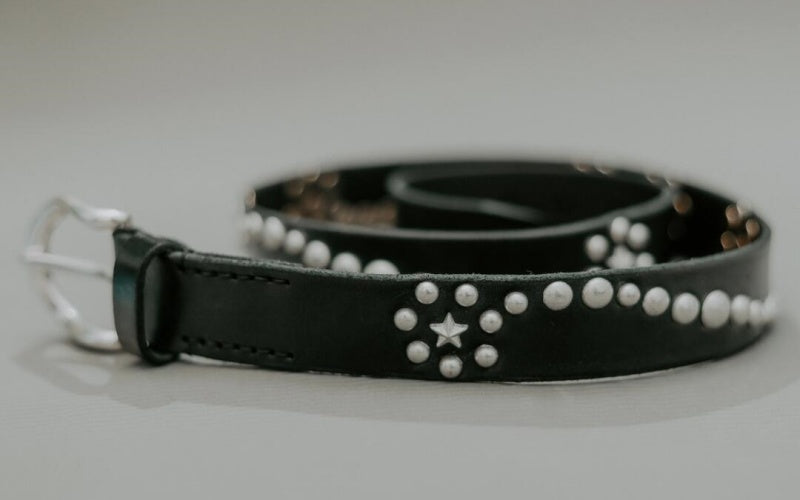
| Flat disc studs | Smooth, rounded metal circles flush with leather | Sometimes — depends on district |
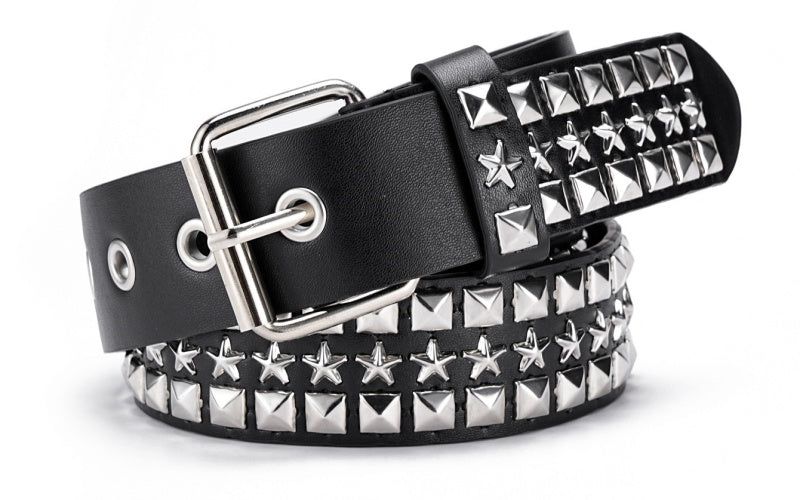
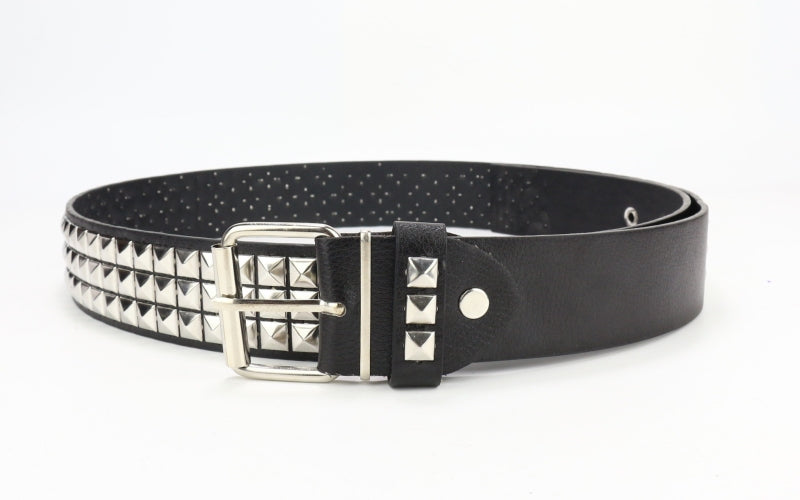
| Pyramid studs | Four-sided pointed metal squares | Rarely — classified as "spiked" |
| Cone spikes | Tall, sharply pointed metal cones | Almost never — treated as weapon-like |
| Rhinestone studs | Flat-set decorative stones | More likely — seen as decorative, not dangerous |
| Micro studs | Tiny, subtle metal dots | Best chance — often overlooked |
If your school's policy says "no studs," it means all types. But if the policy says "no spikes" or "no sharp projections," flat or rhinestone-studded options might pass. Understanding what studded belts are made of helps you make a smarter choice about which styles to invest in.

What Happens if Your Studded Belt Gets Confiscated?
If your belt violates dress code, the typical process looks like this:
- First offense: You're asked to remove the belt or change into a school-provided alternative. A warning is issued and logged.
- Repeat offense: Detention, parent notification, or a formal dress code violation on your record.
- Aggressive enforcement: In stricter districts, the belt is confiscated. Some schools return confiscated items to parents at the end of the semester. Others — particularly those that classify spiked accessories as weapon-like — may not return them at all.
Pro tip: If your belt is confiscated and you believe the policy was applied unfairly, parents can request a meeting with the principal. Most districts have a formal grievance process outlined in the student handbook. The American Civil Liberties Union (ACLU) provides resources on student rights and dress code challenges.

Are Chain Belts Allowed in School?
Chain belts face the same restrictions as studded belts in most districts — and often stricter ones. Wallet chains, chain-link belts, and heavy metal chain accessories are almost universally banned under the "could be used as a weapon" clause. If you're curious about whether chain belts are still in style in 2026, the answer is yes in fashion — but not in the classroom.
What Belts Are Appropriate for School?
Most school dress codes approve belts that are plain leather or fabric, in solid colors (black, brown, navy, or khaki), with a standard prong or box buckle and no decorative embellishments. Here's what consistently passes:
- Plain full-grain leather belts — A quality full-grain leather belt in black or brown meets virtually every school dress code and lasts years longer than cheap synthetic alternatives.
- Canvas or woven belts — Lightweight and affordable, though they wear out faster.
- Simple buckle styles — Prong buckles and box buckles are universally accepted. Avoid oversized plaque buckles or anything with imagery (skulls, weapons, brand logos).
If you want to explore different belt types, there are plenty of options that express personal style without tripping a dress code violation.
Can You Wear Studded Belts Outside of School?
Of course. Studded belts remain a strong fashion statement — studded belts are very much in style in 2026, appearing across runway collections and streetwear.
The restriction is institutional, not cultural. Wear your studded belt on weekends, at concerts, at parties, and anywhere that doesn't have a formal dress code. If you need styling ideas for guys, there's no shortage of ways to make a studded belt work outside school hours.
The Bottom Line
Most schools prohibit studded belts — especially those with pointed pyramid studs or cone spikes — under safety-focused dress code policies. The ban is less about fashion and more about liability.
Your best bet is to check your specific school's handbook, understand the difference between flat decorative studs and sharp projections, and keep a plain leather belt in your locker as a backup.
A well-made full-grain leather belt actually looks sharper with school outfits anyway — and unlike a confiscated studded belt, it'll still be yours at 3 PM. Save the studs for after the final bell.
Frequently Asked Questions
Q: Are studded belts against school dress code?
In most U.S. public schools, yes. Studded belts are typically listed as prohibited accessories under dress code policies that ban spikes, metal projections, or "weapon-like" items. Check your district's student handbook for the exact language.
Q: Can you get in trouble for wearing a studded belt to school?
Yes. Consequences range from a verbal warning and belt removal on first offense to detention, parent conferences, or suspension for repeat violations. In some districts, the belt may be confiscated permanently.
Q: Are studded belts considered weapons in school?
Not under criminal law, but many school districts classify spiked and studded belts as "weapon-like accessories" that fall under the same policy umbrella as sharp jewelry, chains, and items with metal projections.
Q: What type of belt is best for school?
A plain leather belt in black or brown with a simple buckle is the safest choice. Full-grain leather belts are durable, stylish, and universally dress-code compliant.
Q: Are flat-studded belts allowed in school?
It depends on your school's policy. If the dress code specifically bans "studs" or "ornamentation," flat studs are still prohibited. If the language only targets "spikes" or "sharp projections," flat studs may be acceptable — but confirm with your school administration first.
Q: Do private schools allow studded belts?
Private schools generally enforce stricter dress codes than public schools, often requiring specific uniform belts. Studded belts of any kind are almost never permitted in private school settings.