Two-Tone Crocodile Belt: Reversible vs Painted Edge
TL;DR:
- A two-tone crocodile belt comes in two very different forms: true reversible construction (two hides bonded back-to-back, two buckle orientations) or painted-edge finishing (one hide with contrasting edge paint).
- Reversible builds typically cost 1.8–2.4x more because they use two full belly-cut hides plus a rotating buckle mechanism.
- Painted-edge belts are lighter, slimmer, and faster to break in, but the edge paint can chip in 2–4 years under heavy daily wear.
- For pure styling versatility (one belt, two outfits), reversible wins. For sharper visual detail at a fair price, painted edge wins.
- BELTLEY builds both — belts are in stock and ship in 2–3 days after a final hand-finish in our workshop.
Quick Facts Construction styles compared: 2 (reversible vs painted edge) Hides used in a reversible build: 2 full belly cuts Typical buckle on reversible: rotating or quick-release plaque Typical edge-paint layers on painted-edge: 4–7 thin coats Expected edge-paint lifespan with care: 5–8 years BELTLEY lead time: 2–3 days handcraft and ship — belts in stock
I still remember the first reversible crocodile belt I cut on the bench back in 2003 — black belly on one side, cognac on the other, and a tiny rotating plaque buckle I'd sourced from a hardware maker in northern Italy. It took us almost a full day to align the scale patterns so neither side looked like the "back." Painted-edge belts came later in our workshop, and they solved a different problem: how do you give a single hide more visual depth without doubling the price? Twenty-three years later, customers still ask which one is "better." The honest answer is — they aren't the same product. Let me show you why.

Which Two-Tone Build Should You Order?
Two constructions, two buyers:
| Your situation | Go with |
|---|---|
| Travel light, need black AND brown | True reversible — two hides, rotating buckle, genuinely two belts in one slot. |
| Want the contrast detail, one main color | Painted-edge — slimmer, lighter, faster break-in, meaningfully cheaper. |
| Checking a "reversible" listing | Look for two finished scale faces and a rotating buckle — one face plus painted back is not reversible, whatever the title says. |
| Worried about edge-paint chipping | Fair concern at year 2–4 — budget for edge refresh, or choose the reversible build that has no painted edge to chip. |
Construction honestly described on every product page: BELTLEY's crocodile belts.
What exactly is a two-tone crocodile belt?
A two-tone crocodile belt is any crocodile or alligator belt that shows two distinct colors on the finished strap. Those colors can come from two separate hides bonded back-to-back (a true reversible) or from a single hide whose edges are painted in a contrasting tone. The construction method, not the look, defines the category.
In a luxury context, "two-tone" used to mean reversible by default. That changed around 2015, when European ateliers began promoting painted-edge work — sometimes called "tranche peinte" — as a more refined finish. Both are now legitimate options, and both appear across our exotic leather belt collection. The question is which one fits your wardrobe and budget. For a deeper look at how crocodile hides are actually selected, see our note on dyed-through vs surface-dyed crocodile leather.

How is a true reversible two-tone belt constructed?
A true reversible crocodile belt is built from two separately cut belly hides, glued back-to-back with a flexible adhesive, stitched around the perimeter, and paired with a buckle that flips, rotates, or releases so either side can face outward. Both faces are finished as "show" sides — there is no hidden back.
The hardest step isn't the gluing. It's pattern matching. Crocodile belly scales narrow toward the tail, and on a 38-inch belt the scale rhythm on side A has to track sensibly against side B, or the belt looks lopsided when you flip it. Master artisans usually cut both hides from adjacent positions on the same hide batch to keep cell sizing close. Exotic-skin sourcing is one of the slowest, most regulated stages of leather production — which is part of why doubling the hide doubles much more than just the material line on the invoice.
Then there's the buckle. A standard prong won't work because the strap has no "back." You need either:
- A rotating plaque buckle mounted on a pivot
- A quick-release box buckle that lets you slide the strap out and reinsert it reversed
- A clip-on plate with two sets of mounting tabs
At BELTLEY we typically use a stainless steel rotating plaque, which is the same hardware grade you'll find on our men's crocodile belts.

What is painted-edge construction, and how is it different?
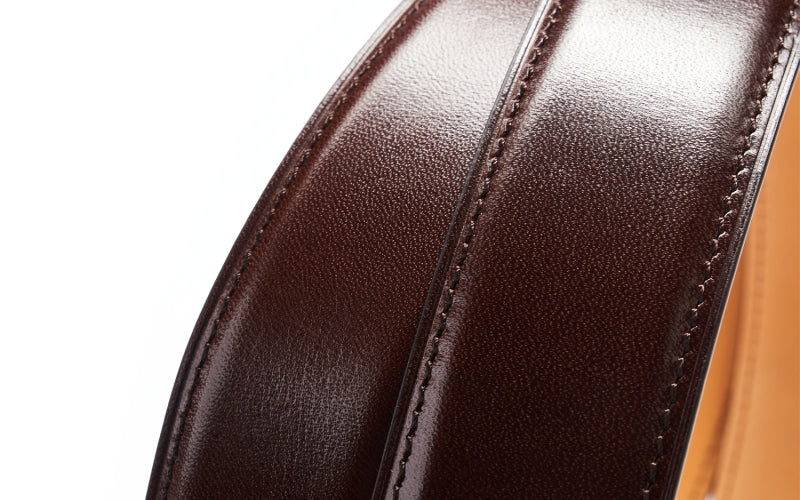
Painted-edge construction uses a single crocodile hide for the strap, with the cut edges finished by hand in a contrasting paint or dye applied in multiple thin layers. The face shows one color, the perimeter shows another. There is one "show" side and one lined back — usually calfskin or microfiber.
Edge paint is more sophisticated than most buyers realize. A proper edge-paint stack involves:
- Sanding the raw edge smooth (often three grits)
- Sealing with a base coat
- Building 4–7 thin pigmented layers
- Burnishing between coats with friction and heat
- A final wax or resin topcoat
Done well, the edge looks almost lacquered. Done poorly, it cracks within a season. The technique has roots in French saddlery — edge finishing has become a quiet status marker in menswear, separating workshop-finished belts from machine-finished ones. We use painted edges on most belts in our alligator belt collection when customers want a sharper line without the bulk of a reversible.

Why does a reversible two-tone belt cost almost twice as much?
A reversible crocodile belt costs 1.8–2.4x more than a comparable single-face belt because it consumes two full belly hides instead of one, requires specialized rotating hardware, and demands extra bench hours for pattern alignment, double-edge finishing, and perimeter stitching. The materials and labor both roughly double.
A useful way to think about it: in a single-face belt, roughly 55–60% of the cost is the hide. Double the hide, and you've already pushed total cost up by about 55%. Add the rotating buckle (usually 2–3x the cost of a standard plaque), the longer assembly time, and the higher reject rate from mismatched scales, and the multiplier lands close to 2x. This is why we keep our reversible options narrower — and why we list them alongside our broader women's belt collection rather than as a separate "premium" tier with a marked-up Brand Tax.
Key Takeaways
- Reversible = two hides, two show sides, rotating buckle, roughly 2x the cost.
- Painted edge = one hide, one show side, contrast paint on the perimeter, standard buckle.
- Edge paint can chip; reversible construction can delaminate at the bond line if cheaply made.
- Choose reversible for outfit versatility, painted edge for visual sharpness at a fairer price.

Which two-tone belt holds up better over time?
Both styles last decades when built properly, but they fail in different ways. A poorly made reversible can delaminate at the glue line within 3–5 years. A poorly executed painted edge can chip in 2–4 years of daily wear. Quality construction pushes both well past the 10-year mark.
Reversible failure usually starts at the buckle end, where the strap flexes most. The fix is a flexible polyurethane adhesive plus a full perimeter stitch — not just glue. Painted-edge failure usually starts where the belt rubs against belt loops; the constant friction lifts the topcoat. A proper resin sealer extends life significantly. We cover routine maintenance in our leather care guide, and the principles apply to both styles. Crocodile leather itself — the substrate — outlasts almost any finish; Wikipedia's overview of crocodile leather notes its exceptional tensile strength compared to cowhide.
How do you tell a real reversible from a "fake" reversible?
A genuine reversible crocodile belt has two finished crocodile faces, matching scale density on both sides, a buckle that visibly rotates or releases, and clean perimeter stitching with no exposed raw edge. A "fake" reversible has crocodile on one side and embossed cowhide on the other, or a buckle that doesn't actually flip.
Quick checks at purchase:
- Look at both edges. Both should be finished identically. If one edge is sealed and the other is raw, it isn't truly reversible.
- Press both faces. Real crocodile has a slight give and a distinctive cell structure. Embossed cowhide feels flatter and more uniform.
- Test the buckle. It should rotate smoothly or release cleanly. A buckle that requires tools isn't a reversible — it's a buckle swap.
- Check the stitch. A real reversible is stitched around the full perimeter. Glued-only construction usually fails first.
If you're sizing either style, our size guide helps — reversible belts in particular size slightly differently because the strap is fractionally thicker.
What about styling — which two-tone belt works for which wardrobe?
Painted-edge belts read sharper and more formal because the contrast is a thin line, ideal under tailoring. Reversible belts read more versatile and casual-luxe because the contrast covers the full face, ideal for travel, weekend dressing, and any wardrobe split between two dominant tones.
A few patterns we see from customers:
- Tailored wardrobes (navy, charcoal, gray suits): painted edge in cognac-on-black or burgundy-on-espresso. Reads as a quiet detail.
- Bi-color wardrobes (mix of brown and black shoes): reversible in black/cognac is the single most useful belt you can own.
- Resort and travel wardrobes: reversible in navy/white or espresso/tan cuts your packing in half.
For palette ideas, see our notes on cognac crocodile belts, burgundy crocodile belts, and navy crocodile belts. If you're considering a brighter contrast edge, our piece on white crocodile belts covers tone pairing in more depth.
The Bottom Line
A two-tone crocodile belt is one of those rare accessories where the construction matters more than the color. A true reversible doubles your styling range and roughly doubles the build cost — fair, because it's effectively two belts on one strap. A painted-edge belt gives you a sharper visual line at a more accessible price, with the trade-off that the finish needs occasional attention. Neither is "better." They solve different problems. At BELTLEY we make both because our customers — the Smart Money crowd who'd rather buy one belt that lasts than three that don't — ask intelligent questions about which to choose, and we'd rather give them the real answer than upsell the more expensive option. Browse our full alligator belt collection to see live examples of both styles, in stock and shipping in 2–3 days.
Frequently Asked Questions
Q: Is a reversible crocodile belt worth the extra cost?
If you currently own one black belt and one brown belt — yes, almost certainly. A well-built reversible replaces both, takes up one slot in your wardrobe, and the per-wear cost over a decade is lower than buying two separate belts.
Q: Does the edge paint on a painted-edge belt come off?
Quality edge paint, applied in thin layers and sealed properly, lasts 5–8 years of daily wear before any touch-up is needed. Cheap edge paint can chip within a season. The number of paint layers and the burnishing technique matter more than the brand of paint.
Q: Can a painted-edge belt be re-finished if the paint chips?
Yes. A skilled leather worker can sand the edge down, rebuild the paint stack, and reseal it. Most workshops charge a modest flat fee. We offer edge-paint refresh as part of our 10-year warranty service for BELTLEY belts.
Q: Do reversible belts use the same buckle on both sides?
Most do — the buckle either rotates on a central pivot or releases so the strap can be reinserted facing the other direction. A small number of designs use two completely different buckles that swap out, but those are rarer and harder to use day-to-day.
Q: Which two-tone style is better for formal wear?
Painted edge. The contrast is subtle — a clean line at the belt's perimeter — which sits more naturally under tailoring. Reversible belts, with their full-face color change, tend to read better in smart-casual and resort contexts.
By the BELTLEY artisan team — handcrafting exotic leather belts since 1999.
%20or%C2%A0painted-edge%C2%A0finishing%20(one%20hide%20with%20c...)