Leather Belt vs Ratchet Belt: Which Lasts Longer?
Quick answer: Both can last a decade — the deciding factor isn't holes vs track, it's build quality. A traditional leather belt fails at the holes, which stretch and crack under repeated point pressure. A ratchet belt avoids hole wear by spreading tension along a track, but adds a mechanism that can fail if cheaply made. A full-grain strap with solid hardware is what lasts longest, in either format.
Last updated: May 2026 • By BELTLEY Editorial
TL;DR:
- A leather belt vs ratchet belt lifespan contest comes down to construction, not closure type.
- Traditional belts fail at a single point — the holes stretch, fray, and crack from repeated pressure.
- Ratchet belts distribute that pressure across a track (no holes to wear), but a cheap mechanism can fail before the strap does.
- The longest-lasting belt in either format follows the BELTLEY 3-Material Rule: full-grain leather + solid metal buckle + sealed edges.
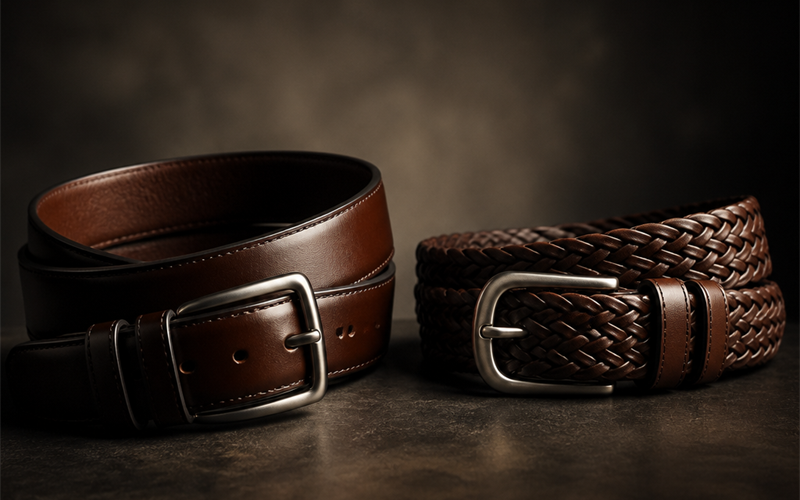
Here's the thing most "leather vs ratchet" debates miss: a ratchet belt is usually also a leather belt, and both can run 7–10+ years when well made. The real difference is the closure — a traditional belt uses punched holes and a prong, while a ratchet (or "automatic") belt uses a toothed track with 30+ micro-adjust stops about ¼ inch apart and a clamping buckle. So the durability question isn't really leather versus something else; it's hole-based versus track-based, and where each one tends to fail. A traditional belt's weak point is the holes; a ratchet's is the mechanism. Below we break down the failure modes, realistic lifespans, and what actually determines how long either lasts. For the mechanics of how the two closures differ, our explainer on how ratchet belts work vs traditional hole belts is the companion piece.
Holes or Track: Pick for YOUR Decade
The longevity question, personalized:
| Your situation | Go with |
|---|---|
| Waist fluctuates through the day | Ratchet — micro-adjustment is the feature holes can't match. |
| Traditional looks, simple mechanics | Prong on full-grain — nothing to jam, ever; holes on quality leather hold for years. |
| Past belts died at the holes | That was thin or bonded leather — full-grain at 4mm doesn't blow out holes. |
| Either format, maximum lifespan | Buy the strap grade, not the mechanism — full-grain + solid hardware wins both races. |
Both formats in full-grain: BELTLEY's men's collection.
Which Lasts Longer, a Leather Belt or a Ratchet Belt?
Neither wins automatically — both can last 7–10+ years when well made. A well-engineered ratchet belt often outlasts a traditional pin-hole belt because it has no single hole to stretch out, but a high-quality traditional leather belt will easily outlast a cheaply built ratchet belt whose mechanism fails early. Strap and hardware quality decide it.

This is the honest verdict the evidence supports. As menswear retailer BeltBuy explains, ratchet belts can outlast hole belts because wear is spread more evenly through the mechanism rather than concentrated on one part of the strap — but the same source warns "a low-quality ratchet mechanism can fail sooner than a simple pin buckle because it has more moving parts." In other words, the ratchet concept has a structural edge, but only when the build is good. The deciding question is always how well is it made, not which type is it.
Why Do Traditional Belt Holes Wear Out?
Because all the fastening pressure lands on one small point every time you buckle. With a pin-hole belt, the same hole bears the full tension of holding your trousers, day after day, so the leather around it stretches, frays, and eventually cracks. It's the single most common failure point on a traditional belt.

This is a real, predictable weakness — not a manufacturing defect. The hole you use most simply takes the most abuse, which is why a favorite belt often shows an elongated, distorted hole long before the strap itself wears out. We cover the mechanics of this in detail in why belt holes wear out so fast, but the short version is that concentrated point-loading fatigues the leather. A thicker, denser full-grain strap resists it far better than a thin or bonded one, which is part of why material quality matters more than closure type.
Does a Ratchet Belt Avoid That Wear?
Yes — that's its main durability advantage. A ratchet belt's track distributes holding tension across many teeth instead of one hole, so there's no single stress point to stretch or crack. The strap stays cleaner and more uniform for longer. The trade-off is that the buckle mechanism has moving parts that can wear or fail.

So the ratchet doesn't eliminate wear; it relocates it. Instead of the strap failing at a hole, a ratchet belt's risk shifts to the track teeth and the clamping buckle. Belt brand Fairwin makes the same point in its leather vs ratchet comparison: "no holes means less wear at the fastening points," giving a quality ratchet belt comparable longevity — provided the metal buckle is well built. A cheap plastic-toothed track or a flimsy clamp will strip or slip, ending the belt's life before the leather is anywhere near done. Our ratchet buckle belts pair full-grain straps with properly engineered metal mechanisms for exactly this reason.
| Factor | Traditional leather belt | Ratchet belt |
|---|---|---|
| Main failure point | Stretched/cracked holes | Track teeth or buckle mechanism |
| Tension distribution | One hole at a time | Spread across the track |
| Realistic lifespan | 7–10+ years (full-grain) | 7–10+ years (well-built) |
| Fit precision | Fixed ~1" hole spacing | Micro-adjust (¼" or finer) |
| Repairability | Punch a new hole easily | Mechanism harder to fix |
| Formality range | Dress to casual | Casual to smart-casual |
What Actually Determines Belt Lifespan?
Three things, in either format: the leather strap, the closure, and how they're finished. A full-grain strap resists stretching and cracking; a solid metal buckle (prong or ratchet) won't bend or strip; and sealed edges keep the leather from splitting. Get those right and the belt lasts a decade — get any wrong and it fails early, regardless of type.

This is where the BELTLEY 3-Material Rule comes in: full-grain leather, a solid brass or stainless steel buckle, and sealed (painted or burnished) edges. Those three elements are what separate a 10-year belt from a 1-year one, and they apply equally to hole-based and track-based belts. A ratchet belt built to that standard outlasts a hole belt that isn't, and vice versa. Real Men Real Style echoes this in its guide to belts, urging buyers to invest in "soft supple leather that doesn't crack" and tight stitching over branding — because, as it notes, "with proper care a high-quality leather belt should last several years, if not a decade or more." Our deeper look at the truth about leather belt durability breaks down each factor.
Key stat: A traditional belt loads its full holding tension onto one hole at a time, while a ratchet track spreads it across 30+ stop points roughly ¼ inch apart — which is why a well-built ratchet strap shows no single wear point.
Which Should You Choose for Longevity?
For maximum lifespan with the simplest repair, choose a full-grain traditional belt — when a hole eventually wears, you punch a new one and keep going. For longevity plus a cleaner strap and precise fit, choose a quality ratchet belt with a solid metal mechanism. Avoid cheap versions of either; that's what actually shortens life.

The practical difference is repairability versus wear-resistance. A traditional belt is almost infinitely fixable — a worn hole is a five-minute repair — but it will develop those wear points. A ratchet belt resists strap wear better but is harder to repair if the mechanism fails. If you want one belt for formal and dress use, traditional leather is the safer, more timeless choice; for everyday comfort and fit precision, a ratchet earns its place. For the full closure-by-closure breakdown, see our ratchet buckle vs classic belt buckle comparison, and browse the full-grain leather belts range for traditional options built to last.
The Bottom Line
In the leather belt vs ratchet belt longevity question, there's no shortcut answer like "ratchets last longer" — both reach a decade when built well, and both fail early when built cheaply. The traditional belt's weak point is its holes; the ratchet's is its mechanism. What truly decides lifespan is the strap, the hardware, and the edges. At BELTLEY, we build to the 3-Material Rule in both formats because a full-grain strap with solid metal hardware is what outlasts everything else — the closure is your preference, the construction is what counts. For a belt engineered to go the distance, start with our full-grain leather belts or a properly built ratchet buckle belt.
Frequently Asked Questions
Q: Do ratchet belts last longer than traditional leather belts?
They can, because a ratchet track spreads holding tension instead of concentrating it on one hole, so the strap doesn't develop a single wear point. But a ratchet's mechanism can fail if cheaply made, while a high-quality traditional belt lasts a decade-plus. Build quality matters more than closure type.
Q: Why do traditional belt holes wear out?
Because the full tension of holding your trousers lands on one small hole every time you fasten it. That repeated point pressure stretches, frays, and eventually cracks the leather around the hole — usually long before the rest of the strap wears out.
Q: Are ratchet belts durable enough for everyday wear?
Yes, if the strap is full-grain, the track is cleanly built, and the buckle is solid metal. A well-engineered ratchet belt is easily durable enough for daily use. A cheap mechanism with plastic teeth or a flimsy clamp, however, can fail before the leather does.
Q: Can you repair a ratchet belt or a leather belt?
A traditional leather belt is easy to repair — you simply punch a new hole when one wears out. A ratchet belt's strap can often be trimmed to length, but a failed buckle mechanism is harder to fix, which is one reason traditional belts are favored for long-term repairability.
Q: Which belt should I buy if I want it to last?
Buy full-grain leather with a solid metal buckle and sealed edges in whichever format you prefer. A traditional belt offers easy repairs; a quality ratchet offers a cleaner strap and precise fit. Avoid bonded leather and cheap mechanisms — those are what cut a belt's life short.