Ratchet Buckle vs. Classic Belt Buckle: Which One Actually Wins?
TL;DR:
- Ratchet buckles adjust in ~4mm micro-increments — far more precise than the standard 1-inch hole spacing of a classic prong
- Classic prong buckles have fewer moving parts, making them more durable over decades of hard use
- Ratchet buckles dominate in daily comfort and business-casual; the classic prong remains the standard for formal occasions
You've seen both. The familiar prong-and-hole setup that's been around since the 19th century, and the sleek click-to-lock ratchet that keeps showing up at the office. One has centuries of tradition behind it. The other has engineering on its side.
This guide breaks down both ratchet buckle belt and classic prong styles across five practical dimensions — fit, durability, formality, aesthetics, and value — so you can pick the right mechanism for your wardrobe.
Ratchet or Classic: Match Your Life First
Both buckles work. The question is which one fits how you actually live:
| Your situation | Go with |
|---|---|
| Desk job, want all-day comfort | Ratchet — ~4mm micro-adjustments mean it's never one hole too tight after lunch |
| You keep belts for decades | Classic prong — fewer moving parts, nothing to wear out |
| Formal events, suits, weddings | Classic prong — it's still the formal standard, full stop |
| Your weight fluctuates | Ratchet — the micro-increments absorb the change without re-punching holes |
| You just like things traditional | Classic — 150 years of menswear can't all be wrong |
BELTLEY makes both — compare them in the men's collection. The mechanics behind each recommendation:
How Do Ratchet Buckles and Classic Buckles Actually Work?
Understanding the mechanics explains most of the trade-offs.

Classic prong buckles (also called pin buckles or frame buckles) use a metal pin that inserts into one of 5–7 pre-punched holes in the leather strap. Zero moving parts. Most men's dress belts space those holes 1 inch apart, giving you roughly five size positions across the belt's usable range.
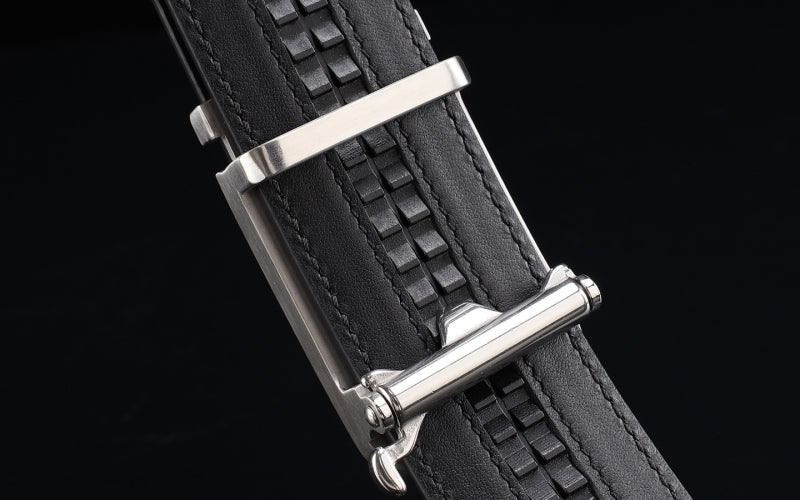
Ratchet buckles (also called automatic buckles or slide buckles) use a hidden-tooth track embedded along the inner face of the strap — typically 36–40 teeth spaced about 4mm apart. A spring-loaded pawl inside the buckle clicks over each tooth as you tighten. To release, you press a lever on the underside. No holes required.
Understanding these two mechanisms is the foundation of knowing what the point of a belt buckle really is — and how hardware quality affects both performance and long-term value. For a full overview of hardware styles from prong to plaque to ratchet, see BELTLEY's guide to types of belt buckles.
Does a Ratchet Buckle Fit Better Than a Classic Prong?
A ratchet buckle fits more precisely than a classic prong in almost every situation. Where a prong forces you to choose between "one hole too tight" and "one hole too loose," the ratchet track adjusts in ~4mm increments — giving you exact tension at any point in the day, no compromise required.

This matters more than people expect. Your waist circumference shifts throughout the day — after a meal, after sitting for hours, after exercise. A classic belt locks you into a single predetermined size. A ratchet belt adjusts in real time.
Research on waistband pressure and posture supports the idea that sustained compression at the waist affects comfort over long wear periods — a small but real argument for precision-adjustable waistbands.
For business travelers and frequent flyers, this is a genuine advantage. A ratchet belt typically adjusts across 6–8 inches without punching new holes, handling weight fluctuations or thicker winter clothing with the same belt. Classic belts handle this only by getting new holes punched at a cobbler.
Which Belt Buckle Type Lasts Longer?
Classic prong buckles outlast ratchet buckles in long-term mechanical durability because they have zero moving parts to fail. A quality steel prong-and-frame can last decades. Ratchet mechanisms contain springs and pawls that fatigue or jam over time — especially in budget-grade versions.
That distinction narrows at the quality tier. A ratchet buckle machined from solid stainless steel with a precision spring will handle daily use for many years. The failure point in most consumer ratchet buckles is the release lever, which bears stress every time the belt is removed. Cheap lever assemblies crack or deform with repeated use.
MatWeb's stainless steel datasheet documents the corrosion resistance and tensile properties that make it the standard choice for premium belt hardware.
For classic buckles, the vulnerability isn't the hardware — it's the leather around the hole. Repeated prong insertion stretches and eventually tears the strap at the same punch point, leaving permanent creasing and hole elongation. The ratchet track avoids this entirely because load distributes evenly across the strap without localized stress concentration.
Verdict on durability: Classic prong wins for hardware lifespan. Ratchet wins for leather preservation.
At BELTLEY, both our prong and ratchet buckles are built from stainless steel — the same alloy used in marine-grade hardware. That's why every belt in the lineup carries a 10-year warranty on materials and construction. See the full range of full-grain leather belts built on that standard.
Can You Wear a Ratchet Buckle Belt to a Formal Event?
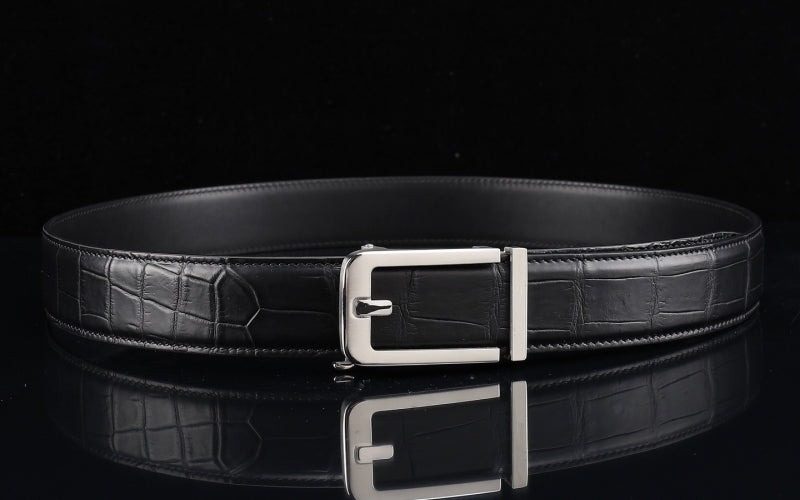
A ratchet buckle belt is appropriate for business-casual, smart-casual, and most office environments. For black-tie and strict business-formal occasions, the classic single-prong buckle remains the accepted standard — ratchet buckles are not yet the conventional formal choice.

The reason is aesthetic, not mechanical. Formal dress codes evolved around the slim, minimalist profile of a single-prong frame buckle. The release lever on a ratchet buckle — even a sleek one — adds visual complexity that trained eyes notice in a boardroom or at a formal dinner.
FashionBeans' guide to formal attire rules confirms that the classic prong buckle remains the standard hardware for black-tie and business-formal dress codes.
The exception: some contemporary dress ratchet designs use flush-mounted levers that read nearly as clean as a traditional buckle at a glance. But the safe choice for a suit or black-tie event remains a classic prong, ideally in a 1.25" (32mm) or slimmer width.
For casual and everyday contexts, ratchet buckles are fully appropriate. Our guide on dress belt vs. casual belt breaks down which hardware suits each occasion. For formal suiting, our dress belts collection covers slim prong styles in polished leather designed for tailored trousers.
Ratchet vs. Classic: Aesthetics at a Glance
Visual appeal is partly subjective, but these patterns hold across style contexts:

| Feature | Ratchet Buckle | Classic Prong Buckle |
|---|---|---|
| Leather surface | Clean, hole-free | 5–7 visible holes |
| Buckle profile | Slightly thicker at clasp end | Slimmer profile overall |
| Dress code range | Business-casual to casual | Casual to black-tie formal |
| Leather aging | Strap surface stays pristine | Holes stretch and crease over years |
| Hardware visibility | Release lever visible | Prong and bar only |
| Repair & adjustment | Requires manufacturer parts | Any leather shop worldwide |
The Art of Manliness complete guide to men's belts covers the full aesthetic and functional differences between buckle styles.
Ratchet belts win on leather surface preservation — the strap looks new longer. Classic belts win on slim formality and universal repair access. If you want the cleanest, hole-free look, BELTLEY's ratchet buckle belts feature flush-lever designs on full-grain leather. For the traditional profile, our box & prong buckle belts use a tight-tolerance hardened steel frame.
Which Belt Buckle Should You Actually Buy?
Choose a ratchet buckle for precise daily fit, a hole-free leather surface, and versatility across business-casual to casual contexts. Choose a classic prong when formal dress credentials matter, maximum hardware durability is the priority, or you want a belt repairable anywhere in the world.
A more specific breakdown:
- You wear suits regularly → Classic single-prong, 1.25" or slimmer, minimalist frame
- You're in a business-casual office → Ratchet — cleaner profile, better comfort over an 8-hour day
- You travel frequently → Ratchet — covers size variance without punching extra holes
- You're building a minimal wardrobe → One of each: slim prong for formal, ratchet for daily rotation
- You want to invest in a single belt → Ratchet on full-grain leather — more versatile day-to-day
- You prioritize long-term durability → Classic prong on heavy full-grain leather
Real Men Real Style's ultimate guide to men's belts covers the full decision framework for choosing between ratchet and classic hardware.
For a complete look at how buckle choice intersects with leather, width, and dress code, our guide to choosing a good leather belt walks through every variable.
The Bottom Line
Ratchet buckles are not objectively better than classic prong buckles — they're better for different things. Ratchet mechanisms deliver precision fit, clean leather, and all-day comfort. Classic prongs deliver formal credibility, mechanical simplicity, and universal repairability. The right answer depends on where and how you wear a belt most.

At BELTLEY, we build both. Our ratchet and prong styles use the same stainless steel hardware and full-grain leather construction — because the buckle mechanism shouldn't mean a compromise on material quality. Both are backed by a 10-year warranty and ship free worldwide (USA 4–8 days, International 4–10 days). Start with the BELTLEY belt buckles collection to compare both styles on full-grain leather.
Frequently Asked Questions
Q: What is the difference between a ratchet belt and a regular belt?
A ratchet belt uses a tooth-track mechanism built into the strap for micro-adjustment without pre-punched holes. A regular belt uses a metal prong that inserts into one of 5–7 holes. The ratchet adjusts in ~4mm increments; a standard belt adjusts in roughly 1-inch increments. The result is more precise fit control with the ratchet system.
Q: Are ratchet belts considered professional or formal?
Ratchet belts are professional and appropriate for business-casual and smart-casual environments. For black-tie and strict business-formal dress codes, the traditional single-prong buckle is still the conventional standard. Slim ratchet designs in polished leather are gaining acceptance in office settings.
Q: Do ratchet belt buckles break easily?
Budget ratchet buckles can fail at the release lever with heavy daily use. Well-made ratchet buckles from solid stainless steel or brass hold up reliably — the spring and pawl in quality versions are rated for thousands of cycles. Material matters more than mechanism design at this price point.
Q: Is a ratchet belt better for people whose weight fluctuates?
Yes. A ratchet belt typically adjusts across a 6–8 inch range without needing extra holes, making it practical for weight changes, seasonal layering, or post-meal comfort. It's a meaningful advantage over a classic belt with only 5 fixed hole positions.
Q: Can you replace a ratchet buckle if the mechanism fails?
On most ratchet belt systems, the buckle separates from the strap via a quick-release mechanism, so buckle replacement is possible without replacing the strap. Classic prong buckles are repairable at any cobbler or leather shop without proprietary parts — a broader repair network.
Q: Which belt buckle works best with dress pants?
For dress pants paired with a formal suit, a slim (1.25"/32mm) single-prong frame buckle is the safest and most conventional choice. For dress pants in a business-casual context, a slim ratchet buckle in polished stainless steel is fully appropriate and increasingly common in professional settings.