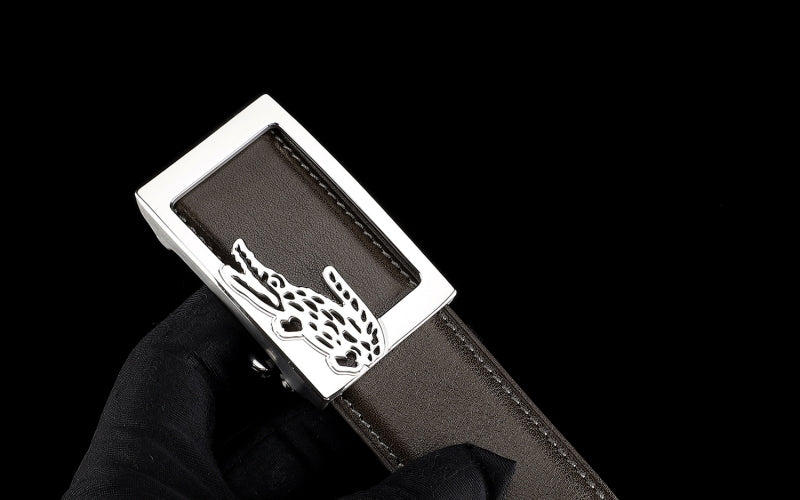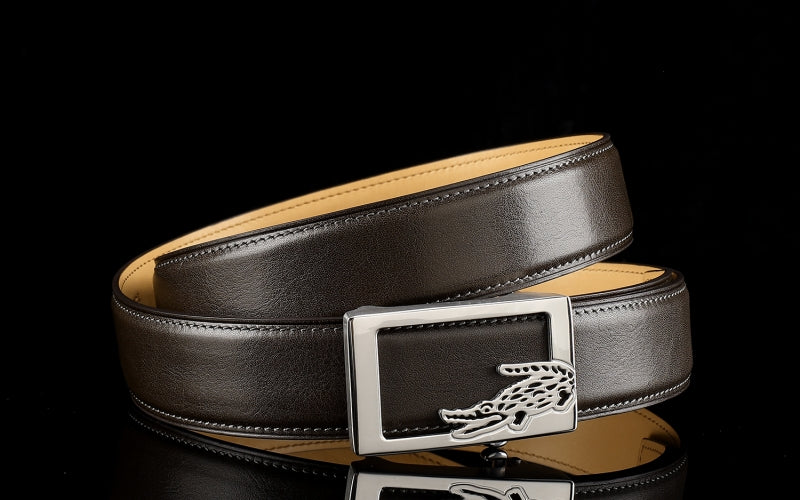
How Ratchet Belts Work vs. Traditional Hole Belts: A Clear Comparison
TL;DR:
- A ratchet belt uses a hidden track sewn into the leather with 30–40 notches, allowing ¼-inch micro-adjustments — roughly 4x the precision of traditional hole belts.
- Traditional belts use a simple metal pin slotting into pre-punched holes, spaced about 1 inch apart. Reliable, simple, zero moving parts.
- Ratchet belts offer a better fit for most wearers; traditional belts win on simplicity, hardware replaceability, and a classic aesthetic.
Most people wear the wrong belt size all day without realizing it. Traditional hole belts force you to choose between two adjustment points — one slightly loose, the next slightly too tight. Ratchet belts solve exactly that problem, but they come with trade-offs. Here's a precise breakdown of how each system works and who should choose what.
Which System Fits You?
Before the mechanics, here's the decision itself:
| Your situation | Go with |
|---|---|
| You want a precise fit all day | Ratchet — ¼-inch adjustments, roughly 4x the precision of holes |
| You value simplicity and replaceable hardware | Traditional — a metal pin and holes; nothing to break, easy to re-buckle |
| Formal occasions are common for you | Traditional prong — the classic aesthetic still wins dressed up |
| This is your first quality belt | Traditional full-grain — learn what good leather feels like before adding mechanisms |
Either way, the strap matters more than the buckle — start with full-grain leather and you can't lose. How each system actually works:
How Does a Ratchet Belt Work?
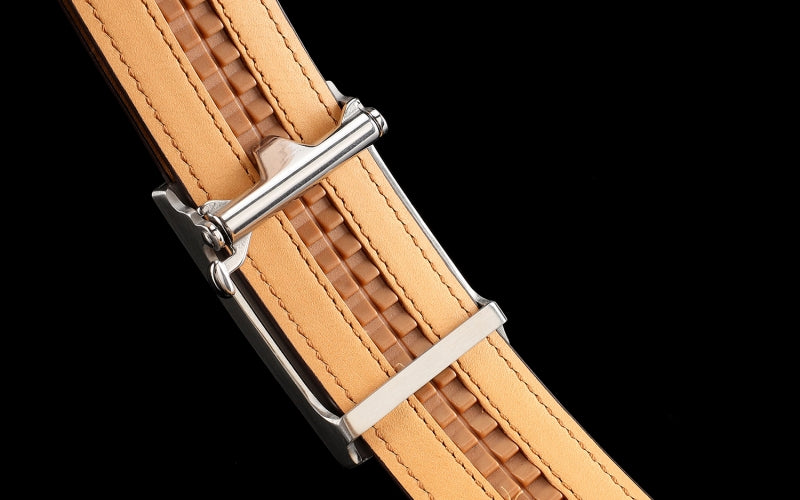
A ratchet belt replaces punched holes with a continuous nylon or polymer track embedded along the back of the leather strap. The track contains 30–40 small teeth, spaced approximately ¼ inch apart. Inside the buckle, a spring-loaded pawl — a small lever with a catch — presses against the track teeth. When you tighten the belt, the pawl clicks along the teeth and locks. To release, you lift or press the buckle lever, which disengages the pawl from the track, allowing the strap to slide freely.

The result: adjustment in ¼-inch increments along the entire length of the belt. No fixed holes, no dedicated adjustment zone. According to Nexbelt's ratchet mechanism breakdown, most ratchet systems provide between 30–40 usable positions across the full belt length — compared to the 5–7 standard positions on a traditional hole belt.
How Does a Traditional Hole Belt Work?
A traditional belt uses a pin buckle — a metal frame with a center bar and a pointed pin. The leather strap has 5 to 7 holes punched at approximately 1-inch intervals, centered around the expected waist size. The pin slots into whichever hole aligns with your waist, and a keeper loop holds the tail of the belt flat.

This is the design that has been standard for centuries. It requires no mechanism knowledge, has no moving parts beyond the rotating buckle pin, and works with any compatible buckle — making hardware swaps straightforward. The simplicity is the point: nothing can break mechanically because there's almost nothing mechanical to break.
Browse our box & prong buckle belts for the premium end of traditional hole-belt construction, or explore the full belt buckle collection for hardware options.
Which Provides a Better Fit: Ratchet or Traditional?
Ratchet belts provide a more precise fit for most wearers. Traditional 1-inch hole spacing means you're always at least ½ inch from your ideal fit — either slightly loose or slightly tight. Over a full day of sitting, eating, and moving, that gap becomes noticeable. Ratchet belts eliminate this by letting you land exactly where your body needs them.
This matters most in three scenarios: after meals (waistline naturally expands 1–2 cm), during long work days where you're sitting for extended periods, and for anyone whose weight fluctuates seasonally. The ¼-inch ratchet increment allows continuous fine-tuning without removing the belt. Research published in PubMed on waist circumference variation by posture and meal timing confirms that measurement site, posture, and meal time all significantly affect waist circumference — meaning average fluctuation throughout the day spans several centimeters — a range that spans 2–3 traditional belt holes.
What Are the Downsides of Ratchet Belts?
Ratchet belts introduce mechanical complexity. The spring-loaded pawl is a moving part that can fatigue over time — particularly in budget ratchet belts with plastic internal components. If the pawl spring weakens, the belt may not hold adjustment positions reliably.

Additionally, the strap on most ratchet belts is designed to be trimmed to length when purchased (cut from the tip end), which means resizing requires scissors or a leather punch. You also cannot easily swap ratchet buckles between leather straps the way you can with traditional buckles, since the track system is specific to the buckle mechanism.
Finally, ratchet mechanisms add bulk to the buckle. The housing must accommodate the internal pawl and track engagement, making ratchet buckles noticeably thicker than flat frame buckles on traditional belts. For dress occasions where a low-profile buckle matters, traditional belts are the cleaner choice.
Are Ratchet Belts More Durable Than Traditional Belts?
On the leather side, ratchet belts outperform traditional belts on longevity because the track eliminates the hole-stretching problem. Traditional belt holes expand over time — especially in chrome-tanned leather — creating a worn-out appearance even when the belt itself is structurally intact. The ratchet track distributes tension across a wider surface area, preventing the localized stress that degrades punched holes.

On the hardware side, the answer depends on buckle quality. A solid brass or stainless steel traditional pin buckle has effectively no failure mode — the pin either stays in the hole or it doesn't. A cheap ratchet mechanism with plastic internals can fail within 12–18 months. A well-engineered metal ratchet mechanism will outlast the leather. As our post on types of belt buckles explains, buckle material and build quality are the dominant factors in hardware longevity regardless of mechanism type. See our broader belt types guide for more on how construction affects wear life.
Who Should Choose a Ratchet Belt?
Ratchet belts are the better choice for:

- Anyone whose weight fluctuates day to day or seasonally
- Office workers who sit for long periods and want comfort throughout the day
- Men who wear their belt through lunch and don't want to adjust between breakfast and dinner
- People who find traditional belt sizing frustrating (always between holes)
- Travelers who want TSA-friendly belts with easy buckle removal (many ratchet systems release cleanly)
Traditional hole belts are the better choice for:
- Formal and dress occasions where low buckle profile matters
- Anyone who wants the ability to swap buckles freely
- Buyers who prefer hardware with zero failure-mode risk
- People who already know their exact belt hole size and never need to adjust
Our ratchet buckle belt collection features full-grain leather straps with precision metal ratchet mechanisms — not the plastic-internal versions common at mass-market price points. If you're unsure of your belt length before trimming a ratchet strap, the size guide walks you through measurements.
The Bottom Line
Ratchet belts work by replacing fixed holes with a continuous notched track, allowing fine adjustments in ¼-inch increments via a spring-loaded internal pawl. Traditional belts use a pin-in-hole system with 1-inch spacing — simple, proven, and mechanically indestructible. For all-day comfort and precision fit, ratchet wins. For dress occasions, buckle versatility, and simplicity, traditional wins. The right choice depends on your primary use case.
Browse BELTLEY's full-grain leather belts in both ratchet and traditional styles — built with genuine leather straps and premium metal hardware in either mechanism.
Frequently Asked Questions
Q: Are ratchet belts better than regular hole belts?
For fit precision and day-long comfort, yes. Ratchet belts adjust in ¼-inch increments versus 1-inch spacing on traditional hole belts, which means you can always hit your exact fit. For dress occasions or buckle versatility, traditional belts are preferred.
Q: How do you size a ratchet belt?
Most ratchet belts are designed to be trimmed to length. Measure your waist where you wear the belt, add 2–4 inches, and cut the tip end of the strap accordingly. Most ratchet belt instructions include a sizing guide, or refer to a belt size chart for your trouser waist measurement.
Q: Can ratchet belt straps be replaced?
On most quality ratchet systems, yes. The buckle and strap are often sold separately or as replaceable components — check with the specific brand. This lets you refresh the leather while keeping a functioning buckle mechanism.
Q: Do ratchet belts last as long as regular belts?
The leather strap typically lasts longer on ratchet belts because the track system doesn't stress the leather the way punched holes do. Hardware longevity depends on build quality — metal internal components outlast plastic ones significantly.
Q: Are ratchet belts good for formal wear?
Ratchet belts can work for business casual and smart casual environments. For strictly formal dress wear, traditional low-profile flat-frame buckles are the conventional choice because the ratchet housing adds bulk to the buckle face.