Is a $100 Leather Belt Worth It? The Cost-Per-Wear Breakdown
TL;DR:
- A $100 full-grain leather belt worn 3x per week for 10 years costs roughly $0.06 per wear. A $25 belt replaced every 18 months costs $0.10+ per wear — and often more in total spend.
- The quality gap between a $25 belt and a $100 belt is not incremental — it's categorical. Different leather grade, different hardware, different expected lifespan.
- At $100, you should get full-grain leather, solid metal hardware, and stitched or burnished edges. If any of those three are missing, the $100 isn't justified.
A $100 belt feels like a significant purchase. A $25 belt feels like the sensible choice. But run the numbers over five years, and the math flips — sometimes by a wide margin. More importantly, the difference between a $25 and $100 leather belt isn't just about how long it lasts. It's about what you're actually wearing. Here's the honest breakdown.
Is $100 Right for You?
The answer depends on how you'll use it, not on the number itself:
| Your situation | The verdict |
|---|---|
| You wear a belt most days | Yes — $100 over 10 years works out to roughly $0.06 per wear, cheaper than replacing $25 belts |
| You need something temporary | A $25 belt is fine — just budget for its 18-month lifespan |
| You're checking if a specific $100 belt is fair | Demand all three: full-grain leather, solid metal hardware, stitched or burnished edges. Missing any one = overpriced |
| You're wondering about $150–$300 belts | Above $100, you're buying exotic hides or hand-finishing — legitimate, but a different question (covered below) |
BELTLEY's full-grain belts start at $58 and pass all three checks. The math in full:
What Do You Actually Get in a $100 Leather Belt?
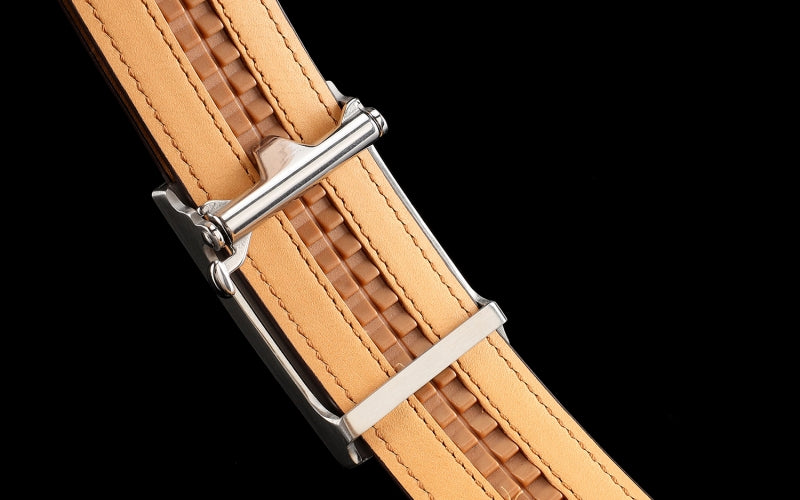
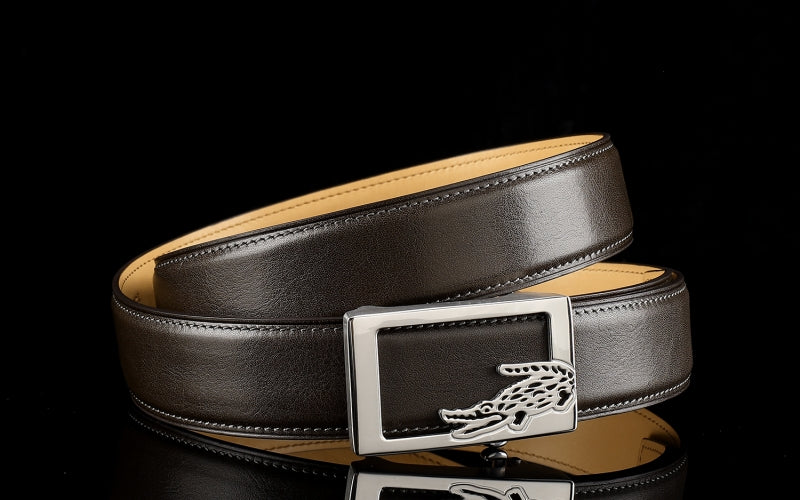
A well-made $100 leather belt should deliver: full-grain leather strap (not genuine or bonded), solid brass or stainless steel hardware, and finished edges — either hand-burnished or edge-painted. These three elements are the baseline for a belt that will last 7–15 years with basic care.

At the $25–$40 price point, you typically get: genuine leather (the lowest real leather grade, made from the inner split of the hide), nickel-plated zinc alloy hardware, and machine-cut raw edges. Genuine leather has roughly one-third the tensile strength of full-grain and begins cracking within 12–24 months of regular wear. The difference in raw material cost between these two grades at manufacturing level is real — and it shows up directly in how the belt ages.
According to the Leather Working Group's leather manufacturer standards, full-grain leather retains its original surface and fiber density, making it the highest-performance grade for products subject to daily stress and flexion — exactly the conditions a belt endures.
The Cost-Per-Wear Math: Does a $100 Belt Actually Save Money?
Run the cost-per-wear calculation and the $100 belt wins decisively in most scenarios.

Scenario A — Budget belt:
- Cost: $25
- Lifespan: 18 months with regular use
- Wears at 3x per week: ~234 wears
- Cost per wear: ~$0.11
- Over 10 years: 6–7 replacements = $150–175 spent
Scenario B — $100 full-grain belt:
- Cost: $100
- Lifespan: 10+ years with basic conditioning
- Wears at 3x per week: ~1,560 wears over 10 years
- Cost per wear: ~$0.06
- Over 10 years: 1 belt = $100 spent
The $100 belt saves $50–75 over a decade while providing a significantly better wearing experience throughout. This calculation doesn't account for the accumulated frustration of replacing belts, the styling inconsistency of wearing different belts with the same wardrobe staples, or the fact that a quality belt only looks better over time. For more on the economics, see our full analysis of whether expensive belts are worth it.
Why Does Leather Grade Matter So Much?
Leather grade determines everything about how a belt performs over time. Full-grain leather — the outermost layer of the hide — retains its original fiber structure, natural grain, and protective oils. It develops a patina with age and flexes without cracking because the fibers remain intact.

Genuine leather, despite the name, is made from the inner layers of the hide after the higher-quality top layer has been removed. The remaining fibers are loosely bound and weaker. To make it look like leather, manufacturers apply heavy topcoats and embossed grain patterns — which crack and peel as the underlying material dries out. Our detailed comparison of full-grain vs genuine leather belts breaks down exactly why this grade difference matters in practice.
At the $100 price point, you should never be buying genuine leather. If the product description says "genuine leather" at $100, you are paying a $100 price for a $25-quality material. Always verify the grade before purchasing.
What Should a $100 Belt Look and Feel Like?
Practical markers of a belt that's genuinely worth $100:

Leather:
- Visible natural grain variation (not uniform embossed pattern)
- Firm, dense feel — not spongy or hollow
- Mild natural leather smell (not chemical)
- Marked as "full-grain" explicitly in the product description
Hardware:
- Buckle feels heavy for its size (solid metal, not hollow alloy)
- Marked as solid brass, stainless steel, or similar specification
- Pin/tongue moves smoothly with no rattle
- No discoloration at the base of the pin indicating cheap plating
Construction:
- Edges are painted or burnished — not raw cuts
- Stitching (if present) is even and uses waxed thread
- Buckle attachment is stitched, riveted, or both — not just glued
If a belt is priced at $100 and fails any of these criteria, the price is not justified. Our full-grain leather belt collection meets all three — with stainless steel buckles, hand-finished edges, and genuine full-grain leather at direct-to-consumer pricing that removes the retail markup.
Is There a Meaningful Difference Above $100?
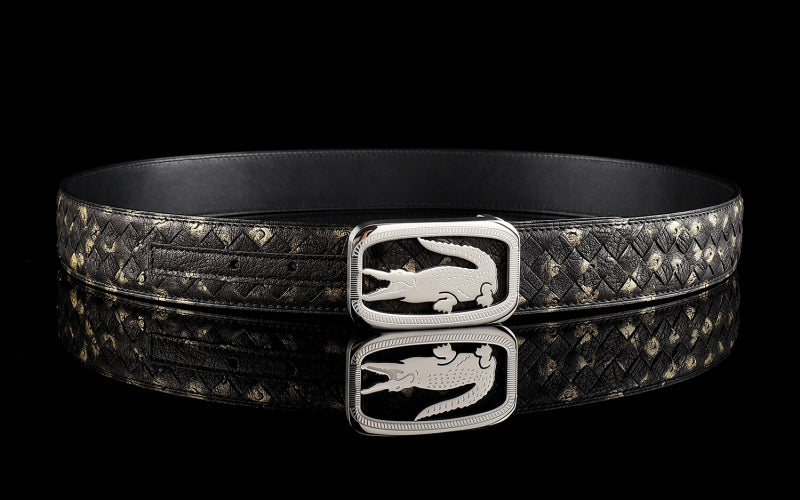
At $150–$250, you enter the territory of exotic leathers (crocodile, alligator, elephant), custom hardware, and small-batch artisan production. The quality step-up is real but narrower than the jump from $25 to $100. Above $300, you're increasingly paying for brand heritage rather than material improvement.

This is why BELTLEY's philosophy centers on DTC pricing: the same artisan construction and premium leather that would retail for $200+ at a heritage brand is available at $58–$299 when you remove the Brand Tax — the middleman markup, retail overhead, and logo premium that luxury brands charge but don't deliver in leather quality. As our post on why leather belts are expensive explains, much of what you pay at established brands goes to distribution infrastructure rather than the belt.
The sweet spot for most buyers — excellent materials, long lifespan, no logo premium — is $80–$150 at a quality DTC brand. Are full-grain leather belts worth that range? Our dedicated analysis says yes, definitively. Independent leather grade guides such as Popov Leather's Ultimate Guide to Leather Grades consistently show the full-grain tier delivers superior long-term value in leather accessories compared to lower grades.
The Bottom Line
A $100 full-grain leather belt is worth it — not just financially (the cost-per-wear math favors it clearly), but in daily experience. A proper leather belt holds its shape, ages better, holds buckle holes longer, and looks more refined after five years than it did on day one. What you're buying at $100 isn't just a belt. You're buying one that doesn't need replacing. Check that it's full-grain, solid hardware, and finished edges, and it will earn its price many times over.
BELTLEY's full-grain leather belts are built to exactly this standard, and all come with a 10-year warranty covering materials and construction — because a belt that's genuinely worth $100 should be backed by the brand that made it.
Frequently Asked Questions
Q: How long should a $100 leather belt last?
A properly made $100 full-grain leather belt should last 7–15 years with occasional conditioning. Cheaper "genuine leather" belts at the same price point may only last 2–3 years. The leather grade — not the price — determines lifespan, so verify you're getting full-grain before buying.
Q: Is it worth spending more than $50 on a belt?
Yes, for regular-wear belts. Below $50, you're almost certainly getting genuine or bonded leather with plated hardware. The quality drop-off is significant in how the belt ages over 2–3 years. For occasional-use belts, $50 may be acceptable; for everyday belts, $80–$150 in full-grain is the smarter investment.
Q: What leather belt brand offers the best value around $100?
Look for DTC brands that specify full-grain leather, solid metal hardware (brass or stainless steel), and offer a warranty. Avoid brands that use "genuine leather" language without specifying grade. The DTC model removes retail markup — the same quality that costs $200+ at department store brands is available for $80–$150 from quality direct sellers.
Q: Does a leather belt get better with age?
Full-grain leather develops a patina — a natural deepening of color and sheen — over time. This makes the belt look richer with age rather than worn out. Bonded and genuine leather belts do the opposite: they crack and peel. The aging behavior is determined by leather grade, not price or brand.
Q: How can I tell if a $100 belt is genuinely good quality?
Look for: "full-grain" stated explicitly, visible natural grain variation (not uniform embossed), heavy solid buckle, burnished or painted edges, and even stitching with waxed thread. If the listing says "genuine leather" or uses vague terms like "premium leather," it's likely not worth $100 in material quality.