How to Tell If a Leather Belt Is Handmade or Mass-Produced: 7 Clear Signs
TL;DR:
- The clearest physical signs of a handmade belt: hand-burnished edges with slight irregularity, saddle stitching with waxed thread, and full-grain leather with natural grain variation.
- Mass-produced belts show machine-uniform stitching, raw or spray-lacquered edges, and embossed grain patterns on genuine or bonded leather.
- You can verify most of these in 60 seconds with your hands and eyes — no expert knowledge required.
"Handmade," "handcrafted," and "artisan" are some of the most overused terms in leather goods marketing. Brands apply them loosely to products that involve a human hand at exactly one step of an otherwise automated production line. Knowing how to physically verify craftsmanship — rather than trusting a label — is the most reliable way to assess whether a belt's quality matches its price. Here are seven concrete things to look for.
Got a Belt in Hand? Run This Check
The 60-second version, by where you are:
| Your situation | Go with |
|---|---|
| In a store, belt in hand | Check the edge first — hand-burnished edges have slight warmth and irregularity; sprayed lacquer looks like plastic dip. |
| Shopping online | Zoom on stitching photos: waxed saddle stitching at a slight angle = hand; laser-perfect rows = machine. |
| Belt claims "handcrafted" at $25 | It isn't. Hand labor alone costs more than that — the word is decoration. |
| Verifying a belt you own | Look behind the buckle: stitched (not just glued) attachment and solid hardware are the tells that survive years. |
Small-batch, artisan-made is BELTLEY's whole model — see the construction up close in the exotic collection.
1. Edge Finishing: The Fastest Quality Test
The cut edges of a leather belt strap tell you more about its production than almost anything else. On a handmade belt, edges are hand-burnished — rubbed with a wooden slicker or bone tool, often with beeswax or gum tragacanth, until the fibers compact into a smooth, rounded seal.

The process takes time and leaves subtle variations in sheen along the edge. Alternatively, premium belts use hand-applied edge paint for a crisp, colored finish.
Mass-produced belts have edges cut by automated presses. The most common finish is a spray-applied lacquer coat that covers but doesn't seal the fibers. It looks uniform and shiny when new, but peels and frays within 12–18 months. The cheapest mass-produced belts have raw, untreated edges that fuzz immediately.
Run your thumb firmly along the strap edge: a burnished edge feels smooth and slightly resistant; a lacquered edge feels plasticky and thin; a raw edge catches your thumbnail.
2. Stitching: Uniform Is a Red Flag
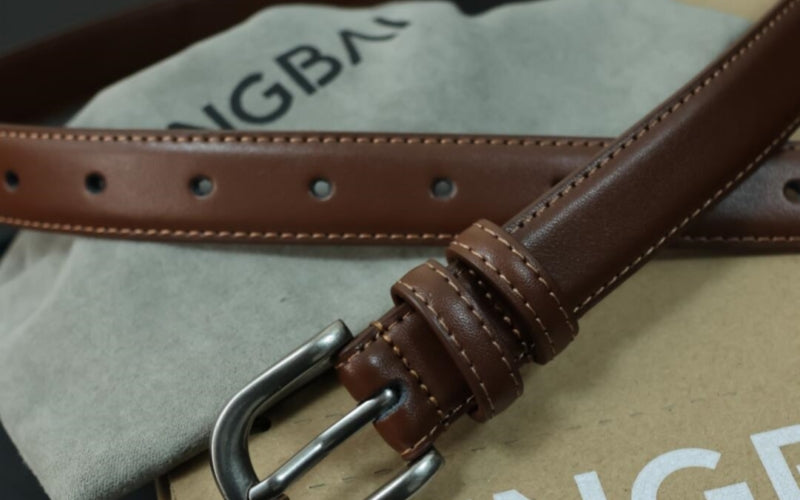
Counter-intuitively, perfectly uniform stitching is the sign of machine production — not quality. Saddle stitching, the technique used by trained leather artisans, involves two needles and a waxed linen thread worked through pre-punched holes from both sides simultaneously. The result is slightly uneven spacing at corners and directional changes — not because of poor skill, but because human hands navigate curves differently than a programmed arm.

Look at the stitching under good light:
- Handmade: Slight spacing variation at curves, thicker waxed thread visible in the holes, thread ends hand-knotted and tucked
- Machine-made: Perfectly even 1mm spacing throughout, thinner synthetic thread, thread ends often cut flush or heat-sealed
As documented by The Irish Saddler on hand-stitching vs. machine stitching in leather, saddle stitching is also functionally superior — if a thread breaks, the remaining thread holds the seam. Machine stitching can unravel from a single break point. For handmade belts that use these techniques, see BELTLEY's handmade belt collection.
3. Leather Grade: Feel the Surface
Handmade belts almost universally use full-grain leather. Mass-produced belts typically use genuine leather, top-grain leather with corrected surface, or bonded leather (leather fiber reconstituted with polyurethane binder). The easiest way to distinguish:
Full-grain: Natural grain variation — no two areas are identical. Surface feels subtly textured, slightly waxy from natural oils. Bends smoothly without surface cracking. Smells like genuine leather, not chemicals.
Genuine/corrected: Uniform, embossed grain pattern that repeats. Surface feels more plastic under pressure. May smell faintly chemical. The "natural" pattern is actually a machine-pressed mold.
Bonded: Often thin, with a plasticky surface sheen. Flexes stiffly and cracks at stress points quickly. Has no smell resembling genuine leather.
Our guide to how to tell if a belt is full-grain leather goes deeper on these tests, and our comparison of full-grain vs genuine leather explains the structural differences in detail.
4. Buckle Attachment: Stitched, Not Just Glued
The buckle loop — the folded leather that holds the buckle frame — reveals a lot about production quality. On handmade belts, the loop is stitched through with waxed thread, often double or triple rows. Some premium belts also add copper or brass rivets as a secondary fastening. The stitching is visible and intentional.

On mass-produced belts, the buckle loop is frequently glued with contact cement and may have a single machine-stitched row added for appearance rather than structural function. Flex the loop back and forth firmly: a glued-only attachment will feel slightly hollow and may begin to delaminate at the edge. A stitched loop resists the flex without movement or cracking sound.
5. Hardware Weight and Material
Handmade belt makers source solid metal hardware — solid brass, solid copper, or stainless steel — because the hardware is part of the value proposition. Mass-market production uses hollow zinc alloy buckles, often nickel-plated to mimic the look of solid metal at a fraction of the cost.
Pick up the belt and heft the buckle in your palm. Solid metal feels noticeably heavier than hollow alloy for the same apparent size. Press a fingernail against the buckle surface: solid metal has no give; plated hollow alloy may have faint flex. If the buckle pin has any wobble in its pivot, it's hollow alloy — solid castings don't wobble. High-quality hardware is not just aesthetic; it determines whether the belt buckle outlasts the leather. For reference, BELTLEY uses stainless steel and solid brass exclusively — the same materials referenced in our post on what type of leather is best for belts.
6. Fiber Cut Direction
This is a detail most buyers never check, but craftsmen know it immediately. Leather cut along the backbone of the hide — the "bend" — has tighter, more consistent fiber alignment and is the strongest, most dimensionally stable part of the hide. Handmade belts are specifically cut from this zone.

Mass-produced belts are often cut from the shoulder or belly regions of the hide to maximize material yield from each skin, regardless of fiber direction. Belly leather is loose and stretchy; shoulder leather is firmer but less consistent. A belt cut from belly leather will stretch and deform at the holes significantly faster than one cut from the bend.
You can't easily see this, but you can feel it: press the belt flat and push the strap sideways. Bend-cut leather resists lateral stretch and springs back immediately. Belly-cut leather has noticeable give and doesn't fully recover.
7. Product Documentation and Brand Transparency
Finally, the way a brand talks about its product tells you something about its production. Handmade belt makers specify: leather grade (full-grain), tanning method (vegetable or chrome), hide origin, hardware material (solid brass, stainless steel), and construction method (saddle stitch, hand-burnished edges). This specificity is only possible when the maker knows exactly how each belt was produced.
Mass-market brands use language like "premium leather," "genuine leather," "high-quality hardware," and "handcrafted touch" — vague terms that signal nothing about actual production method or material grade. The absence of specific material claims is itself a red flag. Our full-grain leather belt collection lists exact specifications for every product. For care recommendations that extend the life of any quality leather belt, see our leather care guide.
The Bottom Line
A genuinely handmade leather belt leaves physical evidence of its production: burnished or painted edges with slight variation, saddle stitching in waxed thread, full-grain leather with natural surface variation, heavy solid-metal hardware, and stitched buckle attachment. These aren't marketing claims — they're checkable in 60 seconds. If a belt fails two or more of these tests, "handmade" or "artisan" on the label is a marketing position, not a production description.

BELTLEY's handmade belt collection meets every one of these criteria — small-batch production by craftsmen who specialize in full-grain and exotic leather, with transparent material specifications on every product listing.
Frequently Asked Questions
Q: Is hand-stitched leather better than machine-stitched?
Yes, structurally. Saddle stitching — the traditional hand technique — uses two threads simultaneously, so a single thread break doesn't unravel the seam. Machine stitching uses a single interlocked thread that can unravel from one failure point. Hand-stitched seams also use thicker, waxed thread that resists moisture and abrasion better.
Q: What is the difference between handmade and handcrafted leather belts?
In practice, "handmade" and "handcrafted" are used interchangeably in marketing. The meaningful distinction is production method — whether key steps like cutting, stitching, and edge finishing were done by hand or by machine. Always verify claims with physical inspection rather than label language.
Q: Can I tell if a leather belt is full-grain without buying it?
Online: look for explicit "full-grain" designation in the product description (not just "premium" or "genuine"), natural grain variation in product photos, and stated leather tanning method. In person: check for natural grain variation, smooth burnished edges, and dense firm feel rather than spongy or plasticky.
Q: How long do handmade leather belts last?
A properly made handmade full-grain leather belt lasts 10–25 years with basic conditioning once or twice a year. The combination of high-quality leather, solid hardware, and hand-stitched construction means no single failure point dominates. Buckle loops are the first wear point — choose a belt where the loop is stitched, not just glued.
Q: Does a higher price always mean handmade?
No. Many premium-priced belts from luxury fashion brands use machine production and genuine or top-grain leather. You are often paying for the brand's marketing and distribution costs. Price is not a reliable proxy for craftsmanship — physical inspection is.