Fish & Salmon Leather Belt — The Sustainable Exotic
Quick answer: A salmon (or fish) leather belt is an exotic belt made from fish skin — usually a byproduct of the seafood industry — that's surprisingly strong thanks to its criss-crossed fiber structure, lightweight, and patterned with a distinctive scale-print texture. It's one of the most sustainable exotic leathers, turning waste skin into a durable material, and it makes a unique, eco-conscious statement belt.
Last updated: June 2026 • By BELTLEY Editorial
TL;DR:
- Fish/salmon leather is strong for its weight due to criss-crossed fibers.
- It's a seafood-industry byproduct — one of the most sustainable exotics.
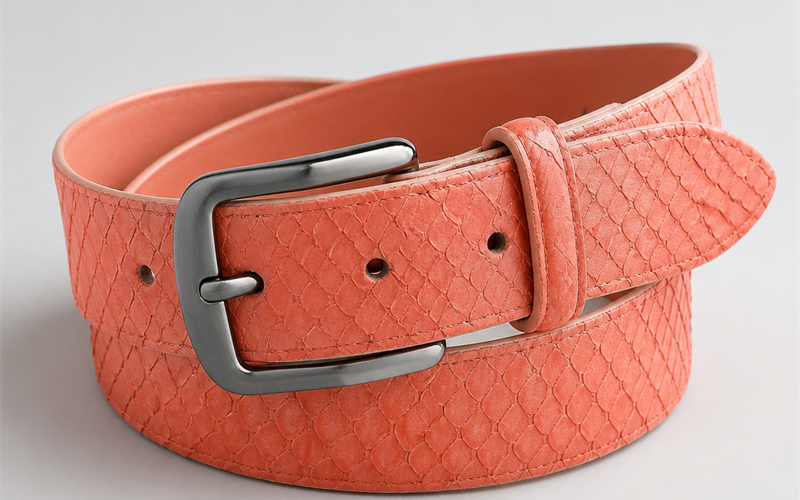
- The surface shows a distinctive scale-print pattern, unlike any land leather.
- It's thin and flexible — best for slim, lightweight statement belts.
Fish leather is one of the most quietly impressive materials in the exotic world: it takes a waste product — fish skin destined for the bin — and turns it into a strong, beautiful leather with a pattern found nowhere else. Salmon is the most common, but cod, perch, and tilapia are also used. This guide explains why fish leather is stronger than it looks, why it's so sustainable, and how to wear a salmon belt. For the broader picture, start with the most iconic leather types for belts.

What is fish or salmon leather?
Fish leather is tanned fish skin — most often salmon — that becomes a thin, strong, flexible leather with a natural scale-print pattern. It's typically made from skins left over after fish are processed for food, so it transforms a waste byproduct into a usable, durable material. The result is a lightweight exotic unlike any land-animal hide.

The material is genuine, tanned leather, just from an unexpected source. Once the scales are removed and the skin is tanned, what remains is a supple leather marked by the geometric imprint where the scales sat — a distinctive cross-hatched or diamond pattern. Salmon is favored for its size and consistency, but many species work. Because each skin is relatively small, fish leather belts are often built from joined panels or used as inlays and accents, much like other small-skin exotics. It's a material with real heritage in Nordic and Indigenous coastal cultures, now enjoying a modern revival driven by sustainability.
Is fish leather actually durable?
Yes — fish leather is surprisingly strong for its thinness, thanks to a criss-crossed fiber structure that resists tearing. While it's thin and lightweight rather than thick and rugged, that interwoven fiber pattern gives it tensile strength that punches above its weight, making it more durable than its delicate appearance suggests.

Key stat: Fish leather's fibers run in a criss-crossed pattern rather than parallel, which is why — for a given thickness — it can be much stronger than ordinary leather, resisting tearing in multiple directions at once.
The strength is structural. The reference on fish leather notes that "for a given thickness, fish leather is typically much stronger due to its criss-crossed fibers" — those interwoven fibers resist tearing from any direction, unlike the more parallel structure of many hides. Sustainability outlet Sustainable Jungle puts numbers to it, reporting salmon skin can reach "up to 90 newtons" of tensile strength against just "8 to 25 newtons" for cowhide. That said, fish leather is thin, so its best use is slim, lightweight belts and accents rather than thick heavy-duty straps. As with every exotic, the finished belt is only as strong as its construction; a fish-leather belt needs a solid backing and sealed edges so the thin, beautiful surface is properly supported. For how durability works across leathers, see the truth about leather belt durability.
Why is salmon leather considered sustainable?
Because it's made from skins that are byproducts of the seafood industry — material that would otherwise be discarded as waste. Turning that waste into durable leather means no animal is raised or killed for the hide itself, giving fish leather a strong sustainability story compared with leathers from animals farmed specifically for their skins.

This is fish leather's headline appeal. Here's how it stacks up on sustainability:
| Factor | Fish/salmon leather |
|---|---|
| Source | Seafood-industry byproduct |
| Extra animals raised for hide | None |
| Waste reduction | High (uses discarded skins) |
| Weight/material efficiency | High (thin, light) |
| Statement value | Unique, eco-conscious |
For buyers drawn to genuine leather but conscious of waste and sourcing, fish leather offers a compelling middle path — real, durable, and made from what would otherwise be trash. It's a different sustainability argument from vegan synthetics (which are often plastic-based), grounded in using a natural byproduct fully. If sustainability matters to you, fish leather is one of the most defensible exotic choices, and it fits the considered, quality-over-hype mindset behind our exotic leather belts collection.
How do you style and care for a salmon leather belt?
Wear it as a slim statement piece — its scale-print pattern and sheen make it a conversation starter, best paired with smart-casual or fashion-forward outfits where the texture can be seen. Care is gentle: keep it dry, wipe with a soft cloth, condition lightly and rarely, and store it flat or loosely rolled away from heat and sun.

Styling fish leather is about letting the unique pattern shine. Because it's thin and patterned, it suits slimmer widths and outfits where a textured belt adds interest rather than bulk. Match it to your shoes where you can, and keep the buckle simple so the leather leads. Care mirrors other delicate exotics: minimal moisture, sparing conditioning, and careful storage — the same gentle approach in our leather care guide and how to keep a leather belt in good condition. Don't soak it, and blot any moisture promptly. Treated with a little care, a salmon belt keeps its striking pattern and sheen for years, a genuinely distinctive piece in a sea of ordinary leather.
The Bottom Line
A fish or salmon leather belt is the sustainable exotic worth knowing: made from seafood-industry skins that would otherwise be waste, surprisingly strong thanks to its criss-crossed fibers, and patterned with a scale-print texture you won't find on any land leather. It's thin and lightweight, so it shines as a slim statement belt rather than a rugged workhorse, and its eco-conscious story is one of the most defensible in the exotic world. At BELTLEY, we value materials chosen with intention and built to last, priced fairly without a Brand Tax. For unique, well-made exotics, explore our exotic leather belts collection.
Frequently Asked Questions
Q: Is salmon leather durable enough for a belt?
Yes. Despite being thin, salmon leather is strong thanks to its criss-crossed fiber structure, which resists tearing from multiple directions. It's best suited to slim, lightweight belts rather than thick heavy-duty ones, and a quality belt with a solid backing and sealed edges supports the surface well.
Q: What does fish leather look like?
Fish leather has a distinctive scale-print pattern — a geometric, cross-hatched or diamond texture left where the scales sat before tanning. Salmon leather in particular has an attractive sheen. It looks nothing like land-animal hides, which is a big part of its appeal as a statement material.
Q: Why is fish leather sustainable?
Because it's made from fish skins that are byproducts of the seafood industry — material that would otherwise be discarded. No animal is raised or killed for the hide itself, so it adds value to existing waste, making it one of the more environmentally defensible exotic leathers.
Q: How do you care for a salmon leather belt?
Keep it dry, wipe it with a soft cloth, condition lightly and infrequently, and store it flat or loosely rolled away from heat and direct sun. Like other thin exotics, it's somewhat delicate, so blot moisture promptly and avoid soaking. Gentle, minimal care preserves its pattern and sheen.
%20leather%20belt%20is%20an%20exotic%20belt%20made%20from%20fish%20skin%20%E2%80%94%20usually%20a%20byproduct%20of%20the%20seafood%20industry%20%E2%80%94%20that's%20surprisingly%20strong%20thanks%20to%20its%20criss-crossed%20fiber%20str...)