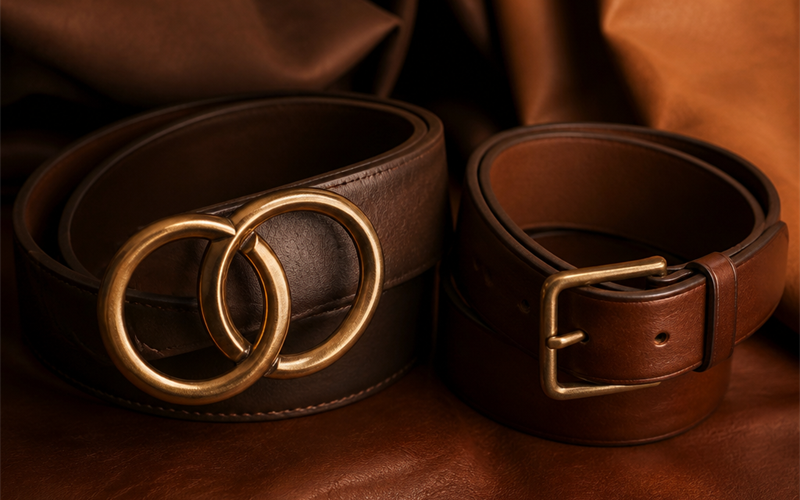
Designer Belt vs Quality Leather Belt: Which to Buy?
Quick answer: A designer belt and a quality (non-designer) full-grain leather belt often use similar leather — the big price gap is mostly brand markup, not better materials. Designer houses commonly mark up 8–12× their cost; honest DTC makers mark up 2–3×. So a $400 designer belt and a $120 quality belt can deliver nearly the same look and longevity. Buy designer only if you specifically want the logo; for material, durability, and value, a quality leather belt wins.
Last updated: June 2026 • By BELTLEY
TL;DR:
- Materials are often similar — the price gap is largely brand markup, not leather grade.
- Markup math: designer houses ~8–12×; honest DTC brands ~2–3× their cost.
- Brand Tax: up to ~70% of a designer belt's price is marketing, retail, and logo — not craft.
- Value sweet spot: ~$80–$150 buys full-grain leather + a solid buckle; quality plateaus above ~$150–$250.
- Cost-per-wear: a $120 full-grain belt worn 10 years costs pennies a day.
- Verdict: designer for the logo; quality leather for material, durability, and value.
It's the question behind every belt purchase over $100: is the designer one actually better, or are you just paying for the name? The honest answer is mostly the name. Once you understand the markup math and what truly justifies a belt's price, the choice gets clear — and it usually isn't the logo. This guide breaks down designer versus quality leather on cost, materials, longevity, and status, so you can put your money where it counts. For the price reality, see is it worth buying an expensive belt.
Designer or Quality Leather: Which Fits You?
Match your priority to the better buy.

| Your priority | Better buy |
|---|---|
| A specific recognizable logo | Designer belt |
| Best leather and hardware per dollar | Quality leather belt |
| Lowest cost-per-wear over years | Quality leather belt |
| Status that reads to everyone | Designer belt |
| Timeless, no-Brand-Tax value | Quality leather belt |
| Resale potential (top-tier only) | Designer (Hermès tier) |
For most wearers, quality leather wins. For the brand-versus-substance debate, see designer belt brands vs luxury brands.
Do designer belts use better materials than quality leather belts?
Not usually. Many designer belts use the same grade of leather — sometimes corrected-grain or coated canvas — as far cheaper belts, and a quality full-grain belt often matches or beats them on material. The price difference is mostly brand markup, not superior leather or construction.

This surprises people, but the data is consistent. Pricing analyses find that designer belts at $400–$600 "often use the same corrected-grain leather as $50 department store belts," and that "a $400 designer belt uses essentially the same materials as a $120 DTC belt — the extra cost is brand markup." A quality maker focused on materials may actually use better leather (full-grain) than a logo belt built on coated canvas. So "designer" doesn't reliably mean "better made"; it means "better known." To judge leather yourself, see how to tell if a belt is full-grain leather.
What is the markup on a designer belt?
Designer belts typically carry an 8–12× markup over manufacturing cost, while honest direct-to-consumer brands mark up about 2–3×. So a belt that costs $40 to make sells for around $400 from a designer house but $80–$120 from a DTC maker. Up to 70% of a designer belt's price is "Brand Tax."
The markup structure is the whole story. As one cost breakdown puts it, luxury houses "employ 8–10× multipliers on manufacturing costs," while "honest direct-to-consumer brands typically use 2–3× markups." The direct-to-consumer model achieves this by "bypassing any third-party retailers, wholesalers, or intermediaries," which "enables smaller companies to compete... in terms of price, availability, and quality, since costs are lower." The result: a designer belt's price reflects marketing, retail overhead, and the logo far more than leather. For the numbers on a specific brand, see how much does it cost to make a Gucci belt.
How does cost-per-wear compare?
On cost-per-wear, a quality full-grain belt usually wins because it lasts for years. A $120 full-grain belt worn daily for a decade costs roughly $0.03–$0.04 per wear, while a $20 bonded belt replaced twice a year costs about $0.11 per wear — several times more. A durable belt is cheaper over time, even at a higher sticker price.

Cost-per-wear reframes the whole decision. A higher upfront price is justified when the belt lasts: a quality full-grain belt that survives 10 years amortizes to pennies a day, as one analysis shows — "a $120 belt lasting 10 years costs roughly $0.04 daily, compared to $0.11 for cheaper alternatives failing in 6 months." The catch for designer belts: paying 8–12× markup doesn't buy proportionally more wears. You can get the same decade-long lifespan from a quality belt at a fraction of the cost-per-wear, because durability comes from materials, not the logo. For when a higher price pays off, see do expensive belts last longer than leather belts.
What actually justifies a higher belt price?
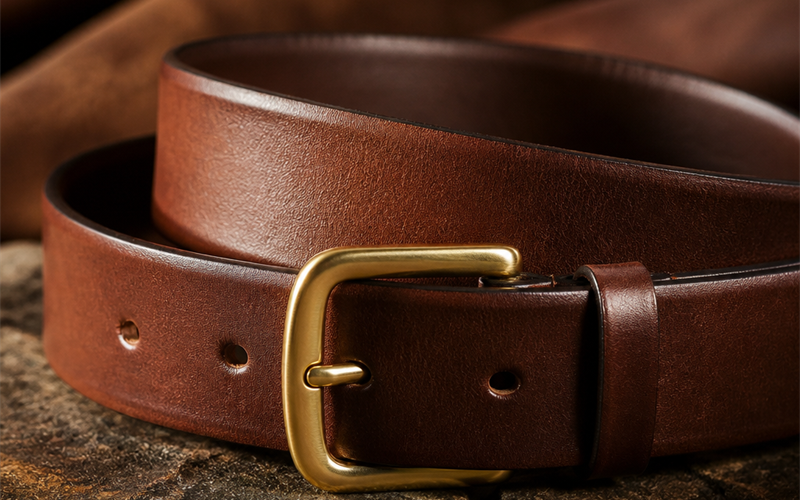
Three things justify a higher belt price: full-grain leather, a solid brass or stainless steel buckle, and hand-finished (sealed or burnished) edges. With all three, you're paying for real quality; without them, you're paying for marketing. Quality climbs steeply up to about $150, then plateaus — above $250 you're buying mostly brand prestige.

This is the test that cuts through branding. The specs that make a belt last — full-grain leather, solid metal hardware, and sealed edges — are what your money should buy, and they top out at a surprisingly modest price. Quality "rises steeply between $30 and $150, plateaus between $150 and $250, and flatlines above $250," so "every dollar above that threshold buys brand prestige, not better leather." Raw full-grain runs about $6–$8 per square foot and a solid brass buckle a few dollars, so a maker can hit all three specs in the $80–$150 range. A designer belt may meet the specs too — but you pay multiples more for the logo on top. For the full picture, see how much should a leather belt cost.
Key stat: Up to 70% of a designer belt's price is "Brand Tax" — marketing, retail overhead, and the logo — not materials or craftsmanship. A quality full-grain belt with a solid buckle hits the same durability specs in the $80–$150 range, where belt quality actually plateaus.
When is a designer belt actually worth it?
A designer belt is worth it in two cases: when you specifically want a recognizable logo for personal or social reasons, or when you're buying top-tier resale (classic or exotic Hermès) that holds value. Outside those, a quality leather belt delivers the same materials and longevity without the Brand Tax.

It's not that designer belts are never worth it — it's that the reasons are specific. If a particular logo genuinely brings you joy or signals something you want it to, that's a legitimate personal call, and worth paying for with eyes open. And at the very top, classic or exotic Hermès can hold or gain value, which most belts never do. But for everyday wear, professional polish, and durability, you're paying a steep premium for a name when the underlying quality is available for far less. Know which reason you're buying for. For the logo question, see what designer belt should I buy.
The Bottom Line
Designer belt vs quality leather belt comes down to what you're paying for. The materials are often similar, but designer houses mark up 8–12× while honest DTC makers mark up 2–3× — so up to 70% of a designer belt's price is Brand Tax, not better leather. A quality full-grain belt with a solid buckle and sealed edges hits the same durability specs for $80–$150, where quality plateaus, and wins decisively on cost-per-wear. Buy designer only if you specifically want the logo or top-tier resale; for everything else, quality leather is the smarter money. That's BELTLEY's whole reason for being: handcrafted full-grain leather and solid hardware at fair DTC pricing, no Brand Tax. Compare for yourself with a full-grain leather belt or a refined designer-style belt — same substance, none of the markup.
Frequently Asked Questions
Q: Are designer belts better quality than regular leather belts?
Not necessarily. Many designer belts use the same grade of leather — sometimes corrected-grain or coated canvas — as far cheaper belts, while a quality full-grain belt can match or beat them. The price gap is mostly brand markup, not superior materials or construction, so "designer" doesn't reliably mean "better made."
Q: How much of a designer belt's price is the brand?
Up to about 70%. Designer houses typically mark up 8–12× their manufacturing cost, versus 2–3× for honest direct-to-consumer brands. That means most of a designer belt's price covers marketing, retail overhead, corporate profit, and the logo — not better leather or craftsmanship.
Q: What should a quality leather belt cost?
A genuine buy-it-for-life full-grain belt with a solid buckle and sealed edges reasonably costs about $80–$150. Quality rises steeply up to roughly $150, then plateaus, so above about $250 for non-exotic leather you're mostly paying brand premium rather than better materials.
Q: Is a designer belt ever worth it?
Yes, in two cases: if you specifically want a recognizable logo and value that for personal reasons, or if you're buying top-tier resale like classic or exotic Hermès that can hold value. For everyday wear and durability, a quality leather belt gives the same materials and longevity for far less.
Q: Which lasts longer, a designer or quality leather belt?
Longevity comes from materials, not the logo. A full-grain leather belt — designer or not — can last 10–15 years, while bonded or coated belts fail far sooner. A quality full-grain belt at $80–$150 can match a designer belt's lifespan, making it the better value on cost-per-wear.
%20full-grain%20leather%20belt%20often%20use%20similar%20leather%20%E2%80%94%20the%20big%20price%20gap%20is%20mostly%20brand%20markup,%20not%20better%20materials.%20Designer%20houses%20commo...)