Desert Heat & Leather — Why Arizona Owners Lose Belts to Dry Rot
Quick answer: Desert heat causes dry rot by stripping natural moisture from leather faster than it can be replaced. Prevent it with full-grain vegetable-tanned leather, a stainless or brass buckle, conditioning every 4-6 weeks, and never leaving belts in a hot car.
Last updated: May 2026 • By BELTLEY Editorial
TL;DR:
- Desert heat doesn't burn leather. It dries it until the fibers crumble. That's dry rot.
- Three desert killers: extreme low humidity, intense UV, and 30°F swings between hot days and cool nights.
- Full-grain veg-tanned cowhide handles desert climates best. Bonded leather lasts a year, maybe less.
- Apply the BELTLEY 3-Material Rule: full-grain leather + stainless or solid brass + sealed edges. Condition every 4-6 weeks. Never leave belts in cars.
Phoenix records 95+ days a year over 100°F (38°C). Las Vegas humidity drops below 10% in June. Albuquerque sees 30°F temperature swings between noon and 2 a.m.
Each condition alone is hard on leather. Together they're the harshest climate any belt faces. Owners in the American Southwest lose more belts to dry rot than to any other cause — and most never know what hit them.
Here's why it happens and exactly how to stop it.
What is dry rot in leather belts?
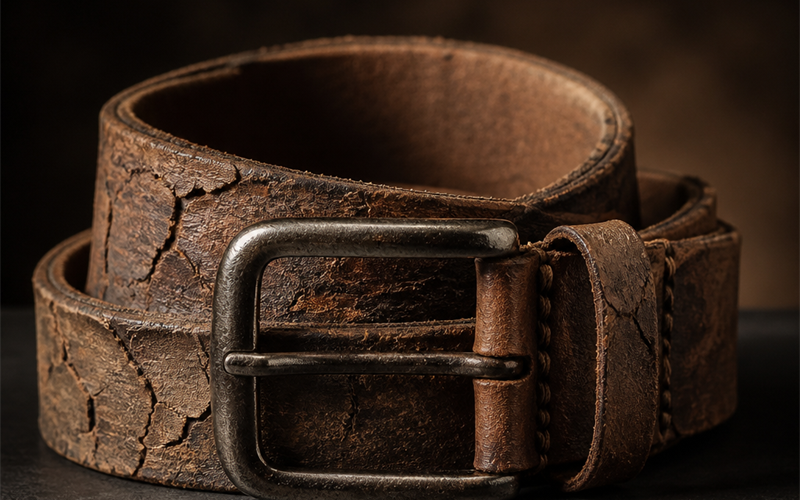
Dry rot is the gradual loss of natural moisture and oils from leather fibers, eventually causing the leather to become brittle, powdery, and structurally weak. Affected belts crack along stress points, lose flexibility, and develop a fine surface dust. Dry rot is essentially leather aging at fast-forward speed.

It's not the same as ordinary wear. A worn belt has scratches and patina. A dry-rotted belt crumbles. The fibers themselves have failed.
Background on what's happening structurally is in our truth about leather belt durability.
Key stat: A parked car in Phoenix can hit 150°F+ (66°C) interior temperature within an hour — the AVMA's pet-safety research documents a typical 20°F rise in just 10 minutes on a sunny day. Leather inside cooks at that rate.
Why does desert heat cause dry rot?
Three combined effects. First, air so dry (often under 10% RH) pulls moisture out of leather faster than oils can compensate. Second, intense UV exposure breaks down leather proteins at the surface. Third, daily temperature swings expand and contract fibers, accelerating fatigue cracks.
The U.S. NWS Phoenix office tracks the conditions through summer monsoon season — see the NWS Phoenix weather and climate hub. Single-digit humidity is normal in May, June, and September.
How does UV damage leather differently than just heat?
UV damages leather by breaking the chemical bonds in collagen at the molecular level, regardless of temperature. Heat accelerates this damage, but UV alone — even at moderate temperatures — causes color fading, surface chalking, and gradual fiber weakening. This is why a belt left on a dashboard fails even in winter desert sun.
The EPA's UV Index page shows desert UV exposure regularly hits 11+ in summer — the highest category. Leather wasn't designed for that dose.
For UV-relevant fading on pale colors, see our vachetta belt darkening guide. What's a feature on a vachetta belt is a problem when it goes too far.
Desert damage — leather grade comparison
| Leather grade | Dry rot resistance | UV fade resistance | Typical Phoenix lifespan |
|---|---|---|---|
| Crocodile / alligator | Outstanding | Good | 25-30+ years |
| Full-grain veg-tanned cowhide | Excellent | Fair | 15-25 years |
| Full-grain chrome-tanned | Very good | Fair | 10-15 years |
| Top-grain leather | Fair | Poor | 4-8 years |
| Bonded leather | Poor | Very poor | <2 years |
Why do desert belts fail at the buckle bend first?
Desert belts fail at the buckle bend first because that's the tightest flex zone and dry fibers there fatigue fastest. Each daily wear bends the dried leather just past its remaining elasticity. After a few months of unconditioned wear in desert conditions, hairline cracks appear behind the buckle, then propagate outward.

If your belt has any cracks behind the buckle, treat it like an emergency. Heavy conditioning can stabilize the leather, but cracks are permanent. Check the 4 quality markers guide for inspection points.
Is full-grain leather better in desert climates?
Yes. Full-grain leather holds natural oils longer than top-grain or bonded alternatives because its fiber structure is intact. Vegetable-tanned full-grain in particular has more residual oil content than chrome-tanned splits, giving it a bigger reserve before dry rot sets in.
For the grade hierarchy, see full-grain vs top-grain leather. For desert buyers, this isn't optional — it's the entry-level spec. Our full-grain leather collection is the starting point.
What about crocodile and exotic leathers in the desert?
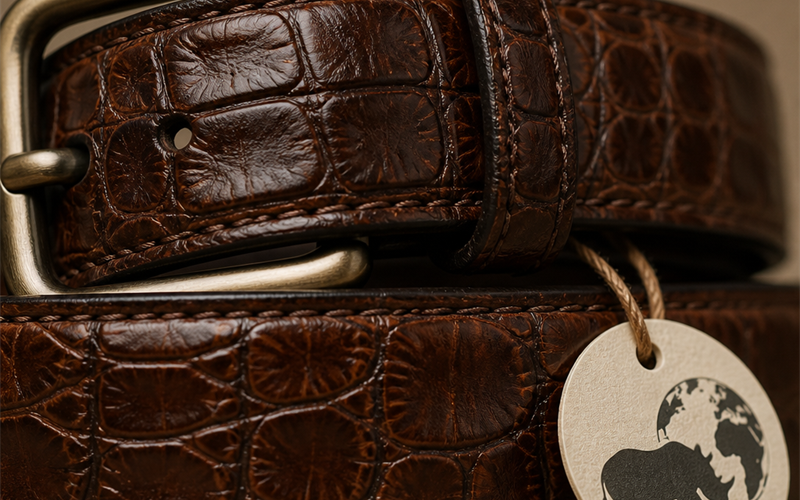
Crocodile and alligator leathers perform exceptionally well in desert climates because their natural oil content is significantly higher than cowhide and their dense scale structure resists moisture loss. They still need conditioning, but the dry rot timeline stretches to decades rather than years.

Background in why is alligator leather so expensive and the crocodile/alligator collection. For desert owners doing 20-year planning, exotic leather is often the smarter long-term investment.
What's the right desert belt conditioning schedule?
Every 4-6 weeks during dry months and every 8 weeks during cooler seasons. Use a neutral, moderate-oil leather conditioner — not heavy beeswax pastes (they trap dust) and not light water-based sprays (they evaporate too quickly).
Apply with a soft cloth in circular motions, let absorb 60 minutes, then buff. Don't over-apply. Fibers absorb a finite amount of conditioner. Excess sits on the surface and attracts dust.
See the right conditioners guide for specific products that work on Italian leather.
Should you store leather belts in air conditioning?
Yes — but watch humidity. Air-conditioned indoor air in Phoenix or Las Vegas often runs 25-30% humidity, on the low end for leather. A small humidifier in the bedroom or closet (aim for 40-50% RH) protects all your leather goods, not just belts.

The American Institute for Conservation's collections care reference recommends 40-55% humidity for museum-stored leather. The same range works for daily-wear belts.
Why is the car the worst place for a desert belt?
The car is the worst place because interior temperatures regularly hit 150°F+ in summer. Combined with direct UV through windshield glass, even an hour in a parked car can do more damage than a month of normal wear. Belts left in cars overnight also cycle through cold morning temperatures.
The AVMA's hot car temperature research documents temperature rises of 19°F in 10 minutes and 43°F in one hour. Don't leave belts, wallets, shoes, or any leather in cars. Period.
City-specific notes
Phoenix / Tucson
Extreme heat, very low humidity, monsoon thunderstorms in summer. Condition every 4 weeks during May-September. Watch for sudden monsoon rain after months of dryness — dry leather doesn't handle sudden soaking well.
Las Vegas
Dry heat with strong UV and indoor air-conditioning extremes. Belt damage often comes from indoor-outdoor temperature swing rather than heat itself. Store belts away from windows.
Albuquerque / Santa Fe
High elevation amplifies UV exposure. Cool nights drop temperatures 30-40°F from daytime highs. Use heavier conditioner schedule (every 4 weeks) to compensate for the thermal cycling.
Are pale-colored belts a bad choice in the desert?
Yes — pale-colored belts (natural veg-tan, light tan, cream) fade faster in desert UV than darker tones. They also show every speck of red Arizona dust. For daily desert wear, espresso, dark brown, and black hold their color longer and look better between conditioning sessions.

See our espresso leather belts and brown leather belts.
The Bottom Line
Desert climates are the leather equivalent of high-altitude mountaineering — brutal, but the right equipment thrives. Apply the BELTLEY 3-Material Rule (full-grain leather + stainless or solid brass + sealed edges) with a 4-6 week conditioning routine, and desert belts last 15-25 years. Skip the routine and even good leather dies in 3-5.
BELTLEY ships daily to Phoenix, Las Vegas, Albuquerque, and Riyadh. The full-grain collection is the desert foundation. For 20-year durability, the crocodile/alligator range outperforms every cowhide in dry climates. 10-year materials warranty, 30-day returns.
Frequently Asked Questions
Q: How long does a leather belt last in Phoenix?
A well-conditioned full-grain belt lasts 15-25 years in Phoenix. An unconditioned bonded leather belt often fails within 12-18 months. The biggest single variable is conditioning frequency.
Q: Does the sun fade leather belts?
Yes, especially pale colors. UV breaks down dye molecules and the leather's surface proteins. Store belts indoors and avoid leaving them on dashboards, sunny shelves, or near windows for hours.
Q: Can you restore a dry-rotted leather belt?
You can soften mild dry rot with heavy conditioning, but cracks and powdering are permanent. The fiber damage cannot be reversed. Catch dryness early.
Q: Is mink oil good for desert leather care?
Mink oil over-softens vegetable-tanned belts and can darken them unevenly. A neutral cream conditioner with moderate oil content is safer for daily desert care.
Q: What's the best belt for off-road or hiking in desert climates?
A full-grain leather belt with a stainless ratchet or box-and-prong buckle handles trail dust, brush, and sweat well. See our ratchet buckle collection for adjustable, durable picks.
Q: Should I avoid leather belts in the desert entirely?
No — leather belts thrive in the desert when properly maintained. The dry environment actually has fewer mold and salt risks than coastal climates. The trade-off is more frequent conditioning.