Customs Rules for Bringing Exotic Leather Belts Across Borders
Quick answer: Exotic leather belts made from CITES-listed species (crocodile, alligator, python, elephant) can be carried internationally for personal use but may require declaration or a CITES permit at customs. The exact rule depends on the species, the country of origin, and the destination. Keep your receipt and any sourcing documentation provided during travel.
Last updated: May 2026 • By BELTLEY Editorial
TL;DR:
- Exotic leather belts are legal to own and travel with in most countries — but trade is regulated by CITES (Convention on International Trade in Endangered Species).
- Personal-use travel below commercial quantities typically clears customs with minimal scrutiny.
- Keep your purchase receipt and any sourcing documentation provided during international travel.
- Some species (Siamese crocodile from Thailand, certain python varieties) face stricter rules — verify before traveling.
You buy a beautiful Nile crocodile belt in Singapore. You fly home to New York. At customs, the agent asks what's in the suitcase. You forgot the belt is exotic leather.
Most travelers in this scenario clear customs without issue. A small percentage face questions, declarations, or — rarely — temporary detention of the item pending verification of legal purchase.
The rules are clearer than most travelers realize. Here's exactly what applies and how to travel cleanly with exotic leather belts.
What is CITES and why does it matter for exotic leather?
CITES is the Convention on International Trade in Endangered Species of Wild Fauna and Flora, an international agreement among 184+ countries that regulates cross-border trade in protected animals and plants. Crocodile, alligator, python, lizard, and elephant leather are all CITES-listed, meaning international shipments and (in some cases) personal-use travel require documentation proving legal origin.

The framework is documented on the Wikipedia CITES overview. For specific crocodile and alligator regulations, see the detailed Wikipedia crocodile leather page.
In the U.S., enforcement runs through the U.S. Fish and Wildlife Service International Affairs program — see their official international affairs program page.
Key stat: CITES regulates trade in over 38,000 species globally, including every species used for commercial crocodile and alligator leather. The convention has been in force since 1975 and is the primary framework countries use to enforce wildlife import rules.
Can you travel with a crocodile belt internationally?
Yes — you can travel internationally with a crocodile or alligator belt purchased legally. Most countries allow personal-use exotic leather items below commercial quantities (typically defined as 1-4 items per person) without a separate CITES permit. Always carry the original purchase receipt and any sourcing documentation the seller provided.
For travel between U.S. and EU, U.K., Japan, Singapore, UAE, and most G20 nations, no special documentation is typically required for personal-use exotic leather belts. Heightened scrutiny applies for Siamese crocodile from Southeast Asia and certain python species — verify before traveling.
Exotic leather customs rules — by species
| Leather species | Common CITES status | Personal travel | Notes |
|---|---|---|---|
| American alligator (US-farmed) | Appendix II | Generally unrestricted personal use | Most common, lowest scrutiny |
| Nile crocodile (farmed African) | Appendix II | Generally unrestricted personal use | Documentation recommended |
| Saltwater crocodile (Australian farmed) | Appendix II | Generally unrestricted personal use | Documentation recommended |
| Siamese crocodile (Thailand/Vietnam/Cambodia) | Appendix I (wild) | Restricted — verify by country pair | Some routes forbidden even with CITES paperwork |
| Burmese python | Appendix II | Generally allowed personal use | Verify destination rules |
| Reticulated python | Appendix II | Generally allowed personal use | Common in fashion belts |
| African elephant leather | Appendix I/II | Heavily restricted | Avoid international travel without permit |
| Caiman (various species) | Appendix II | Generally allowed personal use | Common in mid-tier exotic belts |
Do you need a CITES permit to travel with a personal-use exotic belt?
In most cases, no — personal-use items below commercial quantities (typically 1-4 items per traveler) clear customs without a separate CITES permit. The exception applies when traveling to or from countries that enforce stricter import controls (some EU member states, Australia, New Zealand). For high-value or quantity-edge cases, request proof of legal sourcing from the seller at purchase.

The U.S. Fish and Wildlife Service international affairs page covers the agency's role in enforcing CITES and related wildlife trade regulations.
What happens if customs questions your exotic belt?
Customs agents may ask three questions: where did you buy it, how much did you pay, and do you have documentation. Showing the original receipt and proof of legal sourcing almost always resolves the inspection. Without documentation, agents have discretion to hold the item pending verification, which can delay clearance by hours or days.
Travelers carrying exotic leather without documentation rarely lose the item permanently — but inconvenience and possible fines are real risks.
How can you tell if your exotic belt was legally sourced?
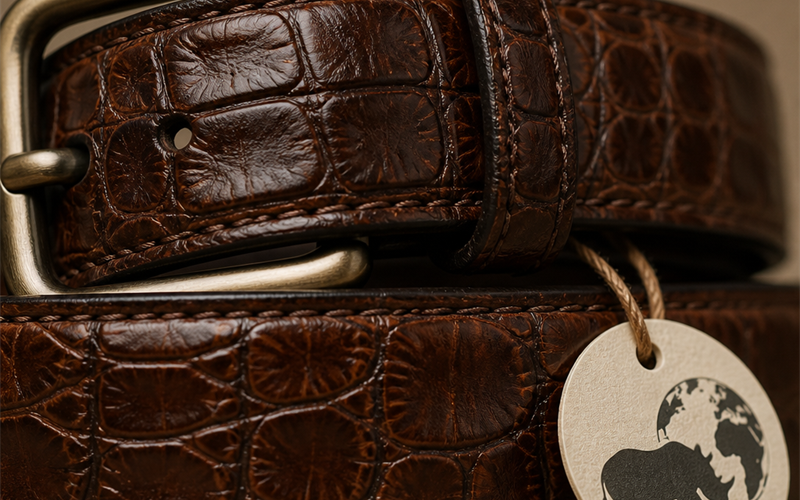
Quality exotic leather is sourced legally and moves under CITES permits at the trade level; a reputable seller can confirm legal sourcing and provide import documentation on request. The tag references the species, the country of origin, the year of production, and a unique tracking number. Reputable brands include this documentation by default. If the seller cannot confirm legal sourcing or provide any documentation, they may have skipped CITES compliance.
BELTLEY's crocodile and alligator collection is made from legally and responsibly sourced exotic leather, backed by official import documentation.
Are all alligator belts subject to CITES?
Yes — American alligator (Alligator mississippiensis) is listed under CITES Appendix II, even though it's no longer endangered in the U.S. The listing remains in place to monitor sustainable-trade quotas and prevent confusion with truly endangered crocodile species. All commercial alligator leather is tracked through the CITES framework, but personal-use international travel rarely faces friction with American alligator items.

See the Wikipedia alligator leather page for production history and are alligator belts legal in the USA for domestic context.
What about traveling with an alligator watch strap?
Alligator watch straps fall under the same CITES rules as alligator belts, but watch straps face even less customs scrutiny because they're worn on the watch and rarely declared separately. See our are alligator watch straps legal post for the full breakdown.
Which countries are strictest about exotic leather imports?
Australia, New Zealand, and certain EU member states (notably Germany and the Netherlands) enforce CITES rules most aggressively at customs. Travelers entering these jurisdictions with undocumented exotic leather face the highest risk of inspection, documentation requests, and possible temporary detention of the item. The U.S., U.K., and most Asian countries enforce more leniently for personal-use items.

The strictness reflects each country's enforcement priorities, not the CITES framework itself — the underlying rules are uniform across signatory nations.
What's the easiest way to travel with exotic leather without trouble?
Four steps. Buy from a brand that can confirm legal sourcing and import documentation. Keep the receipt and tag with the belt during travel. Declare proactively if asked at customs (honesty resolves nearly all inspections quickly). Avoid Siamese crocodile and any African elephant leather for international travel — both face stricter rules.
For a clean travel record, stick with American alligator, farmed Nile crocodile, and farmed saltwater crocodile from Australian sources. All three trade widely with minimal customs friction.
Can you ship exotic leather belts internationally?
Yes, but commercial shipments require full CITES permits, not just product documentation. This is why reputable exotic leather brands can document the legal sourcing of every exotic piece they sell. Personal shipments (gifts to friends, online orders) sometimes face customs holds if documentation is incomplete.
BELTLEY ships exotic leather to over 80 countries, sourced legally with official import documentation on file. Browse the crocodile and alligator collection for current shipping options.
What if you bought an exotic belt from a small artisan without paperwork?
Vintage exotic belts and small-artisan purchases sometimes lack CITES paperwork — particularly belts manufactured before CITES expansion in the 1990s or items from boutique workshops. Inheritance pieces are usually grandfathered under "pre-CITES" status, which most jurisdictions accept with reasonable proof. Without any documentation, expect possible customs questions during international travel.

When in doubt, declare proactively and answer honestly. Customs treats undeclared exotic leather more harshly than honestly declared items lacking paperwork.
The Bottom Line
CITES sounds intimidating but the rules for personal travel are clear: buy legitimate exotic leather, keep documentation, declare honestly if asked. Personal-use belts below commercial quantities almost never face seizure or fines. American alligator, farmed Nile crocodile, and farmed Australian saltwater crocodile are the cleanest options for frequent international travelers. Siamese crocodile and African elephant require extra paperwork — usually not worth the hassle.
BELTLEY's exotic leather collection ships globally and is made from legally and responsibly sourced leather, backed by official import documentation. Every belt in the crocodile and alligator range is sourced from CITES-compliant farms and legally imported with official documentation on file. Free worldwide shipping in 4-10 days.
Frequently Asked Questions
Q: Is it illegal to bring a crocodile belt into the US?
No. Crocodile and alligator belts are legal to import into the U.S. for personal use. Commercial quantities require CITES permits. Keep your receipt during international travel.
Q: Do I need to declare a leather belt at customs?
Ordinary cowhide belts require no declaration. Exotic leather (crocodile, alligator, python, elephant) may require declaration depending on destination — declare proactively if asked.
Q: Can I bring my Hermès crocodile belt internationally?
Yes. Hermès, BELTLEY, and other reputable brands sell legally and responsibly sourced exotic leather. Carry the receipt and any sourcing documentation the seller provided during international travel.
Q: What countries ban exotic leather imports entirely?
A handful of countries enforce stricter rules but few enforce outright bans on personal-use items. Australia and New Zealand are among the strictest. India bans many exotic leathers domestically.
Q: How can I tell if my exotic leather belt was legally sourced?
Ask the seller to confirm the species, country of origin, and import documentation — reputable sellers keep CITES permit records on file. Reputable brands include this by default.
Q: Are vintage or inherited exotic belts legal to travel with?
Generally yes — pre-CITES items (typically manufactured before 1975) are grandfathered in most jurisdictions. Proof of age helps if customs questions the item.

%20can%20be%20carried%20internationally%20for%20personal%20use%20but%20may%20require%20declaration%20or%20a%20CITES%20pe...)