Crocodile Leather Belt vs Full-Grain Cowhide Belt
TL;DR:
- Crocodile leather lasts 20–25+ years, has a tensile strength of ~2,500 PSI, and costs $150–$299 DTC — roughly $8 per year over its lifespan.
- Full-grain cowhide lasts 10–15 years, develops a rich patina through wear, and costs $58–$180 — also roughly $7–$8 per year when you do the math.
- The cost-per-year gap between these two materials is almost negligible. The real difference is aesthetics, structural strength, and what you want your belt to say about your priorities.
If you're choosing between a crocodile leather belt and a full-grain cowhide belt, you're not choosing between quality and compromise. Full-grain cowhide is the finest standard leather available and the material that most premium belt makers have relied on for generations. Crocodile leather is structurally superior in measurable ways — but at a price point that isn't right for every buyer or every occasion.
This guide breaks down both materials honestly across every dimension that matters: durability data, lifespan, cost-per-year math, appearance, and maintenance requirements. Both collections are part of what BELTLEY offers — full-grain leather belts and crocodile and alligator belts — because the right choice depends on what you actually need.
Croc or Cowhide: The Decision Beyond the Math
Cost-per-year is nearly a tie (~$8 either way), so the real question is which of these is you:
| Your situation | Go with |
|---|---|
| You want presence and 20–25+ years of wear | Crocodile — stronger structurally, unmistakable visually, $118–$289 DTC |
| You love leather that evolves with you | Full-grain cowhide — the patina story is its superpower, from $58 |
| This is your first serious belt | Cowhide first — learn what quality feels like, make croc your second |
| You already own good cowhide belts | You're the croc customer — it's the upgrade your rotation is missing |
Compare the two in person, so to speak: full-grain belts and crocodile belts. The full side-by-side:
What Is the Difference Between Crocodile and Full-Grain Leather?
Crocodile leather comes from the belly or spine of a farmed crocodilian hide — a thick, densely structured material with an interlocking collagen fiber matrix beneath each scale, producing exceptional tensile strength and natural water resistance. Full-grain cowhide is the top layer of a cattle hide, left intact without sanding or buffing, giving it the tightest fiber structure and best long-term durability of any bovine leather.

Both are genuine, high-quality leathers — but they differ fundamentally in structure. Crocodile's fiber arrangement runs multi-directionally, resisting tearing from any angle. Cowhide fibers run more parallel to the surface, which means concentrated stress at a single point — like a buckle hole — has a greater cumulative effect over time. That structural difference is why crocodile leather is classified by the industry as a premium-tier material above even the finest full-grain cowhide. For a detailed breakdown of where full-grain leather stands relative to other bovine grades, our full-grain vs genuine leather belt comparison covers the hierarchy clearly.
How Long Does Each Belt Last?
A well-maintained crocodile leather belt lasts 20–25+ years. A well-maintained full-grain cowhide belt lasts 10–15 years. Both figures assume regular conditioning, sensible storage, and reasonable wear frequency — not daily abuse and no maintenance.
These aren't marketing estimates. The 20–25 year crocodile figure is based on the hide's ~2,500 PSI tensile strength and the multi-directional fiber structure that distributes flexing stress across the entire surface rather than concentrating it. Full-grain cowhide's 10–15 year lifespan reflects the finest bovine leather available — correctly treated, it's a remarkable material. Under poor conditions — no conditioning, daily single-hole wear, storage coiled tightly in a hot car — both timelines compress significantly. For the full structural data on the crocodile side, are alligator or crocodile leather belts durable covers the mechanics in depth. For the cowhide case, the truth about leather belt durability addresses what actually kills standard leather belts.
Which Belt Is Better Value? The Cost-Per-Year Breakdown
When measured by cost per year of use, crocodile leather and full-grain cowhide are nearly identical in value — despite a significant difference in upfront price.

The math is straightforward:
| Crocodile Belt | Full-Grain Cowhide Belt | |
|---|---|---|
| Typical DTC price | $200 | $95 |
| Expected lifespan | 25 years | 12 years |
| Cost per year | $8.00 | $7.92 |
At the DTC price point BELTLEY offers for both materials, the annual cost difference is less than ten cents. The crocodile buyer pays more upfront and replaces the belt once in a career. The cowhide buyer pays less upfront but buys twice over the same period. Neither is the wrong financial decision — but the framing of crocodile as "expensive" versus cowhide as "affordable" misrepresents the actual long-term economics.
The gap widens at luxury heritage house prices ($400–$800 for crocodile) where the Brand Tax inflates cost-per-year considerably. That's a different conversation — one that are alligator or crocodile belts worth it addresses directly. At DTC pricing, the value case for crocodile is genuinely strong.
How They Look and Wear Over Time
This is where personal preference genuinely drives the decision.

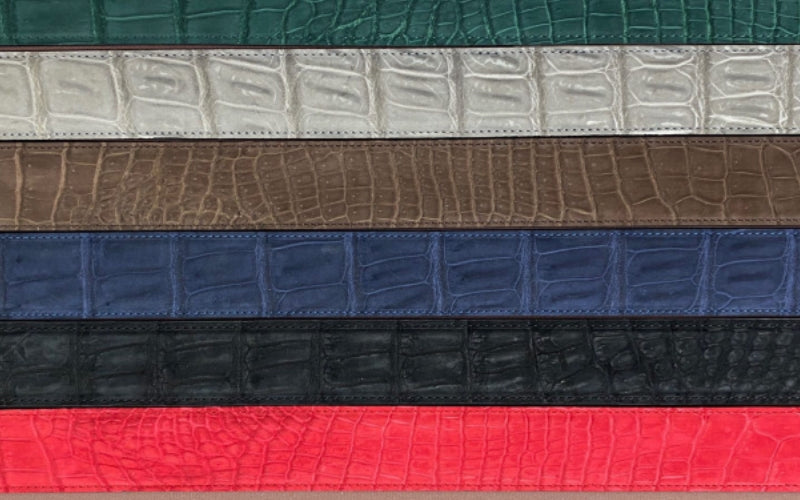
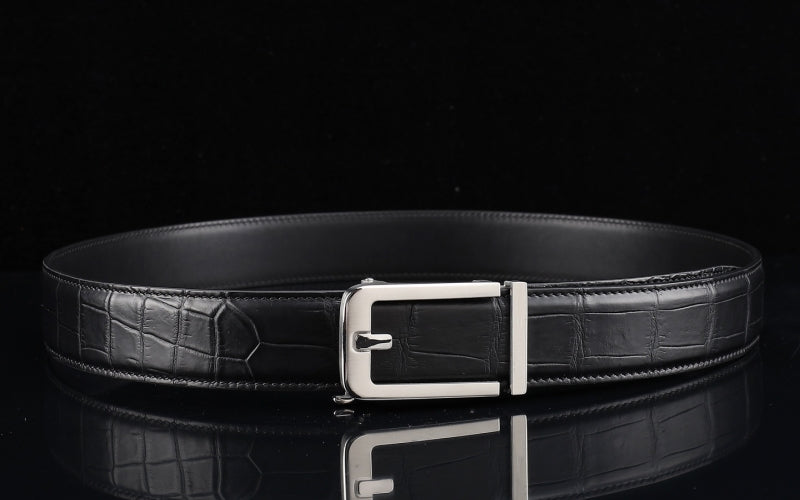
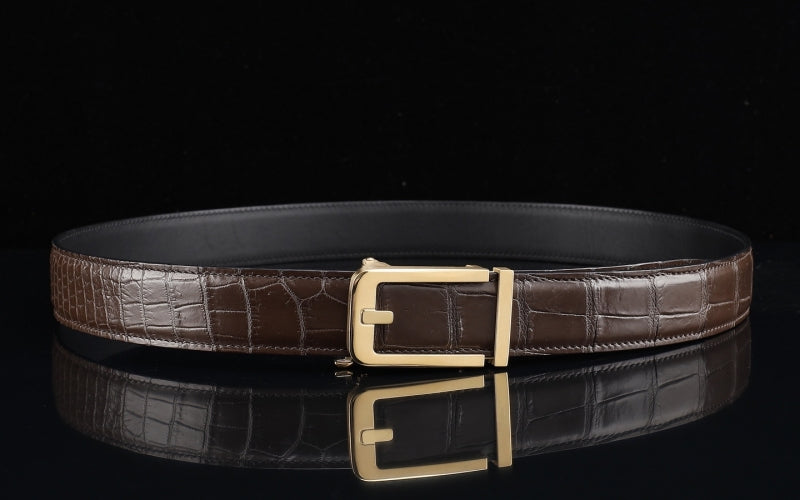
Crocodile leather arrives with its visual character fully formed. The scale pattern — large, flat, symmetrical on belly-cut; bold and ridged on hornback — is immediately distinctive. It does not change fundamentally with age; a well-maintained crocodile belt at year fifteen looks essentially the same as it did at year one. That's part of its appeal to buyers who want consistency. The exotic character is the point from day one.
Full-grain cowhide earns its character over time. Unlike corrected-grain or top-grain leather that has been sanded smooth, full-grain retains the natural surface where a patina develops through use — the oils from your hands, the slight compression from daily wear, the gradual darkening that makes each belt distinctively yours. A quality full-grain cowhide belt at year ten looks better than it did at year one in a way that crocodile leather simply does not replicate. If you value a material that evolves and develops history, full-grain cowhide delivers something exotic leather cannot.
Both materials are available in the same color range at BELTLEY. Our full-grain leather belt collection and crocodile and alligator collection cover black, brown, espresso, and more across both material types.
Which Material Is More Durable in Daily Use?
Crocodile leather is more durable in measurable structural terms. Its tensile strength of approximately 2,500 PSI — roughly double that of standard top-grain cowhide — means it resists tearing more effectively under the repeated stress of daily buckle use. The scale architecture also distributes surface abrasion across a wider area, reducing localized wear at any single point.
Full-grain cowhide has superior abrasion characteristics compared to lower leather grades but remains behind crocodile in raw tensile and structural terms. Its advantage is in repairability and forgiveness: a scuffed full-grain belt can often be reconditioned and buffed back to a serviceable appearance more easily than exotic leather. According to Proven Hands' analysis of full-grain leather durability, full-grain leather "continues to develop strength over time" as the natural fiber structure compresses and consolidates with wear — a property that partially closes the gap with exotic leather in practical use.
Water resistance also favors crocodile. The natural oils in crocodile hide provide inherent moisture resistance that full-grain cowhide lacks unless treated with a water-repellent conditioner.
Care and Maintenance: Which Is Easier to Look After?
| Care Factor | Crocodile Leather | Full-Grain Cowhide |
|---|---|---|
| Conditioning frequency | Every 3–4 months | Every 3–6 months |
| Conditioner type | Exotic-specific leather cream | Standard leather conditioner or cream |
| Water resistance | Moderate-high; blot dry if wet | Low-moderate; treat with conditioner |
| Patina development | Minimal — stays consistent | Rich — deepens with wear and conditioning |
| Scratch resistance | High — thick scale surface | Moderate — shows scuffs on lighter colors |
| Home repair | Limited — exotic care products required | More forgiving — standard products work |
| Storage | Flat or loose roll, dry environment | Flat or hanging; tolerates most storage |
Both materials are straightforward to maintain when handled correctly. Full-grain cowhide is marginally more forgiving because standard leather care products work effectively, and the patina-developing surface is more tolerant of minor lapses in conditioning. Crocodile requires exotic-specific products, and a neglected hide dries out faster than cowhide. Our leather care guide covers protocols for both in full.

Which Belt Should You Choose?
Choose a crocodile leather belt if:

- You want the highest-durability material available for a belt — one that measurably outlasts full-grain cowhide
- Visual distinctiveness matters: you want a belt that reads as clearly exotic and premium
- You're making a single long-term investment and want to buy once, correctly
- You wear primarily formal or business attire where the exotic scale pattern registers appropriately
- Water resistance in daily conditions is a practical priority
Choose a full-grain cowhide belt if:
- You value a material that develops a personal patina and improves with age and wear
- Everyday versatility is the priority — full-grain works across formal, business casual, and smart casual with equal ease
- You prefer a lower upfront cost even with near-identical cost-per-year economics
- You're building a multi-belt collection and want a reliable everyday foundation before investing in exotic pieces
- Standard leather care products and wider repairability matter to you
If you're unsure which to start with, what is the most durable leather belt covers the full material hierarchy and helps anchor the decision. Both choices come with BELTLEY's 10-year warranty on materials and construction — because the quality standard applies regardless of which hide you choose.
The Bottom Line
Crocodile leather and full-grain cowhide are the two best belt materials available — one exotic, one standard, both worth owning. Crocodile edges ahead on raw durability, tensile strength, and water resistance. Full-grain cowhide edges ahead on patina development, everyday forgiveness, and lower upfront cost. Over a full lifespan, the cost-per-year gap between them is almost zero.
At BELTLEY, both materials are handcrafted in small batches by master artisans, paired with stainless steel hardware, and backed by a 10-year warranty. Free worldwide shipping and 30-day hassle-free returns mean you can evaluate the material quality in person with no risk. Choose the hide that fits your wardrobe, your lifestyle, and your investment horizon — both are the right answer for different buyers.
Frequently Asked Questions
Q: Is crocodile leather better than full-grain cowhide for belts?
Crocodile leather is structurally superior — it has roughly double the tensile strength and lasts 20–25 years versus 10–15 years for full-grain cowhide. However, full-grain cowhide develops a rich patina over time that exotic leather does not replicate, and the cost-per-year of both materials is nearly identical when measured over their full lifespans. "Better" depends on your priorities.
Q: How long does a full-grain leather belt last?
A well-maintained full-grain cowhide belt lasts 10–15 years with regular conditioning and proper storage. This is the longest lifespan among standard bovine leather grades — significantly above top-grain (7–10 years) and far ahead of genuine or bonded leather (2–5 years). Daily heavy wear without conditioning can reduce this considerably.
Q: Is a crocodile belt worth the extra cost over full-grain leather?
At DTC pricing, the cost-per-year difference between crocodile and full-grain cowhide is less than a dollar annually over the belt's full lifespan. The premium for crocodile reflects a measurable durability advantage, not just prestige. Whether that's worth it depends on whether you prioritize structural performance and exotic aesthetics over the lower upfront price.
Q: Which leather belt develops a better patina — crocodile or cowhide?
Full-grain cowhide develops a significantly richer patina over time. The intact natural grain surface responds to oils, handling, and wear by deepening in color and character — making each belt genuinely individual over years of use. Crocodile leather's visual character is stable from day one and does not change substantially with age, which is either an advantage or a disadvantage depending on what you value.
Q: Can I condition a crocodile belt with the same products I use on a cowhide belt?
No. Crocodile leather requires exotic-specific leather conditioner — standard cowhide conditioners, saddle soaps, and petroleum-based products can damage the scale surface or strip its finish. Full-grain cowhide is more product-tolerant, accepting most standard leather creams and balms without issue. Always use the appropriate conditioner for each material type.