Best Belts for Frequent Flyers — No-Metal & Travel-Friendly Picks
Quick answer: The best belts for frequent flyers have low-mass buckles that often pass TSA detectors, pack flat without creasing, and handle the humidity swings of multiple climates. Top categories: slim 1.25" full-grain with a brass or stainless pin buckle, plastic-buckle athletic belts, and crocodile belts for owners who want one belt that works everywhere.
Last updated: May 2026 • By BELTLEY Editorial
TL;DR:
- Frequent flyers need belts that pass security cleanly, pack flat, and handle climate swings.
- Three categories matter: slim pin-buckle dress belts, no-metal casual belts, and exotic-leather all-rounders.
- Heavy plaque buckles, oversized ratchet plates, and ornate Western buckles are the worst for travel.
- Apply the BELTLEY 3-Material Rule to any travel belt: full-grain leather + stainless or solid brass + sealed edges. Pack flat. Wear high-value belts during transit.
If you fly 30+ times a year, you've already learned which belts are a hassle. The plaque-buckle one triggers TSA every time. The chunky Western buckle leaves marks on your shirts. The pale natural-veg-tan stained the first time you got caught in Bangkok rain.
The right travel belt is a system, not a single product. This guide breaks down what frequent flyers actually wear, why it works, and which categories to skip.
Which Flyer Are You? Belt Accordingly
Frequent-flyer belt picks by travel style:
| Your situation | Go with |
|---|---|
| Weekly business traveler | Slim 1.25" full-grain with a small pin buckle — low metal mass, often sails through scanners. |
| Hate the security shuffle entirely | Plastic-buckle athletic belt for flight days; real belt in the carry-on. |
| One belt for every city and climate | Matte croc in espresso ($118–$289) — handles humidity swings and every dress code on the itinerary. |
| Packing the good belt | Loose 3" coil inside a shoe — never folded, never checked. |
Travel-grade builds: BELTLEY's men's collection — free shipping wherever you're flying from.
What's the best belt for frequent travelers?
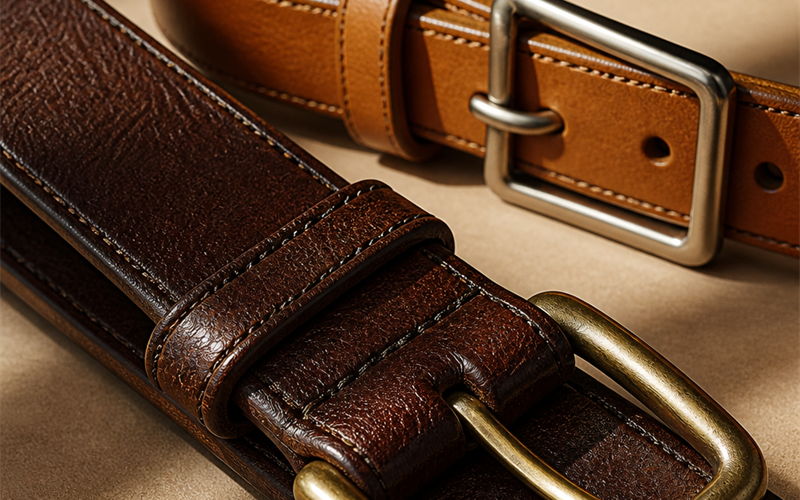
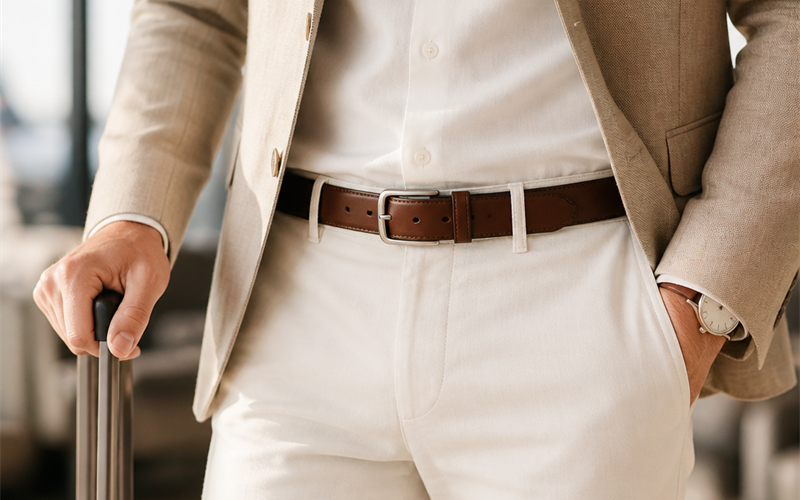
The best belt for frequent travelers is a slim 1.25" (32mm) full-grain leather belt with a low-mass solid brass or stainless pin buckle. This setup passes most TSA detectors, dresses up or down, packs flat along a suitcase perimeter, and handles humidity changes between climates. Plastic-buckle athletic belts are a strong second choice for casual-only travel.

The BELTLEY 3-Material Rule applies cleanly here: full-grain leather, stainless or solid brass buckle, sealed edges. Travel just stress-tests the same fundamentals.
Key stat: A frequent business traveler passes through 120-200 airport security screenings per year. Switching from a plaque-buckle to a slim pin-buckle belt saves an estimated 2-5 hours of cumulative airport time annually.
What buckle types work best for airport security?
Three buckle types pass TSA detectors most reliably. Slim brass or stainless pin buckles (under 40g) pass roughly 70-80% of the time. Plastic and nylon athletic buckles pass 100% of the time. Carbon fiber buckles pass cleanly but look athletic. Avoid plaque buckles, heavy ratchet plates, and chunky Western buckles — all three trigger walk-through detectors consistently.
For background, see our TSA rules for belts and types of belt buckles guide.
Frequent flyer belt categories — comparison
| Category | TSA-friendly? | Dress-formal? | Pack-flat? | Climate range | Typical lifespan |
|---|---|---|---|---|---|
| Slim pin-buckle full-grain dress | Mostly | ✅ | ✅ | All | 15-25 yr |
| Stainless ratchet (low-mass) | Mostly | Business casual | ✅ | All | 10-15 yr |
| Plastic-buckle athletic | Always | ❌ | ✅ | Hot/humid | 3-8 yr |
| Crocodile / alligator | Mostly | ✅ | ✅ | All | 25-30+ yr |
| Plaque buckle dress | Never | ✅ | ✅ | Limited | 10-15 yr |
| Western buckle | Never | ❌ | ❌ | Limited | 10-20 yr |
| Bonded leather | N/A | ❌ | ✅ | Failed in any climate | <1 yr |
Why is full-grain leather better for travel?
Full-grain leather is better for travel because it absorbs less moisture than chrome-tanned or bonded alternatives, dries evenly when it does, and resists climate-swing damage. A frequent flyer going from Dubai (dry, hot) to Seoul (humid, cool) to London (rainy, cool) in a week subjects a belt to extreme moisture cycling. Full-grain handles it; bonded leather often cracks.

Background in full-grain vs top-grain leather and is genuine leather real leather. For travel buyers, this isn't optional.
Are crocodile or alligator belts good for travel?
Yes — crocodile and alligator leather perform exceptionally well in travel because their natural oils and dense scale structure resist humidity, rain, and dry-air damage. Frequent flyers who want one belt that works in every climate often gravitate to crocodile after their first international trip.
The trade-offs are upfront cost and customs awareness (CITES regulations on exotic leather imports). See our crocodile and alligator collection, the value math in are alligator belts worth it, and customs rules for exotic leather belts.
How many belts should a frequent flyer own?
Three to four belts cover most frequent flyer wardrobes: one slim dress belt for meetings and suits, one casual brown for evenings out, one no-metal or low-mass airport belt for fast security passage, and (optionally) one exotic leather all-rounder for premium travel.
Most owners build to this slowly. The first two belts should be the slim dress and the airport-friendly belt. Casual and exotic come later. See our seasonal belt rotation guide for the full math.
What colors work best for travel?
Espresso, dark brown, and black hide travel wear (sweat, splashes, scuffs) far better than pale colors. They also match more outfits — a single dark brown belt works with chinos, denim, suits, and most dress shoes. Pale natural veg-tan and cream-colored belts show every rain mark and look unprofessional after one wet flight.

Browse the espresso leather belts and black leather belts for daily travel picks.
Why do plaque buckles fail travelers?
Plaque buckles fail travelers because they trigger TSA detectors almost universally, scratch easily during baggage handling, and look out of place with both very formal and very casual wear. They also weigh enough (often 80-150g) to throw off pant-line drape. Frequent flyers usually retire plaque buckles within 6-12 months of starting heavy travel.
For background on why these designs developed, see why are Gucci belts so expensive and most popular Gucci belt ranked 2026.
What about ratchet belts for travel?
Ratchet belts are excellent for travel when the buckle is slim and low-mass. Heavy plate ratchet buckles trigger TSA detectors. Slim ratchet buckles (under 40g) often pass. The micro-adjust feature is genuinely useful for travelers whose waistline fluctuates with airplane food, alcohol, and time-zone shifts.

Browse our ratchet buckle belt collection and look at buckle weight when listed.
Should you own a dedicated "airport belt"?
For travelers who fly weekly, yes — a dedicated airport belt (no-metal or low-mass) saves cumulative time and removes the morning-of-flight decision. Pair it with TSA PreCheck or Global Entry and security becomes a 60-second formality. Most frequent flyers keep the airport belt in a travel-only drawer with their passport and chargers.
For dressy travel where the no-metal athletic look doesn't fit, a slim brass-pin dress belt is the compromise — high pass rate, still works with a suit.
What about humid vs dry travel routes?
Two-climate travelers (NYC ↔ Dubai, LA ↔ Singapore, London ↔ Mumbai) should consider one humidity-resistant belt for the tropical leg and one drier belt for the home base. Crocodile and alligator handle both ends well. Heavy beeswax-conditioned full-grain belts thrive in dry climates but soften too much in humidity. Light conditioner suits both.
See our hot humid climates guide and desert heat guide.
What's the worst belt to bring on a trip?
The worst travel belt is a heavy plaque-buckle bonded leather belt in pale natural veg-tan. It triggers TSA every time, the bonded core fails fast in climate swings, the pale color stains visibly from rain or sweat, and the buckle scratches everything in the suitcase. If your current belt matches this description, leave it home.

For better picks across budgets, see our men's belt collection and women's belt collection.
The Bottom Line
The right travel belt is unglamorous on purpose. Slim profile, low-mass buckle, dark color, full-grain leather. Apply the BELTLEY 3-Material Rule — full-grain leather + stainless or solid brass + sealed edges — and you have a belt that survives airline humidity swings, packs flat, and clears most security checkpoints. Add a no-metal athletic belt for casual travel days, and an exotic leather all-rounder if budget allows.
BELTLEY's slim full-grain belts are the workhorses for frequent flyers heading to Tokyo, Frankfurt, Dubai, and São Paulo. Start with the 1.25" belt collection or the men's belts. For the one-belt-fits-everywhere option, the crocodile and alligator collection handles every climate on earth. Free worldwide shipping, 30-day returns, 10-year warranty.
Frequently Asked Questions
Q: What is a "no-metal" belt?
A no-metal belt uses plastic, nylon, or carbon-fiber buckles instead of metal. It passes TSA metal detectors 100% of the time. Most no-metal belts are casual or athletic style.
Q: Are leather belts allowed in carry-on bags?
Yes. Leather belts pose no security restrictions and can be worn or packed in either carry-on or checked luggage. See our carry-on vs checked luggage packing guide.
Q: Do TSA agents inspect leather belts?
Belts in checked luggage receive X-ray screening but rarely physical inspection. Carry-on belts go through metal-detector or AIT scans. CT scanners on carry-on bags render leather goods clearly but never flag a belt as suspicious.
Q: Should I bring my crocodile belt internationally?
Yes, but carry proof of legal purchase (receipt and any sourcing documentation provided). For most destinations and personal-use quantities, no declaration is needed. See customs rules for exotic leather belts.
Q: What's the lightest TSA-friendly belt?
Plastic-buckle athletic belts weigh under 70g total and pass all metal detectors. The trade-off is they look casual. For dressy travel, a slim brass pin buckle (under 40g) is the right compromise.
Q: Do exotic leather belts trigger TSA detectors more than cowhide?
No. The leather itself has no metal content. Only the buckle determines metal-detector readings.