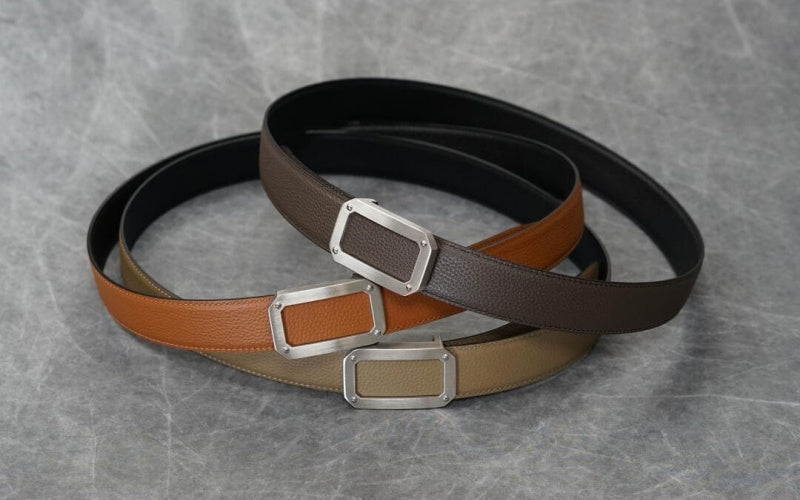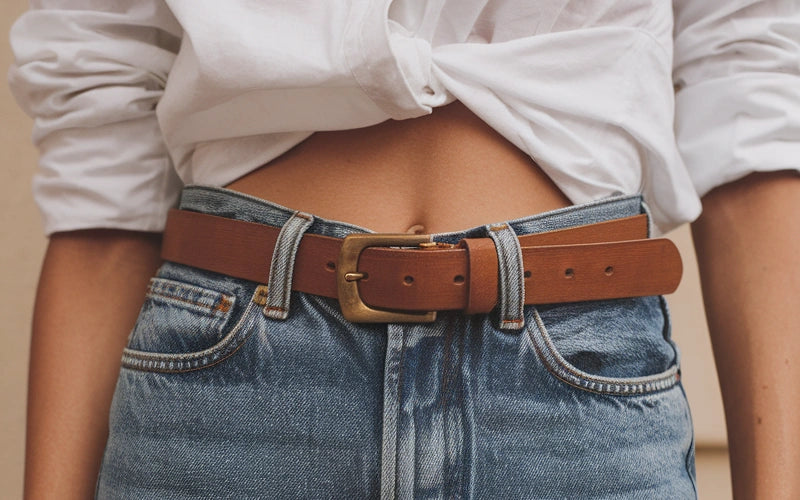
Women’s Belts: How Many Is Enough?
TL;DR: Quick Answer and main takeaways
- A practical women's belt wardrobe needs 3–4 belts: a classic leather everyday belt, a slim dress belt, a wide or statement belt, and one casual option.
- The right number depends on your lifestyle — not on some arbitrary "essentials" checklist.
- In 2026, belts are doing more styling work than they have in years. A few good ones go further than a drawer full of cheap ones.

The internet will give you wildly different answers here. Fashion blogs insist on five. Minimalist accounts argue for two. Elliot Rhodes' belt wardrobe guide makes a case for eight. The honest answer is none of those numbers are universally right — it depends on what you actually wear.
What's true is that most women are either under-belted (one tired brown leather loop they thread through jeans out of habit) or over-belted (a tangled drawer of impulse buys that never quite match anything). The goal is the middle: a small, deliberate collection where every belt earns its place. BELTLEY's women's belt collection is built around that logic — not volume, but versatility and quality.

How Many Belts Does a Woman Actually Need?
The minimum functional wardrobe for women's belts is 3–4 belts: one classic leather everyday belt, one slim dress belt, one wide or statement belt, and one casual belt. That combination covers denim, dresses, office outfits, and weekend wear without overlap or gaps. You can own fewer if your lifestyle is simple; more if you dress across a wide range of formality levels or use belts as active styling tools rather than just waist support.
The case for 3–4 (rather than 8 or more) is that belt redundancy doesn't add versatility the way it does with shoes or tops. A second black leather belt at the same width isn't an option — it's a duplicate. Every belt you add should handle a situation your existing belts can't. When you can no longer think of an outfit that needs the new belt, you already have enough.
Amsterdam Heritage's guide to belts every woman should own lands on a similar figure, noting that the most versatile wardrobe is built around function first — a belt that works across multiple outfits is worth five that each work for one.

The Four Belts That Cover Almost Everything
If you're building from scratch or auditing what you have, here's the framework.
1. The Classic Leather Belt (1"–1.5" width, neutral color) This is the backbone. A full-grain leather belt in black or dark brown at a mid-width — roughly 1.25" to 1.5" — threads through jeans, chinos, trouser loops, and midi skirt waistbands without looking wrong. It's the belt you reach for without thinking. Quality matters more here than anywhere else because this one takes the most use. A cheap belt at this width will crack and stretch at the buckle hole within a year. Full-grain leather, properly conditioned, lasts a decade.
2. The Slim Dress Belt (under 1", or very narrow) A slim belt — 0.75" to 1" — changes what you can do with dresses, blazers, and tailored trousers. It sits at the waist without dominating the silhouette, which makes it the right tool for cinching a wrap dress, defining an oversized blazer, or adding shape to a column-cut outfit. Our post on thin vs. thick belts with a dress covers exactly when slim wins over wide — and it's more often than most people assume.

3. The Wide or Statement Belt (2"+ width) A wide belt transforms an outfit instead of just completing it. Over a knit dress, a maxi skirt, or a flowy top, a 2"–3" belt creates a defined waist where there wasn't one, changes the proportions of the outfit, and does the kind of styling work that would otherwise require a different garment entirely. Are wide belts still in style? — yes, and strongly so in 2026.
4. The Casual Belt (braided, woven, or relaxed leather) This is the weekend belt — one that works with denim shorts, linen trousers, or summer dresses without the formality of smooth leather. Braided leather, woven canvas, or a more relaxed-finish full-grain strap in a tan or natural tone. It should feel effortless rather than polished. Our casual belt collection has options across this range.

What Makes a Belt Worth Adding to Your Wardrobe?
A belt is worth adding when it enables an outfit combination your current belts can't handle. If you already have a black slim belt and a wide tan belt and the new option is a medium-width black belt, you're adding a duplicate. If the new belt is a white or metallic option that opens up summer dresses and resort outfits you currently skip, it earns its spot.
The test is simple: name three specific outfits in your current wardrobe that this belt makes work. If you can, it belongs. If you're struggling to get to two, leave it on the rack. This filter alone prevents most impulse belt purchases — not because the belt is bad, but because it doesn't extend your range.
There's also a quality filter worth applying. A belt you'll wear 200 times over five years deserves investment. A belt you'll wear four times and retire should cost accordingly. Our guide to choosing a good belt for a woman covers what to look for in leather grade, buckle construction, and strap thickness — the details that separate a belt that lasts from one that doesn't.

The Belt Styles Trending in 2026 — Worth Owning or Just Hype?
Two 2026 trends are worth owning because they add genuine function: big-buckle belts and over-garment styling. Both change what a belt can do rather than just changing what it looks like. Who What Wear's 2026 belt trend report confirms that Celine, Dior, and Khaite are all centering the buckle as the focal point — which means statement hardware on an otherwise simple strap is a real styling move, not just runway noise.
What that means practically: a wide belt with a distinctive plate buckle worn over a coat, a blazer, or a knit dress is both current and functional. It defines the waist, adds visual interest, and layers in a way that a thin belt can't. If you don't already own something in this category, 2026 is the right time to add one.
The western-influenced belt trend — wide leather with tooled details, concho hardware, or vintage stitching — is also worth considering if your wardrobe runs casual or bohemian. Worn with flare jeans, maxi skirts, or over a denim jacket, it's a piece that does real outfit work rather than just following a moment.
Trends that are probably hype for most women: ultra-micro belts worn as purely decorative waist accessories on dresses that don't need them, and double-layer belt systems that require significant outfit commitment to style correctly. Both photograph well and wear awkwardly in real life.
For a current breakdown by type, our post on what kinds of belts are in style for women in 2026 covers trends with more detail.

How to Size a Women's Belt Correctly
Women's belt sizing is less standardized than men's, and it's where most online belt purchases go wrong. The key rule: measure your actual waist or hip at the position where the belt will sit, then add 1–2 inches to find your belt size. Do not use your clothing size as a proxy — women's clothing sizing varies too much across brands to be reliable for belt ordering.
If the belt sits at your natural waist (above the hip), measure there. If it'll be worn at the hip (common with wide or statement belts over dresses), measure at the hip. The two measurements can differ by 8–12 inches depending on body proportions, so measuring at the right position matters.
Buckle My Belt's women's belt sizing guide notes that most women's belts come with 5–7 holes spaced about 1 inch apart, and the correct fit puts you at the middle hole — same logic as men's belts. If you're ordering from BELTLEY, our how to size a belt for a woman post walks through the measurement steps and includes a size chart.
A final note on color: for maximum cross-wardrobe coverage, start with black and one shade of brown before adding color or metallics. Our belt color guide for women covers the pairing logic in full, including when neutrals work and when a color accent actually earns its place.

The Bottom Line
Most women need 3–4 belts: a classic leather everyday belt, a slim dress belt, a wide or statement belt, and a casual option. That's the practical answer. The number can go up if your lifestyle spans multiple formality levels or you use belts as active styling tools rather than just functional closures — but more than 5 or 6 starts to produce duplicates rather than options.
The variable that matters more than quantity is quality. One full-grain leather belt that fits correctly and holds its shape for ten years does more wardrobe work than five belts that stretch, crack, or look tired after a season. At BELTLEY, every belt in our women's collection is handcrafted from full-grain leather with hardware built to last — no plated zinc that corrodes, no bonded leather that peels, no guessing about construction because every belt comes with a 10-year warranty on materials and workmanship. If you're starting the collection over or adding to it, that's the standard worth holding every new belt to.

Frequently Asked Questions
Q: How many belts should a woman own?
A practical starting point is 3–4 belts: one classic leather belt for everyday wear, one slim belt for dresses and tailored outfits, one wide or statement belt for styling impact, and one casual belt for weekends. Add more only when a new belt covers outfit situations your current collection can't.
Q: What type of belt is most versatile for women?
A mid-width (1"–1.5") full-grain leather belt in black or dark brown is the most versatile option. It works with jeans, chinos, dresses, and blazers without looking too formal or too casual. It's the one belt worth spending more on because it sees the most use across the most outfit types.
Q: What is the best belt color for women?
Black and dark brown cover the widest range. Black pairs with most neutrals and formal outfits; dark brown works across casual and smart-casual combinations. Once you have both, a tan or camel leather adds warmth for summer outfits, and a metallic or statement color can serve as a deliberate accent piece.
Q: Are wide belts still in style for women in 2026?
Yes. Wide belts — worn over dresses, blazers, knits, and even coats — are a key styling move in 2026. The trend is toward belts that shape and define the silhouette as an intentional design element, not just a functional closure. Wide statement belts with distinctive buckles are particularly strong this season.
Q: How do you size a women's belt?
Measure your waist or hip at the position where the belt will sit — not your clothing size. Add 1–2 inches to that measurement to find your belt size. For a belt worn at the natural waist, measure there; for hip-worn wide belts, measure at the fullest part of the hip. The correct fit puts you at the middle hole of the belt.