Will My Belt Buckle Set Off Airport Metal Detectors?
Quick answer: A metal belt buckle can set off a walk-through metal detector, but most U.S. airports now use millimeter-wave body scanners instead, which flag the buckle as an "anomaly" rather than beeping. Either way, TSA usually asks you to remove your belt before screening, so the safest move is to take it off and place it in a bin. A small, solid buckle is far less likely to cause a secondary pat-down than a large studded one.
Last updated: June 2026 • By BELTLEY Editorial
TL;DR:
- Metal detectors react to the metal mass — a large buckle beeps; a small one often doesn't.
- Most major airports now use body scanners, which show the buckle as a shape to inspect, not a beep.
- TSA generally asks you to remove your belt anyway, so it rarely matters in practice.
- Smaller, solid, low-profile buckles cause the fewest delays; big or studded buckles draw scrutiny.
If you've ever shuffled through airport security wondering whether your belt is about to trigger an alarm, you're asking a question millions of travelers share — and the answer has changed with the technology. Old-school walk-through metal detectors react to the mass of metal on your body, so a chunky buckle could beep. But security screening in the U.S. and many countries has shifted to millimeter-wave body scanners, which work differently. Knowing which machine you're facing — and what TSA will ask you to do — takes the guesswork out of it. This guide explains both, tells you which buckles are most travel-friendly, and how to breeze through. It pairs with our look at whether studded belts are allowed on airplanes.

Will a belt buckle set off a metal detector?
It can, if the buckle has enough metal mass and the detector is sensitive. Walk-through metal detectors sense conductive and ferrous metal, so a large brass or steel buckle may trigger them while a small, slim buckle often slips through. But because policies usually have you remove your belt first, the buckle rarely gets the chance to beep.

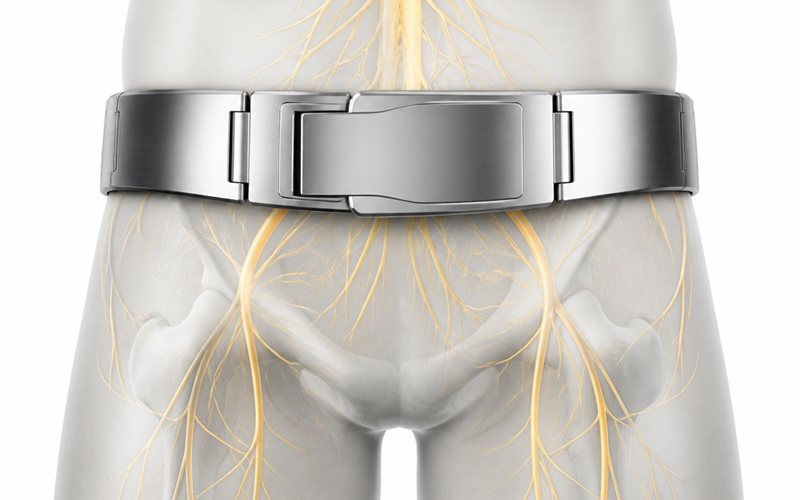
The physics is straightforward. A metal detector "detects the nearby presence of metal" by inducing eddy currents in conductive material — the more metal, the stronger the signal. A delicate dress buckle has little mass; an oversized Western or studded buckle has plenty. The buckle metal matters less than its size: solid brass, stainless steel, and zinc all register. For the full rundown of buckle metals, see our types of belt buckles guide.
Do airport body scanners detect belt buckles too?
Yes, but differently. Most U.S. airports now use millimeter-wave body scanners, which detect objects on the body — metal or not — and display them as areas to check. A belt buckle shows up as a shape the operator may want to inspect, which is exactly why TSA asks you to remove your belt before stepping in.

Key stat: Full-body scanners began supplementing metal detectors at airports in 2007 precisely because, unlike metal detectors, they "can detect non-metal objects" — meaning even a plastic or composite buckle can register as an anomaly on a scanner.
This is the key shift many travelers miss. A full-body scanner "detects objects on or inside a person's body for security screening purposes" and, crucially, can flag non-metal items too. So switching to a plastic buckle doesn't guarantee a clean pass on a scanner the way it might on an old metal detector — the buckle still appears as a shape. Removing the belt entirely is the only sure way to avoid a flag, regardless of machine.
Which belt buckles are most airport-friendly?
Small, solid, low-profile buckles. A slim dress buckle has the least metal mass and the smallest profile, so it's least likely to beep a detector or draw a second look on a scanner. Large statement buckles, studded belts, and heavy Western buckles are the most likely to trigger secondary screening. When in doubt, smaller and simpler wins — our belt buckle size guide covers judging buckle scale.

Here's how common buckle types compare for hassle-free travel:
| Buckle type | Metal mass | Detector risk | Scanner visibility | Travel verdict |
|---|---|---|---|---|
| Slim dress (plaque/flat) | Low | Low | Small shape | Best |
| Standard prong | Medium | Medium | Visible | Fine (remove belt) |
| Ratchet | Medium | Medium | Visible | Fine (remove belt) |
| Large Western/statement | High | High | Large shape | Most scrutiny |
| Studded belt | Very high | Very high | Many shapes | Avoid for travel |
For a sleek, low-profile travel option, the plaque buckle belts and dress belts sit flattest and screen cleanest.
Should you just take your belt off at security?
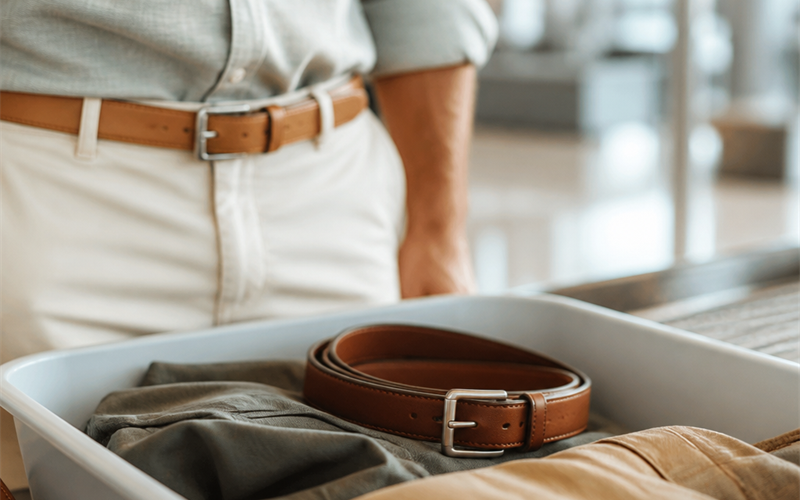
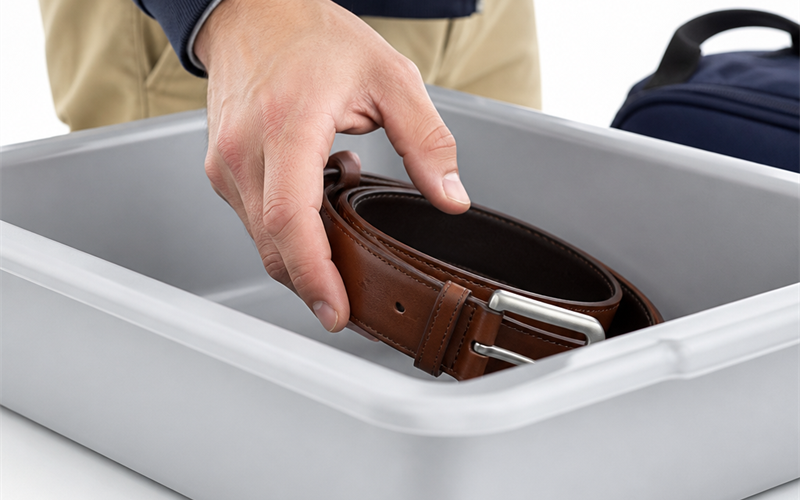
Yes — it's the simplest, fastest path. TSA and most international airports ask travelers to remove belts during screening anyway, so taking it off proactively and placing it in a bin avoids any beep, flag, or pat-down. Wear a belt that's easy to slip on and off, and you'll move through faster than fumbling with one that snags.

The practical takeaway: don't over-engineer your buckle for security — engineer your routine. Travel guides agree: SmarterTravel notes that most flyers must remove their belts before screening because the vast majority have metal clasps. A belt that unbuckles and re-buckles quickly saves more time than chasing a "detector-proof" buckle that scanners flag anyway. A clean, low-profile leather belt slides off in a second and looks sharp the moment you're through. Explore easy-wearing options in the men's belts collection; see what frequent flyers actually buy in our TSA-friendly belt buckles guide, and for the carry-on question, are studded belts allowed on airplanes.
The Bottom Line
Whether your belt buckle sets off airport security depends on the machine: a walk-through metal detector reacts to metal mass, so a big buckle may beep while a slim one often doesn't, while modern millimeter-wave body scanners flag the buckle as a shape regardless of what it's made of. In practice it rarely matters, because TSA usually asks you to remove your belt before screening anyway. The smart play is a small, solid, low-profile buckle on an easy-off belt — least likely to draw scrutiny and quickest through the line. BELTLEY's clean leather belts with refined buckles are built to look sharp and travel easy. Browse the travel-friendly plaque buckle belts and dress belts.
Frequently Asked Questions
Q: Do I have to take my belt off at airport security?
In most cases, yes — TSA and many international airports ask you to remove belts with metal buckles before screening. Taking it off proactively and placing it in a bin is faster than risking a beep or a flag. Slim belts with small buckles are sometimes allowed on, but rules vary.
Q: Will a plastic belt buckle avoid setting off security?
It can avoid a metal detector beep, but not a body scanner — millimeter-wave scanners detect non-metal objects too and will show a plastic buckle as a shape to inspect. For guaranteed ease, just remove the belt regardless of buckle material.
Q: Why does my belt buckle beep at the airport but not at the store?
Airport walk-through detectors are far more sensitive than retail anti-theft gates, which look for specific security tags. A buckle with enough metal mass registers on a sensitive airport detector. Store gates aren't tuned to detect ordinary buckle metal.
Q: What's the best belt to wear for flying?
A slim, low-profile leather belt with a small solid buckle that's quick to remove and re-fasten. It screens cleanly, slips off in a second for the bin, and looks polished on arrival. Avoid large statement buckles and studded belts, which draw the most scrutiny.