Why Hermès Belts Are Considered the Most Luxurious in the World?
TL;DR:
- Hermès belts are the most luxurious because of hand saddle-stitching, the same grade of leather used in Birkin bags, and a modular buckle system that elevates a single strap into an heirloom-quality wardrobe piece.
- Every retail Hermès belt is hand-stitched by an artisan who trained for months before ever touching the brand's premium hides.
- A complete Hermès belt kit starts around $790 and can run past $22,000 for rare VIP metal buckles — the price reflects genuinely exceptional materials plus a significant brand premium.
- If your goal is heirloom-grade leather without the Hermès markup, handcrafted full-grain and exotic alternatives exist at a fraction of the price.
Ask ten people which luxury belt sits at the very top of the pyramid, and nearly all of them will say Hermès. The H belt isn't the most logo-heavy, the most fashion-forward, or even the most recognizable on the street. But in quiet rooms where people actually know leather — tanners, saddlers, watch collectors, serious menswear enthusiasts — it's treated as the benchmark the rest of the market is measured against.
This guide breaks down why that reputation exists. Not in marketing terms, but in material terms: the leather, the stitching, the metalwork, the training, and the modular system that makes a Hermès strap behave less like an accessory and more like a platform. For a broader look at how Hermès ranks against competitors, our survey of the top luxury belt brands in the world provides useful context.
What Makes Hermès Belts the Most Luxurious?
Hermès belts are the most luxurious because of three factors no mass-luxury brand fully matches: the same grade of leather used in Birkin and Kelly bags, retail belts that are entirely hand-stitched using the sellier saddle-stitch method, and a modular strap-and-buckle system that treats the belt as a decades-long investment rather than a seasonal product.

That combination is unusual. Most "luxury" belts from houses like Gucci or Louis Vuitton use top-grain leather (good, not elite), machine stitching (fast, not artisanal), and fixed buckles (disposable once the trend passes). Hermès deliberately breaks all three conventions — and charges accordingly.
The house's origins explain the obsession. Hermès began in 1837 as a saddle maker for European nobility, and the brand still trains every new leather worker on saddle-making fundamentals before they touch a handbag or belt. That heritage isn't marketing. It's a production discipline that carries over literally — the same bridle-grade stitching and hand-edge finishing used on $50,000 equestrian saddles ends up on a $790 H belt.
How Hermès Sources and Selects Its Leather
Hermès sources from a small network of French, Italian, and Dutch tanneries — many of which the brand either owns outright or maintains exclusive supply contracts with. According to The RealReal's authentication guide, the two most common belt leathers are Box calf (a smooth, glossy calfskin with a polished finish) and Clemence (a heavier, matte-grained bovine leather). Both come from young animals raised under strict conditions — the finish depends on the hide being pristine before tanning even begins.
What separates Hermès leather from competitor leather isn't any single attribute. It's the rejection rate. Hermès reportedly discards 20–30% of each hide because minor scars, insect bites, or surface irregularities disqualify the affected areas. Mid-tier luxury brands use those same rejected sections. The discard discipline is why a Hermès Box calf belt has a uniformity of color and finish that's visibly different in person — even from a Gucci or Louis Vuitton belt three feet away.
The brand also uses exotic leathers — alligator (Mississippiensis), porosus crocodile, Niloticus crocodile, ostrich, and lizard — on premium belt lines. For a deeper comparison of exotic leather grades used across luxury, our explainer on how to tell if a belt is full-grain leather covers the visual and tactile markers of the highest leather tiers.
Why Is Hermès Stitching Different From Other Luxury Brands?
Hermès belts use the sellier (saddle) stitch — a two-needle, hand-sewn technique where both needles pass through the same pre-awled hole from opposite sides. It's structurally superior to machine stitching because if one thread breaks, the other holds. Machine-stitched belts unravel entirely when a single thread fails. No other mass-luxury belt brand hand-stitches every retail belt.

That's the technical explanation. The human explanation is slower: a new Hermès artisan in Paris spends the first month learning tools and the next several weeks practicing saddle stitch on scrap leather before being allowed near a hide destined for sale. A master saddle-stitcher can sew roughly 6–8 stitches per minute at full production quality. A machine can do 1,000+. That speed delta is where a significant share of the price premium comes from.
Visually, the sellier stitch has a distinctive 45-degree diagonal slant — each stitch leans slightly because of the hand pressure variation between left and right needles. Machine stitches are perfectly upright and uniform. Counterintuitively, the slight irregularity of a hand-stitched Hermès belt is the authentication marker. Perfect stitching on a supposed "Hermès" belt is usually a sign that it's fake.
The Modular Buckle System: One Strap, Many Belts
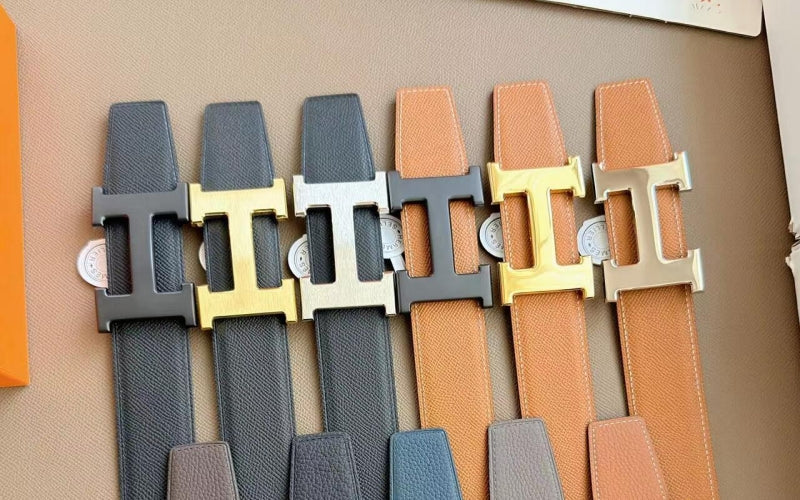
This is the design choice that most often gets missed when people ask why Hermès is positioned above its competitors. The H belt, Constance belt, and Chaîne d'Ancre belt are all built around a modular strap-and-buckle system: you buy a reversible strap (one side in one color/leather, the other side in another) and a separate buckle. The buckle detaches and swaps freely across compatible straps.

According to Gentleman's Gazette's H belt construction review, a collector with three straps and three buckles has 18 distinct belt combinations from six physical items — and each strap is reversible on its own, effectively doubling again. No other major luxury house offers this modularity. A Gucci GG belt is a Gucci GG belt forever. A Hermès H belt is a wardrobe that evolves.
The modularity is also practical: if the strap wears out after 15 years of daily use, you replace the $425 strap without re-buying the $500+ buckle. If the buckle style starts to feel dated, you swap to palladium or rose gold and the rest of the belt carries on. The brand also sells buckles without the strap for exactly this reason. That's not a product — that's a platform.
What Are Hermès Belt Buckles Actually Made Of?
Most Hermès belt buckles are cast brass with plated finishes — typically gold, palladium, permabrass, rose gold, or PVD coating. They are not solid gold, despite the luxury price. Solid 18k gold buckles exist for VIP clients but are extraordinarily rare, costing $20,000+ on the secondary market. The plating is what you're paying for: hypoallergenic, scratch-resistant, and finished to a standard that lasts decades with care.

The honest truth about Hermès hardware is a subject the brand itself rarely addresses directly, but BELTLEY's breakdown of Hermès belt buckle materials covers it in full. For most buyers this isn't a problem — the palladium plating on a Hermès buckle is significantly thicker and more durable than plating on a $200 designer belt, and it's what actually determines how the buckle looks in year ten.
For anyone asking whether the Hermès buckle is real gold, the short answer is: functionally gold-appearing, technically gold-plated brass. Genuine solid-gold and solid-palladium buckles do exist (usually Kelly or Constance variants in limited runs), and they show their metal purity on the resale market — palladium buckles regularly sell for $1,449 on average at 1stDibs, with rare pieces reaching $42,900.
How Much Does a Hermès Belt Really Cost?
A complete Hermès H belt kit starts at approximately $790 at retail — roughly $425 for the reversible strap and $355–$500 for a standard buckle. Exotic leather straps (alligator, crocodile) run $2,000–$5,000. Limited-edition and VIP buckles in solid precious metals have sold for over $22,000 on the secondary market. There is no "cheap" Hermès belt, and that's intentional.
The pricing logic is built into the modular system. You're not buying a belt; you're buying the starter set for a decades-long platform. A $790 entry is steep, but a belt that lasts 20 years with buckle swaps and strap replacements along the way has very different economics than a $450 fashion belt replaced every three years.
According to 1stDibs secondary market data for Hermès gold H belt buckles, the resale market ranges from $295 (older/worn) to $22,469 (rare and VIP), with an average of $600. That average retention is higher than almost any other luxury belt brand. Our full breakdown of why Hermès belts are so expensive walks through the cost structure in detail — including tanning, artisan labor, Parisian atelier overhead, and retail margin.
Do Hermès Belts Hold Their Value Better Than Other Luxury Brands?
Yes. Hermès belts retain more of their retail value on the secondary market than any other major luxury belt brand. Classic H belts in good condition typically resell for 60–80% of retail, versus 30–50% for comparable Gucci or Louis Vuitton pieces. Rare buckles, exotic leathers, and discontinued colors frequently appreciate above retail — a phenomenon almost no other belt category achieves.

The resale pattern is a market verdict on craftsmanship. Buyers on platforms like The RealReal, 1stDibs, and Vestiaire Collective treat Hermès belts differently from other designer belts precisely because the hand-stitching, leather grade, and hardware hold up after years of wear in ways that plated alloy and machine-stitched canvas do not. Our analysis of whether Hermès belts are still in style found that the H belt's value has been remarkably trend-immune — a belt sold in 2015 looks current in 2026.
That said, not every Hermès belt is a smart buy. Recent palladium hardware runs risk scratching — documented in buyer reviews — and can depreciate faster if surface wear shows. Box leather scratches more visibly than Clemence. Condition and leather type matter enormously to resale outcomes.
The Bottom Line
Hermès belts earn their "most luxurious" reputation through a combination almost no competitor replicates: Birkin-grade leather, saddle-stitching done entirely by hand by artisans trained for months before touching a retail piece, and a modular buckle system that turns a single purchase into a platform. The $790 entry isn't just paying for leather or metal — it's paying for the entire upstream discipline that makes those materials and that construction possible.
That doesn't mean a Hermès belt is the right purchase for everyone. A significant share of the price is genuine craftsmanship. A meaningful share is also pure brand premium — and brand premium is a personal decision, not a universal value.
At BELTLEY, we build belts with the same material philosophy Hermès started from in 1837: full-grain leather, genuine exotic hides (crocodile, alligator, elephant, python), and hardware that's built to outlast fashion cycles. Our exotic leather belt collection starts at $58 and tops out at $299, and every belt ships free worldwide with a 10-year warranty. It's not Hermès. It's also not trying to be. But if genuine material quality — not brand cachet — is what you're actually buying, there's a far more direct way to get it.
Frequently Asked Questions
Q: Why are Hermès belts considered the most luxurious?
Hermès belts are considered the most luxurious because they use Birkin-grade leather, are entirely hand-stitched using the sellier saddle-stitch method, and feature a modular buckle system that makes a single strap the foundation of a decades-long wardrobe piece. No other mass-luxury brand matches all three elements.
Q: Are Hermès belts really hand-made?
Yes. Every retail Hermès belt is hand-stitched by trained artisans in Paris using the sellier saddle-stitch technique. New Hermès leather workers spend their first month learning tools and several more weeks practicing stitches on scrap leather before touching a hide destined for sale. The hand-finished 45-degree diagonal stitch pattern is one of the primary authentication markers.
Q: Is a Hermès belt worth the price?
A Hermès belt is worth the price for buyers who value genuine craftsmanship, long resale retention (60–80% of retail), and the modular strap-buckle system that extends the belt's functional life across decades. If you're primarily buying for logo visibility or short-term fashion impact, cheaper designer options offer better immediate value.
Q: What leather does Hermès use for belts?
Hermès uses Box calf (smooth, glossy calfskin), Clemence (matte-grained bovine), Epsom (embossed calfskin), and exotic leathers including alligator, porosus crocodile, Niloticus crocodile, ostrich, and lizard. All come from a small network of exclusive tanneries, and Hermès rejects roughly 20–30% of each hide for minor imperfections.
Q: Are Hermès belt buckles made of real gold?
No. Standard Hermès belt buckles are cast brass with gold, palladium, permabrass, or rose gold plating — not solid precious metal. Solid 18k gold buckles exist but are extremely rare VIP pieces that sell for $20,000+ on the secondary market. Our full breakdown of Hermès buckle materials covers the specifics.
Q: Which Hermès belt is the most luxurious?
The most luxurious Hermès belts are generally exotic-leather Constance or Kelly belts with solid palladium or solid gold buckles — typically limited runs or VIP special orders. These can retail in the $5,000–$20,000+ range. For standard production, the H belt in Niloticus crocodile with a gold-plated buckle represents the flagship luxury offering.
Q: Does a Hermès belt last a lifetime?
With proper care, a Hermès belt strap can last 15–25 years of regular wear, and buckles can last significantly longer. The modular design means buckles and straps are independently replaceable, so the system effectively lasts indefinitely. Hermès offers repair services at their ateliers — a service almost no other designer belt brand provides.