Are Prada Belts Worth the Investment? An Honest 2026 Review
TL;DR:
- Yes — Prada belts are worth the investment if you value quiet, logo-restrained luxury, scratch-resistant Saffiano leather, and strong resale retention. The triangle logo is among the most understated designer markers at this price point.
- No — not for everyone. At $525–$850 for standard styles, Prada is priced above Gucci GG and Burberry but below Hermès. If you want maximum brand visibility, Gucci delivers louder. If you want hand-craftsmanship, Hermès leads.
- Prada belts retain roughly 70–80% of retail value on the resale market — one of the strongest retention rates in the designer tier.
- The Saffiano leather triangle logo belt at ~$750 is the flagship pick and the smartest first Prada belt purchase.
"Are Prada belts worth the investment?" is a question that usually gets answered in two ways. The first is the marketing answer: yes, because Prada is Prada. The second is the honest answer: it depends on whether you actually care about what you're paying for. This guide takes the second approach.
Prada occupies an unusual space in the luxury belt market. It's priced squarely in the $500–$850 designer-tier bracket, uses scratch-resistant Saffiano leather that genuinely outperforms standard calfskin in daily wear, and the triangle logo plaque reads quieter than Gucci's GG or Louis Vuitton's LV monogram. Whether that combination is worth the price depends on exactly what you want a luxury belt to do. For broader category context, our breakdown of designer belt brands vs luxury belt brands is useful reading before committing.
Does Prada Fit Your Priorities?
Sort yourself before the deep review:
| Your situation | Go with |
|---|---|
| Quiet logo, scratch-proof daily leather | Prada Saffiano ($525–$850) — the triangle whispers and the cross-hatch shrugs off keys. |
| Want louder brand presence | Gucci GG delivers more recognition for less money. |
| Want hand-craft at this price | Saffiano is machine-pressed by design — artisan hand-work lives elsewhere. |
| Want rarer material at a fraction of the price | Genuine crocodile, $118–$289 — handcrafted, legally sourced, and nobody else at dinner has one. |
The handcrafted alternative: BELTLEY's crocodile collection.
Are Prada Belts Worth the Investment?
Yes — Prada belts are worth the investment for most buyers seeking a mid-to-high designer belt with understated logo signaling. They use Italian Saffiano leather (genuinely more durable than standard calfskin), retain 70–80% of retail on resale, and the triangle plaque survives trend cycles better than louder designer logos. They're not worth it if you want maximum brand recognition at lower entry prices — Gucci and Burberry deliver that for less.

The investment case rests on three specific advantages. First, Saffiano leather — Prada's signature treatment, a cross-hatched finish applied to calfskin that significantly increases scratch and water resistance. Second, the triangle plaque logo — arguably the most restrained designer buckle in the $500–$850 range, which ages better than trend-driven logos. Third, resale performance: Prada belts consistently outperform Gucci and Burberry on secondary market retention, and vintage Prada has been cycling back into fashion relevance for 2024–2026.
The case against is narrower. Prada belts are not hand-stitched (machine construction), and the brand premium, while smaller than Hermès's, is still real. Buyers hunting for pure material value without brand markup will find better leather-per-dollar ratios from direct-to-consumer alternatives. For a fuller look at luxury belt cost structures, see our piece on whether luxury belts are worth it.
What Makes a Prada Belt Different?
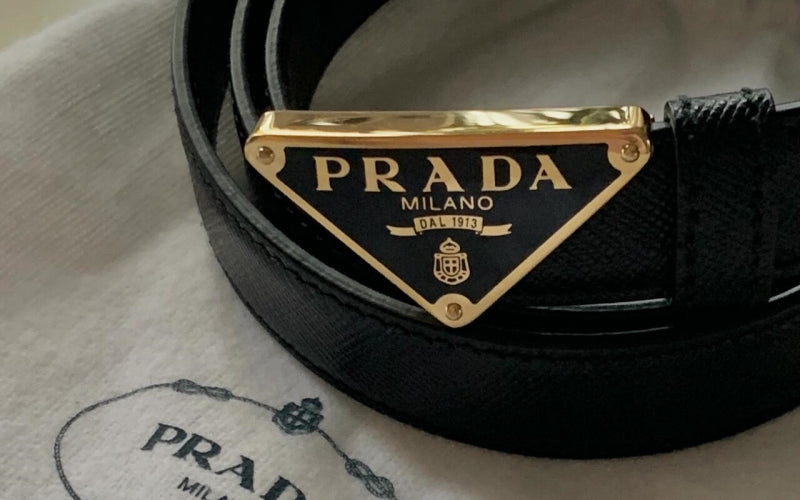
Prada belts are made from Saffiano leather — a cross-hatched, waxed calfskin treatment developed by Prada in the 1910s — paired with a silver-tone or gold-tone enamel triangle logo plaque. The Saffiano finish resists scratches, water, and daily wear noticeably better than smooth calfskin, which is why Prada uses it across its entire leather goods category, not just belts.
Saffiano isn't a marketing term. It's a specific leather-finishing technique where calfskin is stamped with a diagonal cross-hatch pattern and treated with a protective wax coating. The process was invented by Prada's founder Mario Prada in 1913 and remains proprietary to the house in its original formulation. The practical consequence: a Prada Saffiano belt looks newer longer than a smooth-calfskin Gucci or Ferragamo belt under equivalent daily wear.
According to FARFETCH's product specifications for the Prada triangle-logo leather belt, the standard construction is 100% calfskin leather with 100% metal hardware, crafted from smooth leather in Italy. Prada operates its own tanneries in Tuscany, giving the house more direct control over leather selection than most competitors at this price tier. The Saffiano leather belt on Prada's official site is a production staple that's been in continuous catalog for over a decade — a signal of sustained design maturity.
How Much Does a Prada Belt Cost?
A new Prada belt costs $525–$850 for most standard leather styles at retail. The entry point for basic Saffiano belts is approximately $450–$525. The flagship triangle-logo leather belt retails around $750. Premium styles with exotic leather, metal buckles, or limited-edition prints reach $1,200–$1,534. Pre-owned Prada belts on resale platforms range from $205 to $1,320 depending on style, rarity, and condition.

Here's the market breakdown:
| Style | Retail Price | Secondary Market |
|---|---|---|
| Saffiano leather belt (basic) | $450–$525 | $205–$380 |
| Triangle-logo leather belt | $750 | $420–$620 |
| Saffiano triangle-logo belt | $695–$850 | $450–$695 |
| Metal buckle / statement | $1,200–$1,534 | $800–$1,320 |
| Vintage Re-Edition 2005 | Varies | Often exceeds retail |
Lyst currently lists 320 Prada men's belts from 32 partner stores, with the full range spanning $285 to $1,320 — a reliable signal that Prada maintains consistent distribution across authorized retailers worldwide. Stylight aggregates 329 Prada belts from 15 stores with new belts clustering between $525 and $850, confirming the mid-to-high designer bracket pricing.
For cost-structure context across the luxury belt category, our explainer on why designer belts are so expensive walks through the material, labor, and brand-premium math.
Prada Belt Pros and Cons
The honest accounting:

Pros:
- Saffiano leather is genuinely more durable than smooth calfskin
- Triangle plaque logo is the most understated designer buckle at this price
- Made in Italy with Prada-owned tannery supply
- Strong resale retention (70–80%) — above Gucci, Burberry, Saint Laurent
- Trend-resistant design language vs logomania-era pieces
- Widely distributed through authorized retailers (Selfridges, SSENSE, Farfetch, MR PORTER)
Cons:
- Machine-stitched (not hand saddle-stitched like Hermès)
- Brand premium is still significant (~40–50% of retail)
- Counterfeits flood online marketplaces — must authenticate
- Saffiano's cross-hatch texture is divisive aesthetically
- Less brand recognition than Gucci, LV, or Chanel in mass markets
- Some styles use nylon or canvas rather than leather — check specifications
Do Prada Belts Hold Their Value?
Yes. Prada belts retain 70–80% of retail value on the secondary market after 2–3 years — one of the strongest retention rates in the designer tier, above Gucci (60–70%), Burberry (50–60%), and Saint Laurent (55–65%). Vintage Re-Edition 2005 pieces frequently exceed their original retail price on Vestiaire Collective and The RealReal due to consistent demand and low authenticated supply.
The Prada resale story has shifted significantly since 2022. The broader "2000s revival" in fashion brought Prada back into cultural relevance, and Re-Edition pieces — originally introduced as archival reissues — have become some of the most requested resale items in the luxury accessory market. The RealReal's analysis of Prada's investment value confirms that Prada leather goods maintain strong resale performance, with triangle-logo items showing "especially strong investment potential due to sustained popularity and demand in the secondary market."
That doesn't make every Prada belt a financial investment. Resale performance varies significantly by style: the triangle-logo leather belt and Saffiano classics hold value consistently, while heavily branded nylon belts or short-run collaboration pieces depreciate faster. Condition matters heavily — scratched buckles can reduce resale by 25–40%. Proper care (rotation, conditioning, storage) is the difference between 80% retention and 50%.
How Prada Belts Compare to Gucci, Hermès, and Ferragamo
Quick honest comparison across the main competitor brands:

| Brand | Entry Price | Leather | Resale Retention | Logo Subtlety |
|---|---|---|---|---|
| Prada triangle logo | $450 | Italian calfskin / Saffiano | 70–80% | High (understated) |
| Gucci GG | $350 | Italian calfskin / canvas | 50–65% | Low (bold) |
| Gucci Horsebit | $780 | Italian calfskin | 55–65% | Medium |
| Ferragamo Gancini | $450 | Italian calfskin | 65–80% | Medium |
| Burberry TB | $415 | Italian calfskin | 50–60% | Medium |
| Hermès H | $790 (kit) | Birkin-grade leather | 60–80% | Medium |
| BELTLEY Full-Grain | $58 | Full-grain / exotic | N/A (direct) | None |
Prada's closest competitor is Ferragamo — both use Italian calfskin, both Made in Italy, both price around $450–$750, both deliver understated hardware. Prada pulls ahead on resale retention; Ferragamo reads slightly more mature in business contexts. Against Gucci, Prada's quieter logo increasingly wins the quiet-luxury sensibility. Against Hermès, Prada is a tier below on craftsmanship but half the price of a complete H belt kit.
For the broader ranking, see our analysis of the top 10 luxury belt brands in the world.
Who Should Invest in a Prada Belt?
Invest in a Prada belt if you want understated designer signaling, prefer scratch-resistant Saffiano leather for daily wear, and value strong resale retention. Skip Prada if your priority is maximum brand visibility (Gucci is louder for less), hand-craftsmanship (Hermès dominates here), or pure material quality per dollar (DTC full-grain alternatives deliver more leather for the money).

The ideal Prada belt buyer is someone who appreciates that the triangle plaque reads as "expensive to people who know" rather than "expensive to everyone." For creative-industry professionals, architects, consultants, and quiet-luxury adherents, that tonal restraint is genuinely the point. The Saffiano leather's daily durability is a real practical advantage for people who use their belts every day.
If material quality per dollar is the actual priority, the math changes. BELTLEY's full-grain leather belt collection uses full-grain cowhide and genuine exotic leathers with stainless steel hardware, priced between $58 and $299 — typically a fraction of Prada's retail. The brand name isn't there, but if you came for the leather and not the logo, the value case is direct.
The Bottom Line
Prada belts are worth the investment for buyers who value quiet-luxury signaling, Saffiano's daily durability, and the strongest resale performance in the designer tier. The $525–$850 retail range is steep but defensible given the material quality, Italian manufacturing, and 70–80% resale retention that outperforms most direct competitors.
For buyers prioritizing brand visibility, Gucci or Louis Vuitton deliver more recognition per dollar. For buyers prioritizing hand-crafted construction, Hermès remains the benchmark. For buyers prioritizing material quality without the brand markup, direct-to-consumer alternatives offer better leather economics.
If the goal is genuine heirloom-grade leather at a fair price — handcrafted, backed by a 10-year warranty, and shipped free worldwide — our handcrafted designer belt collection covers the material case without the brand tax. Not Prada. Not trying to be. But if you're buying the belt and not the logo, this is where the math works.
Frequently Asked Questions
Q: Are Prada belts a good investment?
Prada belts are a reasonable investment for the designer tier, retaining 70–80% of retail value on the resale market after 2–3 years — better than most competitor brands at similar price points. Triangle-logo leather belts and Saffiano classics perform best. Logo-heavy nylon or short-run collaboration pieces depreciate faster. Like any designer belt, they should be purchased for wear, not as financial investments.
Q: How much does a Prada belt cost?
A new Prada belt costs $450–$850 for standard leather styles, with premium metal-buckle or exotic styles reaching $1,200–$1,534. The flagship triangle-logo leather belt retails around $750. Resale platforms list pre-owned Prada belts from $205 to $1,320 depending on style, rarity, and condition.
Q: What is Saffiano leather and why does Prada use it?
Saffiano leather is a cross-hatched, wax-coated calfskin treatment developed by Prada founder Mario Prada in 1913. The cross-hatch stamping and protective waxing increase scratch resistance, water resistance, and overall daily durability compared to smooth calfskin. Prada uses Saffiano across its entire leather goods category because it holds up better under regular wear — a genuine practical advantage at this price tier. For broader leather quality context, our guide to full-grain leather belts covers the underlying material grades.
Q: Are Prada belts better than Gucci belts?
Prada and Gucci sit at similar price tiers but signal differently. Prada's triangle logo reads more understated and has slightly stronger resale retention (70–80% vs Gucci's 50–65%). Gucci's GG and Horsebit belts have broader global brand recognition. For quiet-luxury buyers and professional settings, Prada often wins; for maximum visibility, Gucci delivers more at lower entry prices.
Q: Are Prada belts made in Italy?
Yes. Prada leather belts are Made in Italy, using Italian calfskin or Saffiano leather with Italian-produced hardware. Prada operates its own tanneries in Tuscany, giving the brand direct supply chain control. The "Made in Italy" designation on Prada belts reflects genuine Italian production, not just final assembly.
Q: How can you tell if a Prada belt is real?
Authentic Prada belts show consistent stitching (even and tight, never skipped), a sharp enamel triangle logo with crisp corners, and "PRADA MILANO" debossing with correct font spacing. The leather should have a firm, substantial feel — not flimsy or plastic-like. Real Saffiano has a precise cross-hatch pattern, not a vague or uneven one. Always buy from authorized retailers (Prada.com, FARFETCH, MR PORTER, Selfridges, SSENSE) or authenticated resale platforms (Vestiaire Collective, The RealReal) to avoid counterfeits.