Why Do My Pants Belts Keep Breaking? - 9 Reasons Explained
Quick answer for busy readers:
- Belts keep breaking mostly because of bonded or "genuine" leather that lacks the fiber structure to withstand daily stress — it cracks, peels, and delaminates within months.
- Cheap zinc-alloy buckles snap under tension, and over-tightening accelerates hole stretching and leather fatigue at every stress point.
- Switching to a full-grain leather belt with a solid metal buckle eliminates the cycle — expect 5-10+ years instead of 6-12 months.
You're on your third belt this year. The last one cracked around the holes. The one before that — the buckle prong snapped clean off. Now you're wondering if you're cursed, or if belts are just built to fail.
You're not cursed. But most belts under $40 are, in fact, built to fail. If your pants belts keep breaking, the problem almost always traces back to materials, construction, or how you wear them. Here are the eight specific reasons it happens — and what to do about each one.

Is Bonded Leather Why Your Belt Keeps Breaking?
Bonded leather is the single biggest reason belts break prematurely. It's made from shredded leather scraps mixed with polyurethane adhesive, pressed onto a fabric backing, and stamped with a grain pattern to look real. It contains as little as 10-20% actual leather fiber.
The problem is structural. Real leather gets its strength from dense, interlocking collagen fibers that flex without fracturing. Bonded leather has no continuous fiber network — just fragments held together by glue. When that adhesive dries out (and it will, usually within 2-4 years according to leather durability research), the material delaminates, peels, and cracks.
Here's the frustrating part: bonded leather is often sold under the label "genuine leather." That term sounds reassuring, but in the leather industry, it's actually the lowest usable grade. It sits below top-grain and far below full-grain in quality. If your belt tag says "genuine leather" and nothing more, you're holding a belt with an expiration date.

Why Do Belts Crack at the Holes?
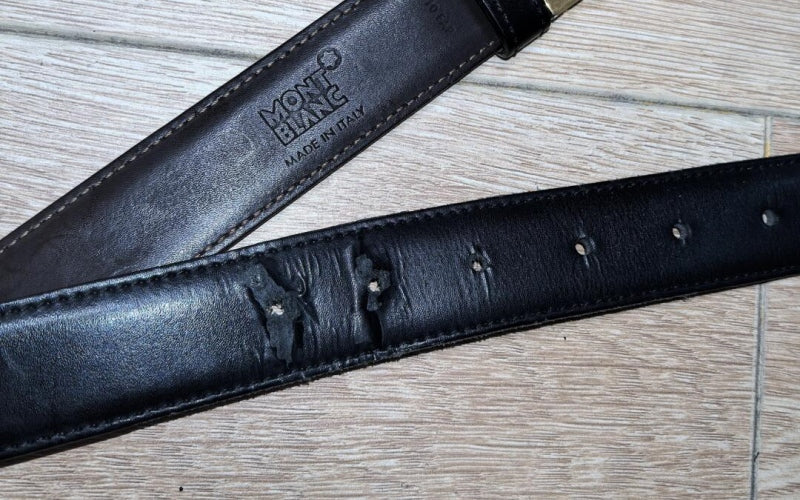
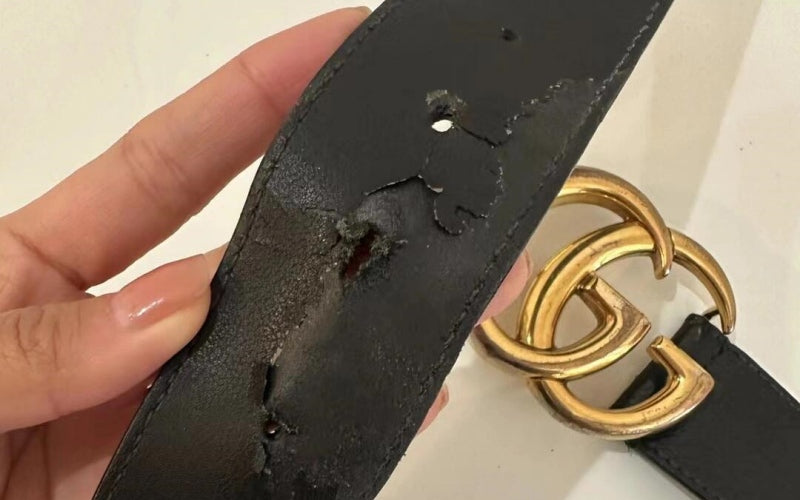
Belts crack at the holes because the punched holes create stress concentration points where the leather has zero material to resist tearing. Every time you fasten the belt, the prong pushes against the hole edge, stretching and weakening the surrounding fibers.
In bonded or split leather, this stress is fatal. The fragmented structure can't distribute the load, so cracks radiate outward from the hole like fractures in glass. Leatherworking forums at Leatherworker.net document this as the most common belt failure pattern.
Full-grain leather resists this because its dense, unbroken fiber structure disperses stress across a wider area. The hole deforms slightly over time — developing a natural oval shape — but the surrounding leather stays intact. That's why full-grain belts develop character rather than damage.
Prevention tip: Always use the middle hole on your belt. Using the first or last hole concentrates all tension at a single point, dramatically accelerating wear. For sizing guidance, check our belt size guide.

Cheap Buckle Hardware Is a Silent Killer
Your belt strap might be fine — but if the buckle is made from die-cast zinc alloy, it's living on borrowed time. Zinc-alloy buckles are lightweight, inexpensive, and brittle. The prong bends under repeated stress, the frame warps, and eventually the whole assembly snaps.
You can identify zinc alloy by weight: pick up the buckle and it feels almost hollow. Compare that to a solid brass or stainless steel buckle, which has a satisfying heft and cool-to-the-touch density. According to materials science data on metal corrosion resistance, stainless steel is the same grade used in surgical instruments and marine hardware — engineered to resist corrosion, bending, and fatigue.
Another hardware failure point: the buckle-to-strap connection. Cheap belts attach the buckle with a single snap or thin pin that loosens over time. Quality belts use Chicago screws or riveted stitching that locks the buckle in place permanently.
At BELTLEY, every buckle is either solid brass or stainless steel — never zinc alloy. That's a materials decision, not a marketing one.

Does Over-Tightening Break Belts Faster?
Yes — and most people over-tighten without realizing it. When you cinch a belt past its comfortable range, you're stretching the leather fibers beyond their elastic limit. The leather doesn't spring back. Instead, it develops permanent micro-tears along the grain that weaken the entire strap.
Over-tightening also grinds the buckle hardware against the leather at the fold point — the spot where the strap wraps around the buckle bar. This fold already absorbs the most stress of any point on the belt. Add over-tightening, and that fold becomes the belt's breaking point.
The right tension: you should be able to slide two flat fingers between the belt and your waistband. If you can't, the belt is too tight. If your pants still feel loose at that tension, the issue is pant fit, not belt tightness.
For a deeper look at what over-tightening does to your body (not just your belt), read about the side effects of wearing a tight belt.

How Heat, Moisture, and Sun Damage Leather Belts
Leather is skin — and like skin, it dries out, burns, and deteriorates without proper care. The collagen fibers that give leather its flexibility require a baseline level of moisture. When that moisture evaporates (from heat, direct sunlight, or dry indoor air), the fibers stiffen and crack.
Here's how each environmental factor damages belts:
| Environmental Factor | What It Does | How Fast |
|---|---|---|
| Direct sunlight / UV | Fades color, breaks down fiber bonds | Visible damage in 2-3 months of daily exposure |
| Heat (car dashboard, radiator) | Evaporates natural oils, causes shrinkage | Accelerated drying in days |
| High humidity / sweat | Promotes mold growth, weakens adhesives in bonded leather | Gradual over weeks |
| Dry indoor air (winter heating) | Dehydrates leather fibers | Cracking within one season |
The fix is straightforward: condition your leather belt 2-3 times per year with a leather conditioner or natural oil. This replenishes the oils that keep fibers flexible. For detailed care instructions, read our guide on how to keep leather belts from cracking.

Wrong Belt Width for the Job
A belt that's too narrow for heavy-duty use will break faster because the strap has less material to distribute stress. A 1-inch (25mm) dress belt worn with heavy jeans and tools absorbs the same total force as a 1.5-inch (38mm) belt — but across 33% less surface area. That means higher stress per square inch, faster fiber fatigue, and earlier failure.
Match your belt width to the workload:
- Light duty (dress pants, office wear): 1"–1.25" is fine
- Medium duty (jeans, casual daily wear): 1.38"–1.5" recommended
- Heavy duty (workwear, tool carry, outdoor use): 1.5" double-layer construction for maximum rigidity
Poor Stitching and Edge Finishing
Stitching failure is the third most common reason belts break, after leather degradation and buckle failure. Cheap belts use single-thread lockstitching that unravels the moment one stitch breaks. The thread itself is often polyester — durable enough in a sewing machine, but not waxed or treated for the constant flexing a belt endures.
Quality construction uses waxed linen or nylon thread in a double-stitch or saddle-stitch pattern. If one stitch fails, the adjacent stitches hold. The wax coating reduces friction against the leather, preventing the thread from cutting into its own stitch holes over time.
Edge finishing matters too. Raw, unfinished edges absorb moisture and fray. Properly burnished or painted edges seal the leather's cross-section, preventing delamination from starting at the perimeter. Check the edge of your current belt — if you see exposed layers or flaking paint, the belt is already on its way out.
The Leather Thickness Factor
Thin leather breaks. Full stop. Most mass-market belts use leather that's 2-3mm thick — just enough to look like a belt but not enough to resist daily bending stress. A quality belt strap should be 3.5-5mm thick for single-layer construction, or 6-7mm for double-layer builds.
Thickness matters because leather flexes every time you sit, bend, or twist. Each flex is a micro-stress cycle. Thicker leather absorbs these cycles across more material, spreading the fatigue. Thin leather concentrates the stress and develops permanent crease lines that eventually crack through.
You can test thickness at home: hold the belt flat and let the end extend off a table edge. A thick, healthy belt holds its shape horizontally for several inches. A thin or worn-out belt droops immediately.
The Bottom Line
If your pants belts keep breaking, the root cause is almost always cheap materials: bonded leather that cracks, zinc-alloy buckles that snap, thin straps that fatigue, and poor stitching that unravels. Add over-tightening and zero conditioning, and even a decent belt won't last long.
The fix is a one-time upgrade. A properly made full-grain leather belt with solid metal hardware will outlast five cheap belts — and cost less over time. Every BELTLEY belt ships free worldwide, includes a 10-year warranty, and comes with 30-day hassle-free returns. Stop replacing belts and start owning one that lasts.
Frequently Asked Questions
Q: How long should a leather belt last?
A full-grain leather belt with quality hardware should last 5-10+ years with basic care. Bonded leather belts typically last 6-18 months before cracking or peeling. The biggest factor is leather grade — full-grain vs. genuine leather makes the difference between years and months.
Q: Can I fix a cracked leather belt?
Minor surface cracks can be reduced with leather conditioner, but structural cracking (where the leather has split through) is permanent and irreparable. This is especially true for bonded leather, where the damage spreads once it starts. For preventive care tips, see our guide on keeping belts in good condition.
Q: Why does my belt buckle keep breaking?
Most buckle failures happen because the buckle is made from die-cast zinc alloy, which is brittle and cracks under repeated stress. Prong bending is the most common failure mode. Upgrading to a solid brass or stainless steel buckle belt eliminates this problem.
Q: How often should I condition my leather belt?
Condition your belt 2-3 times per year, or more frequently if you live in a dry climate or expose the belt to heat and sun regularly. Use a leather conditioner or natural oil (like mink oil or neatsfoot oil). Avoid silicone-based products, which can coat the leather and trap moisture. Read more on whether you should condition your leather belt.
Q: Is a thicker belt always better?
Thicker belts are more durable but also stiffer. For daily casual or dress wear, a single-layer 3.5-4.5mm belt offers the best balance of durability and comfort. For heavy-duty workwear, a 6-7mm double-layer belt provides maximum resistance to bending fatigue. Match thickness to use case — you don't need a workbelt for the office.