Why Cheap Belt Buckles Flake or Rust So Fast
Quick answer: Cheap belt buckles flake or rust because they are built from thin plating over die-cast zinc or low-grade steel. The micron-thin plating wears off under friction, exposing a dull base metal, and any iron content rusts when it meets sweat and air. Solid brass and stainless steel avoid both problems entirely.
Last updated: May 2026 • By BELTLEY Editorial
TL;DR:
- Cheap buckles use thin plating that wears through in months, revealing gray base metal.
- The base is usually die-cast zinc alloy that is brittle, or low-grade steel that rusts.
- Sweat and friction at the waistband accelerate both flaking and corrosion.
- Solid brass and 316L stainless steel do not flake or rust the same way.
You bought a sharp-looking buckle online, and within months it is peeling, spotting, or rusting at the edges. You are not unlucky — you bought the predictable result of cheap construction. The reasons cheap belt buckles flake or rust come down to two things: a paper-thin finish and a low-quality base metal underneath. Understanding both means you never waste money on a throwaway buckle again. This guide explains exactly why it happens and how to spot a buckle built to last. For the fundamentals, see the point of a quality buckle.

Why does the finish flake off cheap buckles?
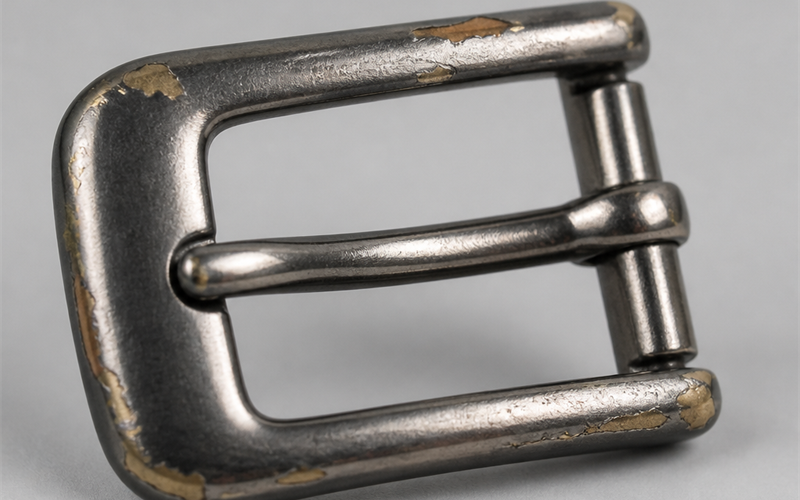
The finish flakes off because it is electroplating — a microscopically thin metal coating that wears through under friction. On a buckle that rubs against belt loops and fabric all day, that thin layer simply abrades away, exposing the different-colored base metal beneath.

The numbers explain it. Electroplated layers can be less than 0.1 micron thick — a coating thinner than you can imagine — applied to make cheap metal look like brass, chrome, or gold. Friction is relentless on a belt buckle, so that cosmetic skin is the first thing to fail. Once it goes, the illusion is over and the gray base shows. Quality buckles avoid this by being solid metal throughout, with no thin coating to lose.
Why do cheap buckles rust?
Cheap buckles rust when their base metal contains iron or low-grade steel that reacts with sweat and air to form iron oxide. Unlike stainless steel, this raw metal has no protective layer, so rust forms, flakes away, and exposes fresh metal to keep corroding.

Rust is iron oxide that forms on iron and steel exposed to oxygen and moisture, and it is flaky and friable, offering no protection to the metal underneath. A belt buckle lives against a warm, sweaty midsection — ideal corrosion conditions. Low-grade steel buckles without proper chromium content rust quickly there. By contrast, brass and aluminum form stable oxide layers, and stainless steel's chromium creates a self-healing shield, so neither rusts the way cheap steel does.
What is the cheap buckle's base metal really made of?
Most cheap buckles are die-cast zinc alloy (Zamak) under their plating. It is inexpensive to mold in bulk, but it is lighter and more brittle than quality metals, and it relies entirely on its plating for looks since the bare alloy is a dull gray.

Zamak is the standard zinc alloy for low-cost die-cast parts, and some variants grow brittle and lose elasticity over time. That is why a cheap buckle can crack as well as flake. The plating hides the cheap base; once it wears, you see — and get — exactly what you paid for. And if you are tempted by a vintage piece, knowing whether old belt buckles are worth anything helps you tell solid treasure from plated junk.
| Failure | Cheap Buckle | Quality Buckle |
|---|---|---|
| Finish | Thin plating, flakes off | Solid metal, no coating to lose |
| Base metal | Die-cast zinc or raw steel | Solid brass or 316L stainless |
| Rust | Yes, if iron content | No — brass and stainless resist |
| Lifespan | Months to a year | Decades |
| Weight | Light, sometimes brittle | Heavy and solid |
Key stat: The plating on a cheap buckle can be under 0.1 micron thick — which is why it abrades away in months on a high-friction item, while a solid brass or stainless buckle has no coating to lose in the first place.
How do you buy a buckle that won't flake or rust?
Buy solid metal, not plated. A buckle made entirely of solid brass or 316L stainless steel has no thin finish to flake and no iron to rust, so it lasts for decades instead of months. Weight and uniform color are your quickest quality checks.

At BELTLEY we hold every belt to a simple 3-Material Rule: full-grain leather, a solid stainless steel (304 or 316L) or solid-brass buckle, and sealed edges. That is why our hardware carries a 10-year warranty instead of a replacement cycle. Pick up the buckle: if it feels light and the back is a different color than the front, it is plated zinc waiting to flake. Solid, heavy, and uniform in color is what you want.
The Bottom Line
Cheap buckles flake and rust for two predictable reasons: a micron-thin plating that wears off, and a low-grade zinc or steel base that is brittle or rust-prone underneath. It is not bad luck — it is the design, built down to a price. The cure is just as simple: buy solid brass or quality stainless steel (304 or 316L), weigh the buckle in your hand, and check that the color is the same throughout. Spend once on solid hardware and you skip the endless replacement cycle for good. Explore BELTLEY's belt buckles collection for buckles built to outlast the leather.
Frequently Asked Questions
Q: Why did my new belt buckle turn silver at the edges?
That silver or gray showing through is the base metal beneath a worn plating. Cheap buckles are coated with a micron-thin finish to look like brass or chrome, and friction wears it off at the high-contact edges first. A solid metal buckle is the same color throughout and never does this.
Q: Can you fix a flaking or rusted belt buckle?
Usually not economically. Re-plating requires specialized equipment, and rust on a low-grade base will keep returning. The practical fix is to replace it with a solid brass or stainless steel buckle. If your belt allows buckle swaps, you can upgrade just the hardware.
Q: Do all metal belt buckles rust?
No. Rust is specifically iron oxide, so only buckles with iron or low-grade steel content rust. Solid brass (copper and zinc) and stainless steel (protected by chromium) resist rust, which is why they are the preferred metals for long-lasting buckles.
Q: Are expensive belt buckles always better quality?
Not always — price can reflect a brand name rather than materials. The real markers are solid construction and metal type: a solid brass or 316L stainless buckle is high quality regardless of logo, while an expensive plated-zinc buckle will still flake. Judge the metal, not the price tag.