PVD Coating on Belt Buckles: Does It Scratch Off?
Quick answer: PVD coating is a vacuum-applied thin film that bonds an extremely hard, wear-resistant color layer to a buckle — black, gunmetal, rose gold, and more. It is far tougher and more scratch-resistant than ordinary plating, so it does not flake off the way cheap coatings do, though years of heavy friction can eventually show wear on high-contact edges.
Last updated: May 2026 • By BELTLEY Editorial
TL;DR:
- PVD (physical vapor deposition) bonds a hard, thin color layer to metal in a vacuum.
- It is significantly harder and more corrosion-resistant than standard electroplating.
- It resists scratching and will not flake like cheap plating, but is not fully indestructible.
- Best results come from PVD over solid stainless steel, not over cheap zinc.
If you have eyed a sleek black or gunmetal buckle and wondered whether the color will rub off in a month, you are asking the right question. The answer depends on how the color was applied — and PVD coating is the gold standard. Unlike thin decorative plating that flakes, PVD bonds a genuinely hard finish to the metal. This guide explains how PVD works, why it outlasts plating, and the honest truth about whether it scratches. For the bigger hardware picture, see what a quality buckle is really built to do.

What is PVD coating on a belt buckle?
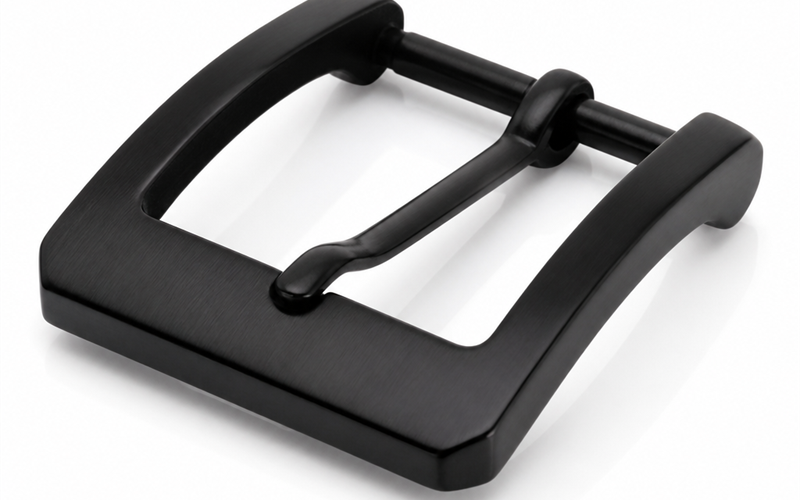
PVD (physical vapor deposition) is a vacuum process that vaporizes a coating material and deposits it as an ultra-thin, hard film bonded to the buckle's surface. It produces durable colored finishes — black, gunmetal, rose gold, brushed steel — that are part of the metal rather than painted on top.

The process happens inside a vacuum chamber, where PVD produces thin films and coatings on metals with high hardness and abrasion resistance. The same technology coats cutting tools, watch cases, and architectural metal precisely because it survives hard use. On a buckle, that means a color finish engineered to last, not a temporary cosmetic dip. You will see it on premium stainless steel buckle belts.
Does PVD coating scratch off?
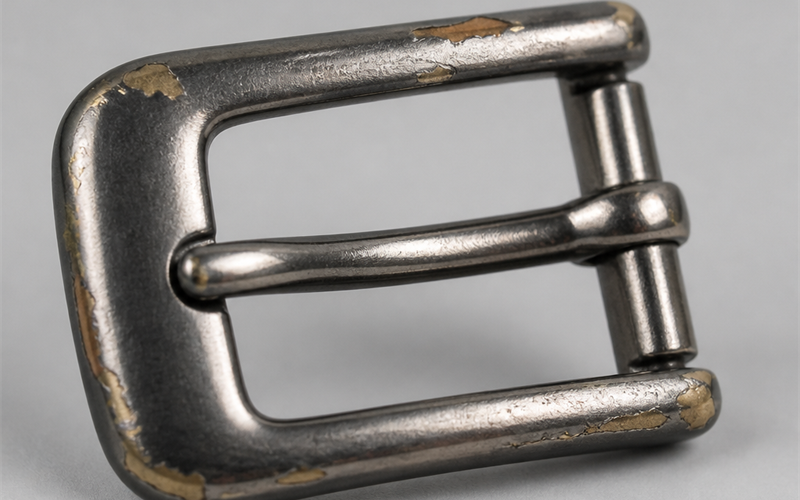
PVD does not flake or peel the way cheap plating does, because it is far harder and chemically bonded to the metal. It strongly resists scratching and everyday wear. Over many years, intense friction at high-contact points can eventually show some wear, but PVD vastly outlasts ordinary coatings.

The durability gap is real and large. PVD coatings offer superior hardness and corrosion resistance compared to electroplating, with abrasion resistance so high that protective topcoats are rarely necessary. A plated finish is a soft, sacrificial layer; PVD is a hard shell. For a belt buckle — which sees friction against fabric and belt loops — that toughness is exactly what you want from a colored finish.
PVD vs. electroplating: why the finish lasts longer
PVD lasts longer than electroplating because it is harder, thinner-but-denser, and bonded at a molecular level, while electroplating deposits a softer metal layer that abrades over time. The difference is a finish measured in years versus months.

| Feature | PVD Coating | Electroplating |
|---|---|---|
| Hardness | Very high | Low to moderate |
| Scratch resistance | Excellent | Poor — wears quickly |
| Corrosion resistance | Superior | Limited |
| Flaking / peeling | Rare | Common over time |
| Color options | Black, gunmetal, rose gold, etc. | Gold, chrome, nickel |
| Typical lifespan | Years of hard wear | Months on high-contact items |
Key stat: PVD coatings are so hard and abrasion-resistant that, per materials science, a protective topcoat is rarely needed — the opposite of electroplating, which wears through on a belt buckle within months.
Does the base metal under PVD matter?
Yes — PVD is only as good as what is underneath it. A hard PVD finish over solid stainless steel gives you a buckle that is durable through and through. PVD over cheap zinc alloy still leaves a brittle, low-quality core once the surface is compromised.

Think of PVD as an excellent finish, not a fix for a bad buckle. The smartest combination is a hard PVD color layer over a solid stainless steel body (304 or 316L), so both the surface and the structure are built to last. If you care about matching that finish to your other metals, our guide on whether your belt buckle should match your watch is worth a look.
The Bottom Line
PVD coating is the answer to "will the color rub off?" — and for once the answer is reassuring. It is a hard, vacuum-bonded finish that resists scratching and corrosion far better than the cheap plating it is often confused with, so a black or gunmetal PVD buckle keeps its look for years rather than flaking in weeks. The one caveat: PVD over solid stainless is the real deal, while PVD over zinc still hides a weak core. Choose a quality base metal with a PVD finish, and you get a colored buckle that actually earns its keep. Explore BELTLEY's belt buckles collection for finishes built to last — or our brass buckle belts for a warm solid-metal alternative.
Frequently Asked Questions
Q: Is PVD coating better than plating?
Yes, considerably. PVD is harder, more scratch-resistant, and more corrosion-resistant than standard electroplating, and it bonds to the metal rather than sitting on top as a soft layer. Plating tends to wear through on high-contact items like buckles within months, while PVD lasts years.
Q: Will a black PVD belt buckle fade?
A quality black PVD finish holds its color very well, because the coating is hard and chemically stable. Unlike painted or cheaply coated finishes, it resists fading and abrasion. Only after years of heavy friction might high-contact edges begin to show minor wear.
Q: Can PVD coating be repaired if it wears?
PVD is not easily touched up at home, since it requires specialized vacuum equipment to apply. The practical solution is to choose PVD over a solid base metal so the buckle remains functional and good-looking even in the rare event of edge wear. Quality construction matters more than reparability here.
Q: Is PVD coating safe for sensitive skin?
PVD finishes are generally inert and stable, and applying PVD over a low-nickel base like 316L stainless steel can create a skin-friendly barrier. For severe metal allergies, pairing PVD with a hypoallergenic base such as titanium or solid brass is the safest route.