Which Way Does a Belt Go? Left or Right Explained
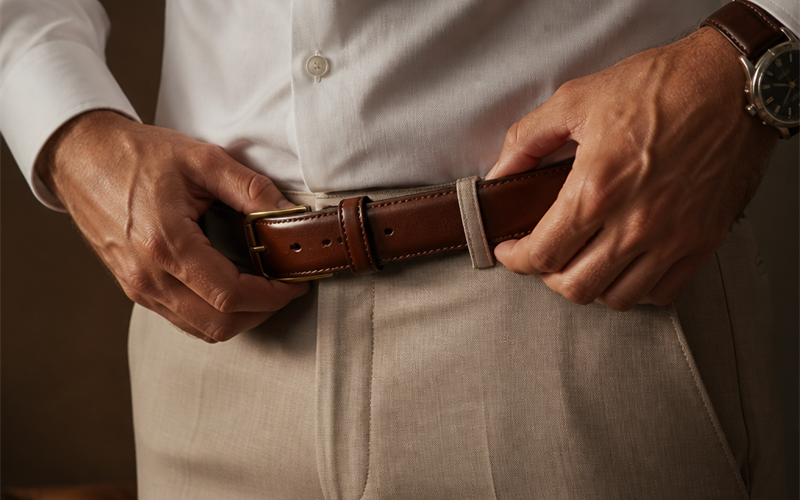
Quick answer: Traditionally, a man threads his belt to the left — the tail ends up pointing to his left after passing through the buckle (counterclockwise). A woman traditionally threads hers to the right, tail pointing right (clockwise). It mirrors the old left/right rule for shirt buttons. In practice, though, there's no real "wrong" way: most people thread toward their dominant hand, and modern style ignores the gender rule entirely. Comfort and a neat tail matter far more than direction.
Last updated: June 2026 • By BELTLEY
TL;DR:
- Traditional men's way: thread to the left, tail points left (counterclockwise).
- Traditional women's way: thread to the right, tail points right (clockwise).
- The origin mirrors shirt buttons — men's on the right, women's on the left.
- Why it existed: old military and dressing-servant conventions, not function.
- Today it barely matters — most thread toward their dominant hand; style is flexible.
- What actually matters: a snug fit, the tail in the keeper, and the right buckle.
It's one of those questions you never think about until you do: is there a correct direction to thread a belt? There is a traditional answer — and a tidy bit of history behind it — but also a reassuring truth that it almost never matters in real life. This guide gives you the rule, the reason, and permission to stop worrying about it. For more on the gendered belt question, see is there a difference between male and female belts.
Which Way Should YOUR Belt Go?
Match your situation to the convention.

| Your situation | Traditional direction |
|---|---|
| Man, by the book | Thread left — tail points to your left |
| Woman, by the book | Thread right — tail points to your right |
| Right-handed, comfort-first | Whatever feels natural (often counterclockwise) |
| Left-handed | Often the opposite — go with your hand |
| Honestly? | Whichever looks neat and feels comfortable |
The "rules" are tradition, not law. For the broader picture, see different types of belts with names.
Which way does a belt go for a man?
Traditionally, a man threads his belt to the left: starting from the right, the tail passes through the buckle and ends up pointing toward his left side (a counterclockwise direction). This mirrors the menswear convention seen in shirt buttons, which sit on the right for men.

This is the "by the book" answer, even if few men know it. As one men's belt guide states, "traditionally, a man threads his belt through the loops to his left, so the tail end points to his left." It lines up with the rest of traditional menswear, where closures favor the right-hand side. That said, real habits vary a lot. Writing in The Globe and Mail, one columnist admitted, "I myself thread counterclockwise (that is, the non-buckle end of the belt finishes by pointing left) and I am right-handed," and concluded there's no enforced standard. So the tradition exists, but nobody's checking. For the buckle's role, see what is the point of a belt buckle.
Which way does a belt go for a woman?
Traditionally, a woman threads her belt to the right: the tail passes through the buckle and points toward her right side (a clockwise direction) — the opposite of the men's convention. It follows the same logic as women's clothing buttoning on the left, mirroring men's garments.

The women's rule is simply the mirror image. Where men's tradition points the tail left, women's points it right, matching the way women's shirts and coats button on the opposite side from men's. Like the men's version, it's a holdover from historical dress conventions rather than anything functional today. And it's even more freely ignored: many women wear classic men's belts with jeans precisely for that borrowed, rugged look, threading them whichever way feels natural. The takeaway is the same for everyone — the direction is a tradition you can follow or skip. For women's options, see our women's belts.
Why do men's and women's belts go in opposite directions?
The opposite-direction tradition comes from the same history as buttons: men's and women's garments have long fastened on opposite sides. Theories trace men's right-side convention to needing a clear hand for a weapon, and women's left-side convention to right-handed servants who dressed wealthy women. Belts simply inherited the pattern.

The belt rule is really a footnote to a much older clothing convention. As Wikipedia notes, "classic clothing has the button on the left side for women and on the right side for men," and the leading historical theories are telling: men's right-side placement may relate to drawing a weapon with the dominant hand, while women's left-side placement accommodated the right-handed servants who dressed them. Belt direction followed the same logic. None of it reflects a functional need today — it's pure inherited tradition, which is exactly why modern style feels free to ignore it. For more belt history, see when were leather belts invented.
Key stat: The men-left, women-right belt rule isn't about belts at all — it mirrors the centuries-old button convention (men's buttons on the right, women's on the left). It's inherited etiquette, not function, which is why most people today simply thread toward their dominant hand.
Does it actually matter which way your belt goes?
No, not really. Belt direction is a tradition, not a rule of etiquette anyone enforces, and there's no functional downside to threading either way. Most people naturally thread toward their dominant hand, and modern fashion has largely dropped the gendered convention. What matters is a comfortable fit and a tidy tail.

Here's the freeing part: you can stop overthinking this. A right-handed person often finds counterclockwise threading easiest regardless of the "rule," and a left-handed person the opposite — both are completely fine. With androgynous and borrowed-from-the-other-department styling now common, the men-versus-women direction is more trivia than guideline. Focus your attention where it counts instead: a belt that fits snugly, a tail that tucks neatly into the keeper loop rather than flapping, and a buckle that suits the occasion. Get those right and no one will ever notice — or care — which way you threaded it. For tail length, see how far should a belt extend past the buckle.
The Bottom Line
So, which way does a belt go? Traditionally, men thread left (counterclockwise) and women thread right (clockwise), echoing the old left/right rule for buttons — a convention rooted in military and dressing-servant history, not function. In real life, it doesn't matter: thread toward your dominant hand, keep the tail neat in the keeper, and wear the direction that's comfortable. Modern style stopped policing this long ago. What's worth caring about is the belt itself — the leather, the buckle, the fit. At BELTLEY, we focus on exactly that: full-grain leather and solid hardware built to look right whichever way you wear it, backed by a 10-year warranty. Find yours in men's belts or women's belts.
Frequently Asked Questions
Q: Which way should a man wear his belt?
Traditionally, a man threads his belt to the left, so the tail points to his left after passing through the buckle (a counterclockwise direction). It mirrors menswear's right-side button convention. In practice there's no enforced rule — most right-handed men thread counterclockwise simply because it's comfortable.
Q: Which way should a woman wear her belt?
Traditionally, a woman threads her belt to the right, with the tail pointing to her right (a clockwise direction) — the mirror image of the men's convention, matching women's left-side buttoning. Like the men's rule, it's a tradition rather than a requirement, and many women wear belts (including men's belts) whichever way feels natural.
Q: Why do men's and women's belts go opposite ways?
Because their clothing traditionally fastens on opposite sides, the same reason men's and women's buttons differ. Historical theories link men's right-side convention to weapon access and women's left-side convention to right-handed servants who dressed them. Belts inherited the pattern; it has no functional purpose today.
Q: Does it matter which direction you thread a belt?
Not really. There's no functional downside to either direction, and no one enforces the traditional gender rule. Most people thread toward their dominant hand. Far more important are a snug fit, a neatly tucked tail, and a buckle suited to the occasion — those affect how the belt actually looks and works.
Q: Which way do you thread a belt if you're left-handed?
Whichever feels natural — often the opposite of a right-handed person, so clockwise. Dominant hand tends to decide threading direction more than any tradition does. There's no wrong choice; comfort and a tidy result are what matter, not following the historical men-left, women-right convention.
.%20A%20woman%20traditionally%20threads%20hers%20to%20t...)