Which Belt Hole Should You Use? The Middle-Hole Rule
Quick answer: You should fasten your belt on the middle hole — the third of five holes on a standard belt. Landing on the middle hole means the belt is the right size and leaves you adjustment room in both directions for weight changes, meals, and layering. If you're using the first (tightest) or last (loosest) hole, the belt is the wrong size, and you should size down or up accordingly.
Last updated: June 2026 • By BELTLEY Editorial
TL;DR:
- Fasten on the middle hole (3rd of 5) — it signals a correctly sized belt.
- The middle hole leaves room to adjust both tighter and looser as needed.
- First or last hole = wrong size; size down or up for the middle-hole fit.
- Belt sizing is measured to the middle hole, not the tip or the buckle.
Most people grab whichever hole holds their trousers and never think about it — but which hole you land on is actually a quick diagnostic of whether your belt fits properly. The middle-hole rule is the standard tailors and belt makers use, and it explains why so many belts feel "off." This short guide covers the rule, what the wrong hole tells you, and how to buy the right size. It pairs with how should a belt fit on a man.

Hole Audit: What's Yours Saying?
Read your current belt:
| Your situation | Go with |
|---|---|
| Middle hole (third of five) | Correctly sized — adjustment room both directions; carry on. |
| First (tightest) hole | Belt's too big — size down or have the buckle end trimmed. |
| Last hole, tail barely reaches | Too small — replace at waist + 2"; stretching never catches up. |
| Buying new | Try it on aiming for the middle — the rule works as a fitting test in reverse. |
Middle-hole fits via BELTLEY's size guide — honest measurements on every belt.
Which belt hole are you supposed to use?
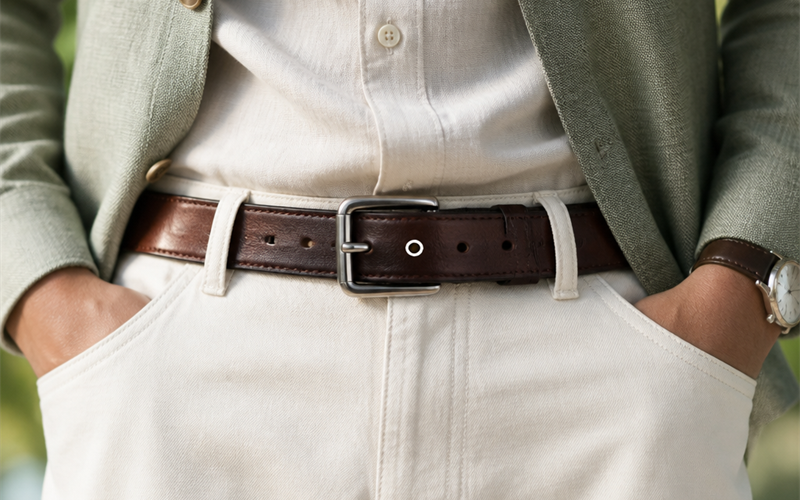
The middle one. On a standard belt with five holes, you should fasten on the third (middle) hole when wearing it at a comfortable tension. This is the target fit belt makers design around, and reaching it means your belt is correctly sized with equal room to tighten or loosen as your waist naturally changes.

This is the industry convention, not an arbitrary preference. Belt length is measured to that middle hole, so a belt's stated size assumes you'll fasten there. The general belt reference describes a belt as adjustable around the waist — and the middle hole is the center of that adjustment range, giving you two holes of margin on each side. Land there comfortably and you've got room for a heavy meal, a winter shirt tucked in, or modest weight fluctuation without ever running out of holes. Men's title MEL Magazine gives the same advice — "use the middle hole" — so you can "neatly tuck the reasonable excess into the next belt loop" rather than ending up with a too-long or too-short tail. It's the fit that keeps a belt versatile across the small day-to-day and season-to-season changes every body goes through.
What does it mean if you use the first or last hole?
It means the belt is the wrong size. If you fasten on the first (tightest) hole, the belt is too big and you should size down; if you're on the last (loosest) hole, it's too small and you should size up. Living on an end hole leaves no adjustment room and signals a sizing mismatch you can easily fix.

Key stat: A standard belt's labeled size corresponds to the middle (3rd) hole — so if your comfortable fit lands on the first or last hole, your true belt size is roughly one size off in that direction.
The end holes are a clear signal. Here's how to read where you land:
| Hole you use | What it means | Fix |
|---|---|---|
| First (tightest) | Belt too big | Size down |
| Second | Slightly big, still fine | Acceptable |
| Third (middle) | Correct size | Ideal |
| Fourth | Slightly small, still fine | Acceptable |
| Fifth (loosest) | Belt too small | Size up |
Being one hole off-center is fine — the second or fourth hole still gives you usable margin. It's the extreme holes that flag a real mismatch. If you've been blaming yourself for an uncomfortable belt, the hole you use may simply be telling you it was sized wrong. For the full method, see how do I know what size men's belt to buy.
How does the middle-hole rule affect buying a belt?
It tells you how to size. Because belt length is measured to the middle hole, you should choose a belt size that puts your comfortable waist fit on that third hole. A common guideline is to buy a belt about 2 inches larger than your trouser waist size, which typically centers the fit on the middle hole.

Sizing to the middle hole is the whole point of belt sizing. The familiar "add 2 inches to your pants size" rule of thumb exists precisely to land you on that center hole — though measuring your actual waist where you wear the belt is more reliable than guessing from trouser size. When ordering, check the maker's size guide and aim for the size whose middle hole matches your waist. Our size guide walks through it. Get this right and your new belt fastens comfortably on the middle hole out of the box, with adjustment room built in — no living on an end hole.
Do all belts follow the five-hole, middle-hole standard?
Most traditional leather belts have five holes and follow the middle-hole convention, but not all belts do. Some have more or fewer holes, and ratchet (holeless) belts replace holes entirely with a fine-toothed track. For hole belts, the middle-hole rule still applies; for ratchet belts, you simply adjust to the comfortable tension directly.

The five-hole standard is common but not universal. Some belts offer seven holes for extra range, and reversible or fashion belts vary. The principle — fasten near the center of the available range for adjustment room — carries over regardless of hole count. Ratchet belts sidestep holes altogether, letting you set any tension along a track, which is why they're popular for precise, between-the-holes comfort. If you find traditional holes too coarse — always slightly too tight or too loose — a ratchet style solves it. Otherwise, a quality five-hole belt sized to the middle hole serves perfectly, and you'll find plenty in our men's belts collection.
The Bottom Line
The middle-hole rule is the simplest sizing check there is: fasten on the third of five holes at a comfortable tension, and you know your belt fits right, with room to adjust in both directions. Using the first or last hole means the belt is the wrong size — size down or up to recenter. When buying, size so your comfortable waist fit lands on that middle hole, measuring your actual waist rather than guessing. And if traditional holes never quite hit the mark, a ratchet belt gives you stepless, precise adjustment. For belts that fit right on the middle hole — or adjust without holes at all — explore our men's belts and ratchet buckle belts collections, with full sizing help in our size guide.
Frequently Asked Questions
Q: Which hole should a belt be on?
The middle hole — the third of five on a standard belt — fastened at a comfortable tension. Landing there means the belt is correctly sized and leaves you room to adjust tighter or looser. If you're on the first or last hole, the belt is the wrong size.
Q: What does it mean if I use the last hole of my belt?
It means the belt is too small for you, and you should size up. The last (loosest) hole leaves no room to let the belt out further, so you've run out of adjustment. Aim for a size whose middle hole gives you a comfortable fit instead.
Q: How many holes should a belt have?
Most traditional leather belts have five holes, designed around fastening on the middle one. Some offer seven holes for extra range. Ratchet belts have no holes at all, using a fine-toothed track for stepless adjustment. For any hole belt, aim to fasten near the center of the range.
Q: How do I size a belt to fit on the middle hole?
Measure your waist where you actually wear the belt and choose the size whose middle hole matches that measurement, using the maker's size guide. A common rule of thumb is to buy a belt about 2 inches larger than your trouser waist size, which usually centers the fit on the middle hole.