Should You Loosen Your Belt When Sitting for Long Periods?
Quick answer: Yes, loosening your belt a notch during long sits — at a desk, on a flight, or after a big meal — is sensible and good for comfort. Sitting and eating both make your waist expand, so a belt that's comfortable standing can compress your abdomen when you sit, aggravating reflux, bloating, and circulation discomfort. Better still, wear a correctly sized, adjustable belt so you rarely need to loosen it at all.
Last updated: June 2026 • By BELTLEY Editorial
TL;DR:
- Yes — loosening a notch for long sits, flights, or after meals aids comfort.
- Sitting and eating expand your waist, so a standing-comfortable belt can dig in.
- A too-tight belt while seated can aggravate reflux, bloating, and discomfort.
- The better fix: a correctly sized, adjustable belt you rarely need to loosen.
You sit down at your desk after lunch, and suddenly the belt that felt fine all morning is pressing into your stomach. That's not your imagination — your waist genuinely expands when you sit and after you eat. Whether to loosen the belt, and how to avoid the problem altogether, is what this quick guide is about. It builds on our look at the side effects of wearing a tight belt.

Long Sit Ahead? Plan the Belt
Desk, flight, and dinner strategies:
| Your situation | Go with |
|---|---|
| Desk all day | One notch looser than standing tension — or size to your seated waist. |
| Long-haul flight | Loosen at cruise, absolutely — or fly in a stretch belt and pack the leather. |
| Big dinner out | The post-meal notch is physiology, not weakness — ratchet buckles make it invisible. |
| Loosening constantly anyway | The belt's a size small — middle-hole fit eliminates the daily negotiation. |
Micro-adjust ratchet options: BELTLEY's men's collection.
Should you loosen your belt during a long sit?
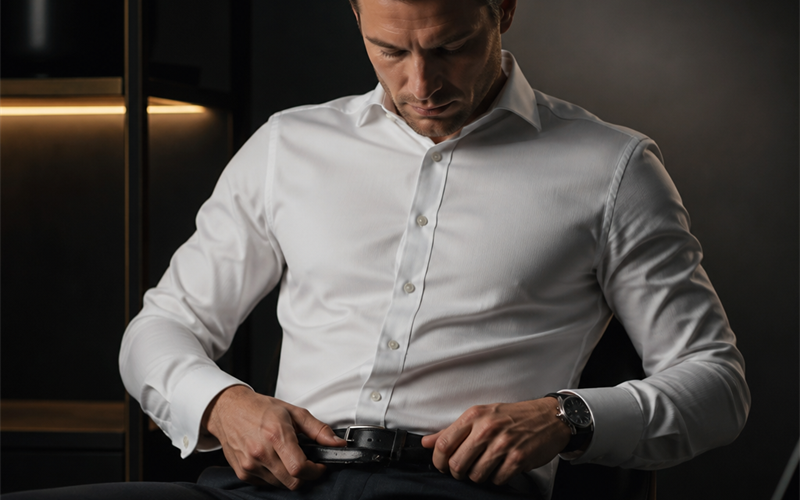
Yes, if it feels tight. When you sit for a long stretch — at a desk, on a flight, or after a meal — your abdomen expands and a snug belt can start to compress it. Loosening a notch relieves that pressure and improves comfort with no downside. It's a small, sensible adjustment, not a sign of a sizing failure.

Sitting changes your geometry. As you fold at the waist, your abdomen pushes forward and your midsection measurement increases, so the belt that sat comfortably while standing now presses in. The general belt reference describes a belt as worn around the natural waist — but that waist isn't a fixed number; it grows when you sit and eat. Loosening a notch simply accommodates the change. There's nothing wrong with doing it; it's the same logic as loosening after a big meal. Digestive-health resource Casa de Sante agrees that "unbuttoning your pants or loosening your belt might provide temporary relief in situations where changing isn't an option." The only thing to watch is forgetting to snug it back up when you stand.
Why does your waist expand when you sit or eat?
Because both compress and shift your abdominal contents forward. Sitting bends you at the waist and pushes the abdomen out, while eating fills and distends the stomach and intestines. Together they can add a noticeable amount to your waist measurement, which is why a belt comfortable while standing on an empty stomach can dig in when you're seated after lunch.

Key stat: Your waist measurement can increase meaningfully between standing-empty and sitting-after-a-meal — the combined effect of postural compression and a full, distended gut — which is exactly why a belt set for the morning can feel tight by mid-afternoon.
This is normal physiology, not weight gain. Here's what's happening:
| Action | Effect on waist |
|---|---|
| Standing, empty stomach | Smallest measurement |
| Sitting | Abdomen pushes forward, expands |
| After a meal | Stomach/intestines distend |
| Sitting + after a meal | Largest — belt feels tightest |
A belt cinched for the first row will feel tight by the last. This same expansion is why a tight belt while seated can aggravate reflux and bloating — the belt is compressing an already-expanded abdomen. Loosening relieves it; correct sizing prevents it.
How do you avoid needing to loosen your belt?
Wear a correctly sized belt at the two-finger tension, fastened on the middle hole, so there's already room for your waist to expand when you sit and eat. An adjustable belt — especially a ratchet style with fine increments — lets you fine-tune comfort without choosing between two coarse holes. Get the fit right and you rarely need to loosen at all.

Prevention beats reaction. If your standing fit follows the two-finger rule and lands on the middle hole, it already has built-in room for sitting and meals — see how tight should a belt be. The common trap is starting too tight, which leaves no margin for normal expansion. For people who sit for long hours or travel a lot, a ratchet buckle belt is ideal because it adjusts in tiny steps, so you can ease off a fraction without going fully loose. Sizing right from the start, as in how do I know what size men's belt to buy, is the real solution.
What about long flights — should you loosen then too?
Yes. Long flights combine prolonged sitting, often a meal, and sometimes mild bloating from cabin pressure, so loosening your belt a notch for the flight is a comfortable, healthy choice. Many travelers go a hole looser the moment they're seated. Just snug it back to the two-finger fit when you stand and move around.

Flying is the perfect storm for belt discomfort: you're seated for hours, you eat, and changes in cabin pressure can increase gas and bloating. Loosening a notch addresses all of it. Travelers often prefer an easily adjustable belt for exactly this reason — a ratchet style lets you ease off and re-tighten without fumbling for the right hole in a cramped seat. The same comfort logic applies to any long-haul sit. Whether on a plane or at a desk, the principle holds: relieve the pressure when seated, restore a comfortable fit when up.
The Bottom Line
Loosening your belt for a long sit, a flight, or after a big meal is a smart, comfort-friendly move — your waist genuinely expands when you sit and eat, and a belt set for standing can compress an expanded abdomen, aggravating reflux and bloating. There's no downside to easing off a notch, as long as you snug it back up afterward. The better long-term answer is a correctly sized belt worn at the two-finger tension on the middle hole, ideally one that adjusts in fine increments so comfort is always a small tweak away. For belts that make that effortless, explore our ratchet buckle belts and men's belts collections.
Frequently Asked Questions
Q: Is it okay to loosen your belt when sitting?
Yes. Sitting expands your abdomen, so a belt comfortable while standing can compress you when seated. Loosening a notch relieves the pressure and improves comfort with no downside — just remember to snug it back to a comfortable fit when you stand up.
Q: Why does my belt feel tight when I sit down?
Because sitting bends you at the waist and pushes your abdomen forward, increasing your waist measurement. If you've also eaten, your stomach and intestines are distended too. A belt cinched for standing on an empty stomach then presses in when you're seated after a meal.
Q: Should I loosen my belt on a long flight?
It's a good idea. Long flights mean prolonged sitting, usually a meal, and sometimes mild bloating from cabin pressure — all of which expand your waist. Loosening a notch keeps you comfortable; an adjustable ratchet belt makes easing off and re-tightening in your seat especially easy.
Q: How do I stop my belt feeling tight when seated?
Wear a correctly sized belt at the two-finger tension, fastened on the middle hole, so there's built-in room for your waist to expand when you sit and eat. A ratchet belt with fine adjustment lets you fine-tune comfort without jumping between coarse holes, so you rarely need to loosen it.