Where to Buy a Full-Grain Leather Belt (7 Best Sources)
TL;DR: Quick Answer
- Buy from DTC leather brands or specialist makers — not department stores or fast-fashion sites
- Look for "full-grain" on the product listing, solid brass or stainless steel hardware, and a warranty of 5+ years
- Expect to pay $58–$200 for a belt that lasts 10–20 years; anything under $40 is almost certainly not full-grain

Finding a real full-grain leather belt is harder than it should be. Most belts sold online — even expensive ones — use "genuine leather," which sounds premium but is actually the lowest usable grade. It cracks, peels, and falls apart within a couple of years.
A true full-grain leather belt uses the outermost layer of the hide with the natural grain intact. It's the strongest, most durable leather available, and it develops a rich patina over time instead of deteriorating.
This guide lists the best places to buy one, what to look for, and what to avoid.

Where Should You Buy? Match Your Priority
The 7 sources below differ mostly in price and proof. Shortcut by what matters to you:
| Your priority | Best source |
|---|---|
| Best quality-per-dollar | DTC leather brands — factory pricing, no retail markup, expect $58–$200 |
| You want to handle it before buying | A specialist leather maker or workshop — not a department store |
| You're tempted by a mall or fast-fashion belt | Don't — that's where "genuine leather" disguises itself as quality |
| You can't verify in person | Demand three things in the listing: the words "full-grain," solid brass or stainless hardware, and a 5+ year warranty |
For reference, BELTLEY's full-grain belts carry a 10-year warranty — double the checklist minimum. The full source-by-source rundown:
What Makes a Belt "Full-Grain"?
Full-grain leather is the top layer of the animal hide. The surface hasn't been sanded, buffed, or corrected. You can see natural markings — small scars, grain variation, subtle texture differences. These aren't flaws. They're proof the leather is real and unprocessed.
According to Obscure Belts' leather guide, full-grain retains the hide's tightest, densest fiber structure. That's what gives it superior tensile strength compared to top-grain or genuine leather. If you want a detailed comparison, our article on full-grain leather vs. genuine leather explains why the difference matters so much.

7 Best Places to Buy a Full-Grain Leather Belt
Here's a curated list of trusted sources, organized by type. Each one sells verified full-grain leather belts with transparent material claims.
1. Hanks Belts
Price range: $60–$120 | Warranty: 100 years | Made in: USA
Hanks Belts is a well-known name in the full-grain belt space. Their belts are 1.5 inches wide, thick, and built for daily use. The Gunner and Everyday models are popular picks. Leather is sourced domestically. Hardware is solid steel.
Hanks is a strong option if you want a no-frills, heavy-duty work belt with a generous warranty.
2. BELTLEY
Price range: $58–$299 | Warranty: 10 years | Shipping: Free worldwide
BELTLEY specializes in handcrafted full-grain leather belts and exotic leather accessories. Every belt is made by master artisans using full-grain cowhide, crocodile, alligator, or elephant leather. Hardware is stainless steel or solid brass — no zinc alloy.
What sets BELTLEY apart is the DTC model. No retail middlemen, no Brand Tax. A belt that would cost $300+ through a traditional luxury brand sells for $58–$150 here. The Brown Vintage Brass Buckle Belt is a good starting point — full-grain leather, solid brass buckle, white topstitching, under $100.

3. Saddleback Leather
Price range: $97–$130 | Warranty: 100 years | Made in: Mexico (US-designed)
Saddleback Leather uses only full-grain leather and is known for overbuilding their products. Their belts are thick, stiff out of the box, and take time to break in. Once they do, they last decades. Their 100-year warranty is backed by a reputation for extreme durability.
4. Main Street Forge
Price range: $50–$90 | Warranty: Lifetime | Made in: USA
Main Street Forge uses vegetable-tanned American steer hide. Their Bootlegger model consistently ranks high in independent reviews. As noted by TechGearLab's belt testing roundup, it's a top pick for thickness and durability at a mid-range price.
5. Popov Leather
Price range: $65–$100 | Warranty: Lifetime | Made in: Canada
Popov Leather makes handcrafted belts from full-grain, thick premium leather with solid brass buckles. Their focus is on minimalist, clean designs that develop a rich patina over time. Small-batch production ensures consistent quality.
6. Bullhide Belts
Price range: $55–$90 | Warranty: Lifetime | Made in: USA
Bullhide Belts specializes in thick, full-grain leather work belts. These are no-nonsense, heavy-duty options designed for tradespeople and gun belt use. If rugged durability is your priority over fashion, Bullhide delivers.
7. Etsy (Vetted Leather Artisans)
Price range: $40–$150 | Warranty: Varies | Made in: Varies
Etsy hosts hundreds of independent leatherworkers who sell full-grain belts. The quality ranges widely. Look for sellers with 500+ reviews, clear photos of the leather cross-section, and explicit "full-grain" claims. Avoid listings that only say "genuine leather" or "real leather" — those are red flags.

Quick Comparison Table
| Brand | Price | Warranty | Leather | Hardware | Shipping |
|---|---|---|---|---|---|
| BELTLEY | $58–$299 | 10 years | Full-grain + exotic | stainless steel / brass | Free worldwide |
| Hanks Belts | $60–$120 | 100 years | Full-grain cowhide | Steel | Paid |
| Saddleback | $97–$130 | 100 years | Full-grain cowhide | Steel | Paid |
| Main Street Forge | $50–$90 | Lifetime | Veg-tanned full-grain | Steel | Paid |
| Popov Leather | $65–$100 | Lifetime | Full-grain cowhide | Brass | Paid |
| Bullhide Belts | $55–$90 | Lifetime | Full-grain cowhide | Steel | Paid |
| Etsy (artisans) | $40–$150 | Varies | Varies (verify) | Varies | Varies |

Where NOT to Buy a Full-Grain Leather Belt
Some popular shopping destinations are terrible for leather belts. Here's where to be careful:
- Amazon (mass-market listings): The platform is flooded with belts labeled "genuine leather" that are bonded scraps. A few legitimate full-grain sellers exist (Main Street Forge has an Amazon store), but most sub-$30 listings are misleading. According to Hanks Belts' buying guide, cheap Amazon belts often use thin, glued layers with plastic-coated surfaces.
- Fast-fashion retailers (Zara, H&M, ASOS): These brands don't use full-grain leather. Their belts are synthetic or bonded. They're designed to last one season.
- Department stores (most brands): Some department store belts use top-grain leather, which is decent but not full-grain. Read the label carefully. If it doesn't explicitly say "full-grain," it isn't.
For a deeper guide on spotting the real thing, our article on how to tell if a belt is full-grain leather walks through every detail.

How to Verify Before You Buy
Use this checklist before adding any belt to your cart:
- Label says "full-grain." Not "genuine," not "real," not "premium." Full-grain. Specifically.
- Thickness is 3.5mm+. Thin belts (under 3mm) aren't cut from the full-grain layer.
- Edges are clean and beveled. Raw, rough edges signal cheap construction.
- Buckle material is specified. Solid brass, stainless steel, or sterling silver. If the listing doesn't say, it's probably zinc alloy.
- Warranty is 5+ years. A brand that offers a multi-year warranty trusts its materials. Our guide on how to choose a good leather belt covers these markers in more detail.
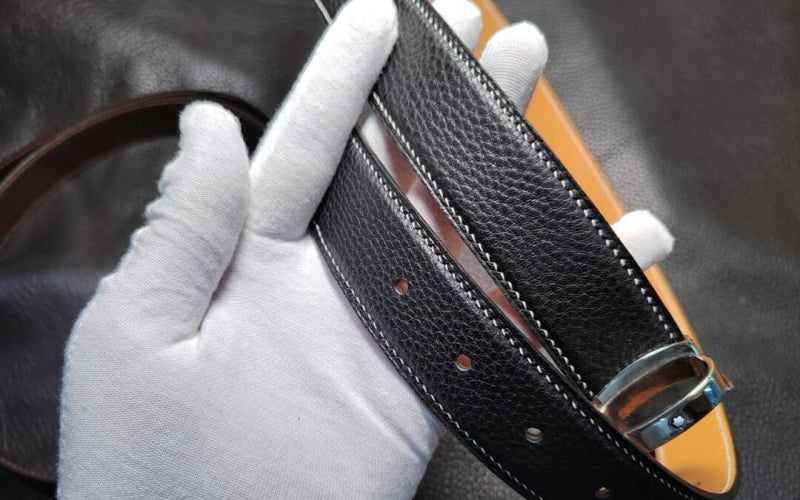
- Photos show natural grain. Look for slight imperfections, natural texture variation, and visible fiber on the back side. A perfectly smooth, uniform surface usually means corrected grain.
If you're wondering whether full-grain leather belts are worth the investment, the cost-per-year math makes the case clearly — a $100 belt lasting 15 years costs $6.67/year.

The Bottom Line
The best places to buy a full-grain leather belt are specialist DTC brands and independent leatherworkers — not department stores or Amazon's mass-market listings. Look for explicit "full-grain" labeling, solid metal hardware, and a warranty that backs up the durability claims. BELTLEY's full-grain leather belt collection starts at $58 with stainless steel buckles, a 10-year warranty, and free worldwide shipping — no Brand Tax, no middlemen.

Frequently Asked Questions
Q: How much should a full-grain leather belt cost?
A quality full-grain leather belt typically costs $50–$200. Below $40, you're almost certainly getting genuine leather or bonded leather mislabeled as full-grain. Above $200, you're paying for exotic materials, designer branding, or both. Our guide on how much a leather belt should cost breaks down pricing by tier.
Q: Can I find full-grain leather belts on Amazon?
Yes, but carefully. A few reputable brands like Main Street Forge and Hanks Belts sell on Amazon. However, most belt listings under $30 use misleading terms like "genuine leather" or "real leather" — which sound good but indicate lower-grade material. Always check the seller's brand page and read reviews for durability feedback.
Q: How do I know if a belt is really full-grain?
Check the surface for natural grain variation — small scars, slight texture differences, and visible pores. Full-grain leather will also have a natural leather smell, a slightly rough back side, and a thickness of 3.5mm or more. If the surface looks perfectly uniform and plastic-like, it's been corrected or coated. Our guide on how to tell if a belt is full-grain covers every test.
Q: Is full-grain leather the same as top-grain?
No. Full-grain uses the entire outermost layer of the hide with the natural surface intact. Top-grain has the surface sanded or buffed to remove imperfections, which also removes the densest fibers and reduces durability. Full-grain lasts 10–20+ years; top-grain lasts 5–10 years. Both are real leather, but full-grain is the superior grade.
Q: Do any luxury brands use full-grain leather in their belts?
Some do, but not all. Hermès uses high-quality calfskin in many of its belts. Some Gucci and Louis Vuitton models use corrected-grain or coated leather. The label "luxury" doesn't guarantee full-grain construction. Always check the specific product description — and if the leather grade isn't listed, that's usually a sign it's not full-grain.