Where Should a Woman Wear a Belt? Waist vs Hips
Quick answer: A woman should wear a belt at the narrowest part of her torso — for most, that's the natural waist, about 1–2 inches above the belly button. But the best spot depends on your shape: hourglass and pear figures flatter best at the natural waist, apple shapes often look better with the belt just under the bust (empire) or low on the hips, and a relaxed hip belt suits straight, boyish frames. The rule isn't "always the waist" — it's "wherever you're narrowest."
Last updated: June 2026 • By BELTLEY
TL;DR:
- Default spot: your natural waist — the narrowest point, ~1–2" above the belly button.
- Hourglass/pear: natural waist (or slightly above) to play up the curve.
- Apple shape: just under the bust (empire) or low on the hips, not the middle.
- Straight/boyish frame: a relaxed hip belt adds shape and a casual vibe.
- The real rule: belt your narrowest point, which isn't always the waist.
- Width matters too: thin belts for delicate framing, wider belts for bold definition.
"Just add a belt" is the most repeated styling tip there is — and it backfires constantly, because nobody says where to put it. Belt the wrong spot and you can widen exactly what you hoped to slim. The fix is simple once you know it: belt your narrowest point, and let your body shape fine-tune the rest. This guide maps placement to figure so your belt flatters every time. For sizing first, see how to size a belt for a woman.
Where Should YOUR Belt Sit? Find Your Spot
Match your shape to the most flattering placement.

| Your shape | Where to belt |
|---|---|
| Hourglass | Natural waist — accentuates the curve |
| Pear (fuller hips) | Natural waist to draw the eye up |
| Apple (fuller middle) | Just under the bust or low on the hips |
| Straight / boyish | Natural waist for a created curve, or hips for ease |
| Petite | High, just under the bust, to lengthen the legs |
When unsure, find where your torso creases when you bend sideways — that's your spot. For more, see how to choose a good belt for a woman.
Where is the natural waist, and why belt there?
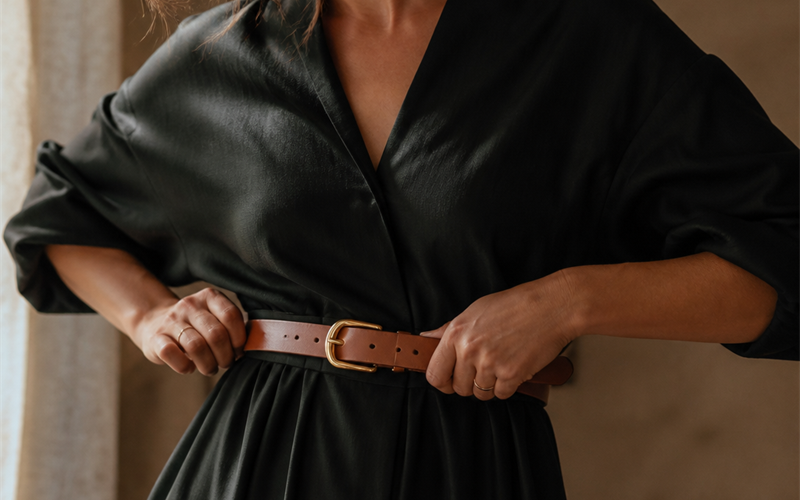
Your natural waist sits roughly 1–2 inches above your belly button, where your torso creases when you bend to the side — usually the narrowest part of your midsection. Belting there cinches the smallest point and creates an hourglass impression, which is why it's the default flattering placement for most women.

It's worth finding yours precisely, because it's higher than most people think — well above the hips where low-rise jeans sit. Bend sideways and notice where the fold forms; that crease is your natural waist. Cinching there nips in the narrowest spot and, by contrast, makes the hips and bust read as curvier. For the majority of figures this is the safest, most flattering choice. But "natural waist" isn't universal advice — for some bodies the narrowest point is actually higher or lower, which is where shape-specific tweaks come in. For the trend context, see are belts with dresses in style.
Should you ever wear a belt on your hips instead?
Yes. A hip belt works well for straight or boyish frames, for a relaxed bohemian look, and for drop-waist or shift dresses designed to skim the body. Sitting the belt low adds a casual, lengthening line and a subtle curve without cinching the middle — ideal when natural-waist definition isn't the goal.
Hip placement is the underused option. On a straighter figure, a belt worn loosely at the hips creates gentle shape and pairs naturally with relaxed silhouettes, drop-waist styles, and tunics. It reads casual and effortless rather than tailored. There's a caveat by shape, though: as one body-type guide warns for curvier figures, hip belts "will make you look unfortunately bottom-heavy," so they're best skipped if you carry weight on your hips. Think of the hip belt as a styling choice for ease and length, not a slimming trick. For a related dilemma, see belt or no belt with high-waisted jeans.
Where should an apple shape wear a belt?
An apple shape — fuller through the middle — usually looks best belting just under the bust (an empire line) or low across the hips, not at the natural waist. Both placements draw the eye away from the midsection. An empire belt elongates the body, while a hip belt adds shape without cinching the fullest part.

The goal for apple shapes is to avoid emphasizing the middle, so the natural waist is the one spot to skip. Belting just below the bust borrows from the empire silhouette — a style whose "fitted bodice ending just below the bust" gives a long, high-waisted line and visually lengthens the legs. Alternatively, a belt low on the hips defines without squeezing the tummy. Both move the focal point to your slimmer zones. This is the clearest example of why "always belt the waist" is wrong advice for some bodies. For more, see how to wear a belt when you have a belly.
Key stat: "Just add a belt" fails when it lands on your widest point. Many straight (H-shaped) bodies are actually narrowest at the rib cage, just under the bust — not the natural waist — so belting there, not in the middle, is what creates the curve. Placement, not the belt itself, does the work.
Why doesn't "just add a belt" always create a waist?
Because a belt only creates a waist if it sits at your narrowest point. If your slimmest spot is higher (at the ribs) or you belt over your widest part, the belt emphasizes width instead of nipping you in. Adding a belt at the wrong height can flatten or widen your shape rather than define it.

This is the styling myth that trips women up. As stylist Imogen Lamport explains, many straighter figures find their narrowest point "is higher than their natural waist, often on the rib cage, just under the bust," so a belt slapped on the natural waist lands on a wider spot and does nothing flattering. The belt isn't magic — placement is. Before you buy or position a belt, locate your true narrowest point and aim there, whether that's the natural waist, the ribs, or the hips. Width helps too: a wider belt makes a bolder statement, a thinner one a subtler frame. For width guidance, see thin or thick belt with a dress.
Does belt width change where you should wear it?
Yes. Wider belts make a stronger statement and generally sit best at the natural waist where they can define a clear curve; thin belts are more forgiving and work at the waist, under the bust, or on the hips. Match width to placement and proportion — a very wide belt low on the hips can overwhelm, while a skinny belt can get lost on a bold silhouette.

Width and placement work together. A wide statement belt commands attention, so put it where you want the eye to land — usually the natural waist on an hourglass or pear figure, defining the curve boldly. Thin belts are versatile: they frame gently at the waist, trace an empire line under the bust, or rest casually on the hips without dominating. Scale matters relative to your frame, too — petite women often look better in narrower belts that don't cut the torso in half, while taller frames can carry a wider belt. Choose the width for the effect you want, then place it at your narrowest flattering point. To explore options, see our women's belts.
The Bottom Line
Where a woman should wear a belt comes down to one principle: belt your narrowest point, not automatically your waist. For most, that's the natural waist about 1–2 inches above the belly button — perfect for hourglass and pear figures. Apple shapes flatter best just under the bust or low on the hips, straight frames can go either way, and petites lengthen with a higher placement. Pair the right height with the right width and "add a belt" finally works as promised. A quality belt makes all of this easier: at BELTLEY, our women's belts are cut in flattering widths from full-grain leather that holds its shape wherever you wear it, backed by a 10-year warranty. Find your spot with a women's leather belt or a versatile skinny belt.
Frequently Asked Questions
Q: Where is a woman's natural waist for a belt?
It's roughly 1–2 inches above your belly button, where your torso creases when you bend sideways — usually the narrowest part of your midsection. It sits higher than where low-rise jeans rest. Belting at this point cinches your smallest spot and creates the most flattering hourglass effect for most figures.
Q: Should I wear my belt at my waist or my hips?
Wear it at your natural waist to define a curve (best for hourglass and pear shapes), or on your hips for a relaxed, lengthening look (best for straight or boyish frames). Avoid hip belts if you carry weight on your hips, since they can look bottom-heavy. Belt your narrowest flattering point.
Q: Where should an apple-shaped woman wear a belt?
Just under the bust (an empire line) or low across the hips — not at the natural waist. Both placements draw the eye away from a fuller middle. The empire position also elongates your legs and torso, while a hip belt adds shape without cinching your widest point.
Q: Why does adding a belt sometimes make me look wider?
Because you're belting your widest point instead of your narrowest. If your slimmest spot is higher (at the ribs, under the bust) and you cinch the natural waist, the belt emphasizes width rather than creating a curve. Find your true narrowest point first, then place the belt there.
Q: What width belt is most flattering for women?
It depends on placement and frame. Wide belts make a bold statement and work best at the natural waist on curvy figures; thin belts are versatile and flatter at the waist, under the bust, or on the hips. Petite women usually suit narrower belts, while taller frames can carry wider ones.