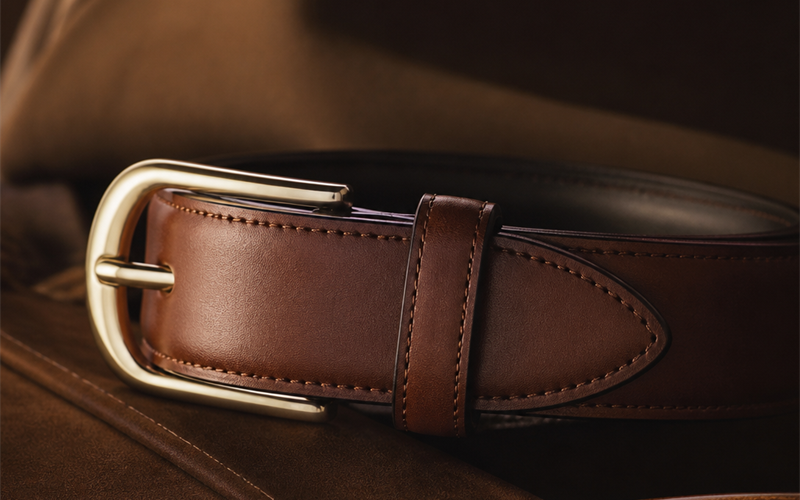
What Is a Belt Keeper Loop? (And Why It Matters)
Quick answer: A belt keeper loop is the small loop near the buckle that holds the free end (the "tail") of your belt in place after you fasten it, so it doesn't flap or stick out. Most quality belts have two keepers: one fixed loop sewn or riveted right beside the buckle, and one "floating" loop that slides along the strap to catch the tail wherever it ends. It's a small detail, but a missing or broken keeper is exactly why a belt tail won't stay tucked.
Last updated: June 2026 • By BELTLEY
TL;DR:
- What it is: the loop near the buckle that holds your belt's tail end in place.
- Its job: stop the free end from flapping or sticking out after you buckle up.
- Two types: a fixed keeper (sewn/riveted by the buckle) and a floating one that slides.
- Quality belts have two keepers; cheap belts may skip the floating one.
- Don't confuse it with the prong keeper, which fixes the belt at the buckle.
- A broken keeper is the usual reason a belt tail won't stay tucked — it's replaceable.
It's one of those belt parts you never think about until it fails — and then your belt tail won't stay put and the whole thing looks untidy. The belt keeper loop is a tiny component doing an outsized job. This guide explains exactly what it is, the two types, why good belts have two of them, and what to do when one breaks. For the full anatomy, see different types of belts with names.
Keeper Trouble? Quick Guide
Match your situation to what's going on.

| Your situation | What it means / do |
|---|---|
| Tail flaps loose after buckling | Missing or broken keeper — replace it |
| Only one loop, tail sticks out | No floating keeper; add or tuck manually |
| Keeper too tight to slide | Floating keeper sized small — ease it on |
| Keeper torn off | Replaceable by a cobbler or DIY |
| Buying a new belt | Look for two keepers, well-attached |
A good belt makes this a non-issue. For choosing one, see how to choose a good leather belt.
What is a belt keeper loop?
A belt keeper loop is the small loop attached near the buckle that holds the free end of the belt — the tail — in place once you've fastened it. It stops the tail from flapping around or sticking out awkwardly, keeping the belt neat. It's a simple but essential finishing component on most belts.

It's a humble part with a clear purpose. As Wikipedia notes, "many belts have a 'keeper loop' affixed to one end, near the buckle" and "the keeper loop stops the free end of the belt from flapping around once the belt is buckled." After you thread the belt and fasten it, you tuck the leftover tail through the keeper, and it sits flat against the belt. Without one, that tail dangles or pokes out past your hip — the difference between a belt that looks finished and one that looks sloppy. The keeper is small, but it's what makes the whole belt look intentional. For where the tail should end up, see how far should a belt extend past the buckle.
What's the difference between a fixed and floating keeper?
A fixed keeper is sewn or riveted permanently right next to the buckle and doesn't move. A floating keeper isn't anchored in place — it slides freely along the strap so it can catch the belt tail wherever it happens to end, no matter your waist size. Most well-made belts have one of each.

The two work as a team. The fixed keeper sits immediately after the buckle and holds the tail at a set point, giving the belt a clean start. The floating keeper, held only loosely so it can slide, moves to wherever your tail lands after fastening — which changes depending on which hole you use. That's why a quality belt includes both: the floating loop adapts to your exact size and tucks the tip neatly, while the fixed loop anchors everything by the buckle. Cheaper belts sometimes include only the fixed keeper (or a too-tight floating one), which is why their tails won't stay put. For more belt-construction detail, see the truth about leather belt durability.
Key stat: A well-made belt usually has two keepers — one fixed by the buckle and one floating that slides to catch the tail at any waist size. Cheap belts often include just one (or none), which is the real reason their tail won't stay tucked. The keeper is tiny, but it's a genuine quality tell.
Is the keeper loop the same as the prong keeper?
No. The keeper loop discussed here holds the belt's tail end, but there's a separate "prong keeper" — a small loop on some belts that the buckle's prong passes through to lock the belt firmly in place at the front. They're both called keepers, but one manages the tail and the other secures the buckle.

It's worth knowing the distinction, because "keeper" gets used for two different parts. The tail keeper loop is what most people mean — the loop that tidies the free end. The prong keeper is a more specialized feature: as one menswear piece describes it, "into this loop goes the buckle's prong, and the belt is fixed in place, impervious to twisting, bending, seating and rising." In other words, the prong keeper anchors the belt at the buckle so it can't shift, while the tail keeper manages the leftover length. Both contribute to a belt that stays neat and secure all day. For why a secure buckle matters, see what is the point of a belt buckle.
How do you fix or replace a broken belt keeper?
A broken or missing keeper is replaceable. A cobbler can stitch on a new leather keeper quickly, or you can DIY one: cut a strip of matching leather, form it into a loop sized to your belt's width, and secure it with stitching or eyelets. In a pinch, the tail can be tucked into your first trouser belt loop instead.

Don't toss a belt over a missing keeper — it's an easy fix. The keeper is just a small leather loop, so a leatherworker can add a replacement in minutes for a few dollars. For a DIY approach, as one repair guide frames the goal, that "extra length that becomes inconvenient (and an eye sore)... can be kept neatly with an adjustable belt loop keeper" — so cut a strip of leather to your belt's width, loop it, and fasten it with stitching or eyelets. As a temporary measure, just tuck the belt tail through the first belt loop on your trousers to keep it flat. None of this means scrapping a belt you like. For more repairs, see how to fix a loose belt buckle.
The Bottom Line
The belt keeper loop is a small part with a real job: holding your belt's tail in place so the whole belt looks neat and finished. Quality belts include two — a fixed keeper anchored by the buckle and a floating one that slides to catch the tail at any waist size — and that pairing is a quiet sign of good construction. Don't confuse it with the prong keeper, which secures the belt at the buckle. And if a keeper ever breaks, it's an easy, cheap fix rather than a reason to retire the belt. Little details like these are exactly what separate a well-made belt from a throwaway — and what we build into every belt at BELTLEY, in full-grain leather with a 10-year warranty. See the difference in a full-grain leather belt or a classic dress belt.
Frequently Asked Questions
Q: What is a belt keeper loop for?
It holds the free end (tail) of your belt in place after you fasten it, stopping the tail from flapping or sticking out. You tuck the leftover length through the keeper so it lies flat against the belt, giving a neat, finished look. Without it, the belt tail dangles untidily past your hip.
Q: Why do belts have two keeper loops?
Because the two do different jobs. The fixed keeper, sewn or riveted by the buckle, anchors the tail at a set point, while the floating keeper slides along the strap to catch the tail wherever it ends for your waist size. Together they keep the tail neat no matter which hole you fasten.
Q: What is the difference between a fixed and floating belt keeper?
A fixed keeper is permanently attached next to the buckle and doesn't move. A floating keeper isn't anchored, so it slides freely along the belt to hold the tail at any position. Quality belts usually have one of each; cheaper belts may include only the fixed one, so their tails won't stay tucked.
Q: How do you replace a broken belt keeper?
Take it to a cobbler, who can stitch on a new leather keeper in minutes, or DIY one by cutting a strip of matching leather, forming a loop sized to your belt's width, and securing it with stitching or eyelets. As a temporary fix, tuck the belt tail through your first trouser belt loop.
Q: Is a belt keeper the same as a belt loop on pants?
No. A belt keeper is the small loop on the belt itself that holds the belt's tail. The belt loops on your trousers are the fabric loops the whole belt threads through to stay on your waist. They sound similar but are different parts — the keeper is part of the belt, the loops are part of the pants.


%20of%20your%20belt%20in%20place%20after%20you%20fasten%20it,%20so%20it%20doesn't%20flap%20or%20stick%20out.%20Most%20quality%20bel...)