What Belt Should a Lawyer Wear in Court? A Complete Guide
TL;DR:
- A lawyer's court belt should be smooth full-grain leather, 32–35mm wide, with a slim rectangular buckle in silver or gold
- Color rule: always match your belt to your shoes — black with black, dark brown with dark brown — no exceptions in court
- Belt quality is visible at close range; a cracked or peeling belt signals the same lack of preparation as a wrinkled suit
Courtroom credibility is built from hundreds of small details. The belt is one of them. Judges, opposing counsel, and jurors all form impressions within seconds of seeing you, and a mismatched, undersized, or low-quality belt is the kind of detail that registers subconsciously even when nobody consciously notices it. The standard for a lawyer's belt in court is specific — not intimidating, but specific. Here is exactly what to wear, and why each element matters.
What Belt Should a Lawyer Wear in Court?
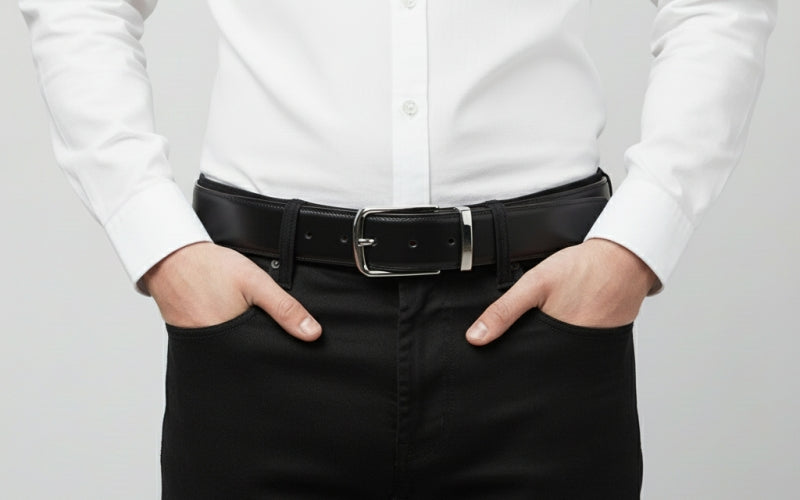
A lawyer appearing in court should wear a smooth, full-grain leather belt, 32–35mm (1.25"–1.38") wide, in black or dark brown, with a slim rectangular metal buckle. The belt must match the shoes in both color and finish. No logo buckles, no texture variations, no novelty hardware. The goal is a belt that reads as part of the suit, not apart from it.

This standard appears consistently across official court dress code guidance. The U.S. District Court for the Eastern District of Texas's written courtroom attire standards specify that attorneys must wear standard business attire, which in practice means the same dress conventions that govern formal corporate environments. For a broader breakdown of how belt width maps to formality, see The Ultimate Guide to Standard Belt Width in MM.
What Color Belt Should a Lawyer Wear in Court?
The color of a lawyer's court belt is determined entirely by shoe color. Black shoes require a black belt. Dark brown or oxblood shoes require a dark brown or espresso belt. This rule is absolute in court — mismatching belt and shoe color is one of the most visible dress errors in a formal professional setting, and it has no upside.

According to Von Baer's attorney dress code guide, attorneys are advised that belt, briefcase, and shoe colors should all coordinate — a standard that reinforces the idea of a cohesive, considered professional appearance. In practical terms, this means most courtroom lawyers wear black. A charcoal, navy, or black suit with black oxford shoes and a black belt is the default combination across every jurisdiction and court type.
Dark brown works well with tan, mid-grey, and some navy suits paired with brown leather shoes. If you're unsure, black is always the safer call in court. See Should Belt and Shoes Match Exactly? for the precise rule and when slight variations are permissible.
The Exact Specifications: Width, Leather Grade, and Buckle
This is where most attorney dress guides stop at generalities. Here are the specific numbers:
| Specification | Court Standard | Why It Matters |
|---|---|---|
| Width | 32–35mm (1.25"–1.38") | Fits dress trouser loops; wider reads as casual |
| Leather grade | Full-grain (top layer of hide) | Doesn't peel or crack; develops patina not damage |
| Finish | Smooth, matte or low-sheen | High-gloss reads as cheap lacquer; textured reads as casual |
| Buckle style | Slim rectangular plaque | Minimal, low-profile; no logos, no beveled edges |
| Buckle metal | Brushed silver or brushed gold | Matches watch and cufflinks; avoid mirror-polish or mixed metals |
| Buckle size | 30–35mm wide | Proportional to belt width; not oversized |
The leather grade point deserves emphasis. Nimble Made's professional dress code guide for lawyers specifically recommends full-grain vegetable-tanned leather as the correct material for attorney belts — and for good reason. Full-grain leather is the outermost layer of the hide, the densest and most durable section, and it ages by developing a patina rather than cracking and flaking. A genuine leather or bonded leather belt will begin to peel at the stress points — the buckle bar and the prong hole — within months of regular use. In court, at close range, that kind of wear is visible and it signals exactly what you don't want it to signal.
At BELTLEY, our full-grain leather dress belts are built to this exact standard — handcrafted, smooth-finished, with stainless steel buckles that maintain their finish without polishing.
Does Belt Quality Actually Matter in Court?
Yes. A worn, cracked, or cheap-looking belt signals the same underlying message as a wrinkled shirt or scuffed shoes — that the wearer did not pay full attention to their presentation. In court, where credibility is your primary asset, that signal is worth avoiding.

Research on courtroom credibility and professional appearance is consistent. A study on attorney appearance and juror perception published in the Journal of Applied Social Psychology found that jurors form competence impressions based on grooming and attire coherence within the first 30 seconds of seeing an attorney. The specific items are less important than the overall coherence — but the belt is the kind of detail that breaks coherence when it's wrong. A cracked leather belt, a mismatched color, or an oversized buckle all register as inconsistencies even to observers who couldn't articulate why.
The practical implication is simple: a quality belt costs more upfront and costs nothing for years afterward. BELTLEY's 10-year warranty reflects exactly this logic — a well-made belt is not a recurring purchase.
What Belt Should a Female Lawyer Wear in Court?
A female lawyer in court should wear a slim belt, 25–30mm (1"–1.18") wide, in smooth black or dark brown leather, with a minimal buckle — if wearing a belt at all. In many courtroom women's outfits, the belt is an optional accent rather than a required component, particularly with structured blazers and skirts where the waist is already defined by tailoring.

Von Baer's guide to lawyer outfit ideas for women notes that belts work best for female attorneys when worn to define a dress silhouette or to break a monochrome suit combination — not as a functional trouser accessory in the male tradition. When a belt is worn, the same rules apply: match shoe color, keep the buckle minimal, and choose smooth full-grain leather over embossed or patent finishes.
For women wearing belted dresses or structured suits in court, a slim black leather belt at 25–30mm is the most versatile courtroom choice. It disappears into the outfit when you want it to, and adds definition when that's the goal. Browse women's belts organized by width to find the right proportion for each outfit.
Common Belt Mistakes Lawyers Make in Court
These are the errors that appear repeatedly in attorney dress guides — and the ones most easily avoided:

1. Mismatching belt and shoe color. Brown belt with black shoes, or vice versa. The single most common and visible error. Always check both before leaving the house.
2. Wearing a casual belt with a suit. A 38–40mm textured leather belt, even a high-quality one, does not belong on dress trousers. The loop won't accommodate it cleanly and the proportions are wrong.
3. A belt that's too long. If the tip of your belt extends past the second belt loop, the belt is too large. Standard rule: the tail should end just past the first loop, or within the first and second. A tail flopping across your hip is a distraction.
4. Logo hardware. Even a subtle designer monogram on the buckle reads as status signaling in an environment where the focus should be on argument, not fashion. In court, the buckle should have no readable text or insignia.
5. Letting the belt deteriorate. A belt you've worn for four years without conditioning will show it. Cracked edges, faded finish, bent prong holes — these are visible at podium distance. Proper leather care extends a quality belt's useful life by years.
Understanding the difference between a dress belt and a casual belt eliminates most of these mistakes before they happen.
The Bottom Line
A lawyer's belt in court follows a tight spec: smooth full-grain leather, 32–35mm wide, color-matched to shoes, slim rectangular buckle, no logos. Every element of that spec serves the same purpose — keeping the belt invisible as a distraction while making it visible as a marker of precision and preparation. That's the right balance for anyone standing in front of a judge.
The belt is one of the few accessories a lawyer wears at all times in court — it's in frame when you're at the podium, when you're seated at counsel table, when you're handing documents to the clerk. It deserves the same quality investment as your shoes and your briefcase. BELTLEY's full-grain dress belt collection is built to exactly this standard, with a 10-year warranty and free worldwide shipping — the kind of purchase you make once.
Frequently Asked Questions
Q: What color belt should a lawyer wear in court?
A lawyer should wear a belt that matches their shoes exactly in color and finish. Black shoes require a black belt; dark brown or oxblood shoes require a dark brown belt. In most courtroom contexts, black is the default choice because it pairs with the standard charcoal and navy suits most attorneys wear.
Q: What width belt is appropriate for court?
The correct belt width for court is 32–35mm (1.25"–1.38"). This fits standard dress trouser belt loops and maintains a slim, formal profile. A belt wider than 38mm (1.5") is a casual belt and does not belong with a courtroom suit.
Q: Can a lawyer wear a designer belt in court?
A designer belt is acceptable in court if it has no visible logo on the buckle or leather. A belt with a Gucci GG buckle, Louis Vuitton monogram, or any readable brand insignia draws attention to the accessory rather than the attorney. Opt for a quality belt that signals craftsmanship through material and finish, not branding.
Q: What leather is best for a lawyer's belt?
Full-grain leather is the best choice for a lawyer's belt. It is the outermost, densest layer of the hide — it does not peel or crack under regular use and develops a patina with age. Avoid genuine leather, bonded leather, or PU leather belts, which degrade quickly and signal low quality at close range.
Q: Do female lawyers need to wear a belt in court?
No. A belt is optional for female attorneys, depending on the outfit. When worn, it should be 25–30mm wide, smooth-finished, and color-matched to shoes. A slim belt works well to define a dress silhouette or break a monochrome suit combination; a wide or embellished belt is inappropriate for formal court settings.