Real vs Fake Crocodile Leather Belt: 7 Tests That Never Lie
TL;DR:
- Real crocodile leather has irregular scale patterns, visible sensory pores, and a unique umbilical scar — embossed fakes have none of these
- Hardware quality (buckle weight, stitching depth, edge finishing) is the second-fastest authentication check
- Any legally imported genuine crocodile leather product should be traceable to a CITES-certified farm
Counterfeit leather goods are a massive problem. The global counterfeit market exceeds $3 trillion annually, and leather accessories — belts, bags, wallets — represent one of the most commonly faked product categories according to Grand View Research's luxury leather goods market analysis. Crocodile leather belts are a prime target: the real thing commands $150–$500+, which means the margin on a convincing fake is enormous.
The challenge is that modern embossing technology has made fakes harder to spot at a glance. A good fake crocodile leather belt can fool someone who doesn't know exactly what to look for. But it cannot fool every test. This guide covers the seven checks that reliably separate a real vs fake crocodile leather belt — from free at-home methods to what a CITES certificate tells you.
Why Fakes Are So Common — and So Convincing
The crocodile leather market operates on razor-thin supply. Stonestreet Leather's analysis of embossed vs genuine exotic leather estimates that the vast majority of "crocodile pattern" leather sold globally is embossed cowhide or synthetic material — not actual reptile skin. Industrial embossing presses can stamp scale patterns into cowhide at scale, producing results that look convincing in photographs and even in hand at quick glance.
The commercial incentive is obvious. A grade-1 Nile crocodile belly skin costs thousands of dollars raw, requires specialist tanning, and is only available in limited quantities from CITES-licensed farms. Embossed cowhide costs a fraction of that. The price gap creates a market where dishonest sellers routinely misrepresent materials.
For buyers of BELTLEY's handcrafted crocodile and alligator belts — or anyone investing in exotic leather — knowing how to verify authenticity is a practical skill, not a luxury.
What Is the Easiest Way to Tell Real from Fake Crocodile Leather?
The fastest test is the scale asymmetry check. On genuine crocodile leather, no two scales are identical — the pattern varies naturally across the hide. On embossed fakes, the scale pattern repeats in a regular, symmetrical grid because it was stamped from a single mold. Look for irregularity: real is random, fake is rhythmic.
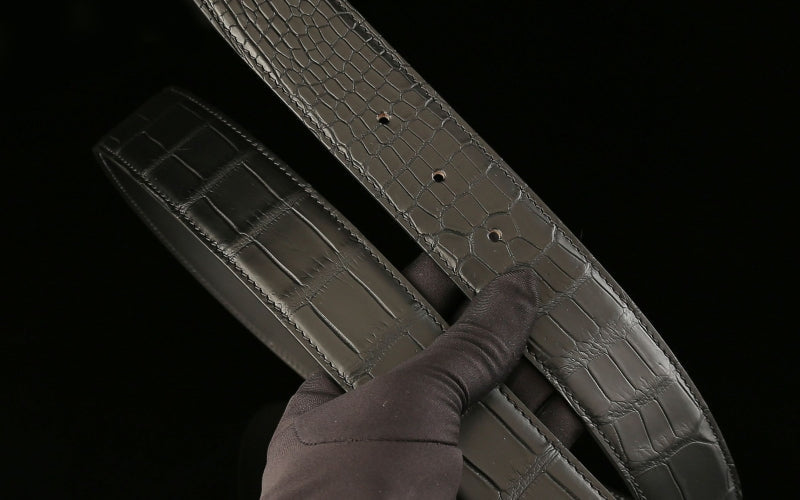
Flip the belt over to the flesh side as a secondary check. Genuine crocodile leather shows a natural grain on the back — slightly uneven, with visible fiber structure. Embossed leather typically has a uniform, machine-smooth backing or a synthetic lining bonded to the surface layer.
The texture test also reveals a lot. Run your thumbnail gently across the scales of a genuine crocodile belt — you'll feel each individual scale edge with slight resistance. On embossed leather, the surface feels flatter and more uniform, because the "scales" are surface impressions in a single piece of hide rather than naturally formed plates. BG Leather Bags' crocodile identification guide confirms the scale-edge tactile test as one of the most reliable beginner methods.
Does Genuine Crocodile Leather Have Visible Pores?
Yes. Real crocodile leather has tiny sensory pores visible on each scale — these are Integumentary Sensory Organs (ISOs), biological structures the animal used to detect water pressure and vibration. On embossed or synthetic fakes, these pores are either completely absent or appear as uniform decorative dots pressed into the surface.
The ISO pores on genuine crocodile leather are irregular in size and placement — typically one to three per scale, positioned asymmetrically. Under a magnifying glass or smartphone camera zoom, they appear as natural openings into the leather, not surface marks. This distinction is definitive: no embossing technology can replicate the biological randomness of genuine ISOs.
A peer-reviewed study published in PMC (NIH) on Nile crocodile leather quality factors confirms that ISO pore structure is one of the primary quality indicators used in professional grading of crocodile skins. Knowing this test gives you access to the same authentication logic professional tanneries use.
For a deeper look at the different types of crocodile leather used in belt production, see BELTLEY's guide to crocodile leather types for belts.
The Scale Pattern Test: Symmetry vs. Natural Variation
Every piece of genuine crocodile leather tells a story of where on the animal it came from. Belly leather — the most prized — features large, flat, rectangular scales with a characteristic shape. Side leather has smaller, more irregular scales. Back leather features bony scutes (raised ridges). No single panel of a genuine belt will have perfectly uniform scale size throughout.
Embossed fakes, by contrast, have a machine-stamped pattern that repeats at regular intervals. If you hold the belt at arm's length and squint, you can often see the repeat — the same cluster of scale shapes appearing every few inches. AMTAN (American Tanning & Leather Association) notes that even high-quality embossed leather cannot replicate the natural variation of scale size, shape, and transition zones found where different parts of the animal's skin meet.
This is also why genuine crocodile leather belts have a natural character that improves with age — the scales flex individually, developing a patina that matches how the belt is worn. Our full breakdown of alligator vs. crocodile leather belts explains how scale patterns differ between species and what that means for authentication.
What Is the Umbilical Scar and Why Does It Prove Authenticity?
The umbilical scar is a small, distinctive marking found on the belly of genuine alligator and crocodile hides — it's the remnant of where the animal's umbilical cord attached before birth. On belly-cut leather, this scar appears as a slightly different-textured patch of 2–4 scales, typically near the center of the hide. No fake can replicate it because it's a biological feature.
The umbilical scar is one of the clearest proof-of-authenticity markers in exotic leather. Its location and appearance vary slightly between individual animals, which makes it impossible to fake consistently. On a finished belt, it may appear as a small section where the scale texture changes — slightly smoother or with a faint discoloration compared to the surrounding area.
Not all belts will show the umbilical scar (it depends on the panel cut and hide size), but when present, its authenticity is unambiguous. Sunny Exotic Leather Tannery's guide to crocodile leather provides detailed visual examples of where to find this marker on finished goods.
How Does the Buckle and Hardware Reveal Fake Crocodile Belts?
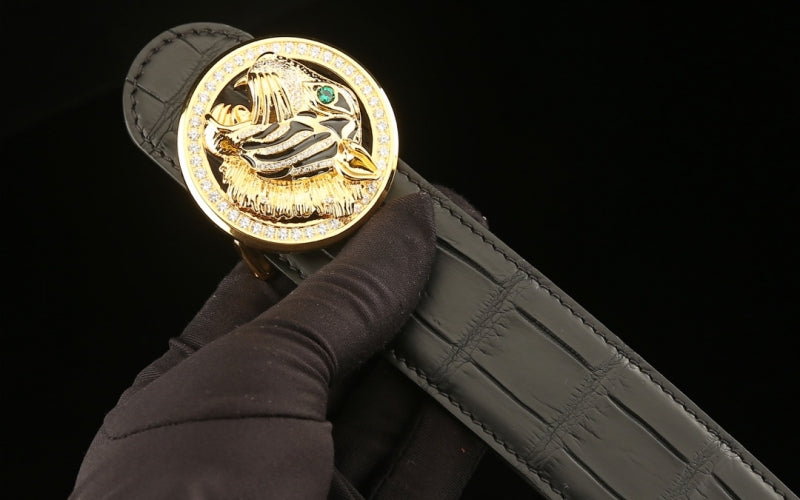
Genuine high-end crocodile leather belts use solid metal buckles — brass or 316L stainless steel — with noticeable weight and a smooth, precise finish. Fake crocodile belts typically use zinc alloy or hollow buckles that feel light, look slightly dull, and show uneven plating. The hardware is a fast authentication tell that requires no leather expertise.
Pick up the belt and hold just the buckle in your palm. A solid brass or stainless steel buckle should feel dense relative to its size — noticeably heavier than you'd expect. Zinc alloy fakes feel hollow and light. Look closely at the buckle face: genuine hardware has crisp edges, even plating, and no visible mold lines. Counterfeit buckles often show slight flashing (thin fins of metal at the edges) from lower-quality casting processes.
The stitching around the buckle loop is equally revealing. On genuine crocodile leather belts, stitching is tight, evenly spaced, and uses waxed or heavy-duty thread that lies flat. On fakes, stitching is often looser, misaligned at the keeper loop, or bonded with glue rather than sewn. BG Leather Bags' authentication guide flags uneven stitching tension as one of the top three counterfeit indicators in exotic leather goods.
BELTLEY uses 316L stainless steel buckles on all crocodile belts — the same grade used in surgical instruments — and backs every belt with a 10-year warranty on materials and construction. That level of guarantee is impossible to offer on fakes.
Crocodile vs. Caiman vs. Alligator: The Authentication Comparison Table
Not all exotic reptile leather is equal — and understanding the difference between species is part of authentication. Caiman leather, for example, is often sold as "crocodile" despite being a legally distinct and lower-grade product. Panam Leathers' exotic skin grading standards and Roje Leather's crocodile grading guide both document how these species differ in structure, grading, and market value.
| Feature | Genuine Crocodile | Genuine Alligator | Caiman (Lower Grade) |
|---|---|---|---|
| ISO Sensory Pores | Yes — irregular, biological | Yes — irregular, biological | No — calcium rivets instead |
| Scale Variation | High — natural asymmetry | High — natural asymmetry | Moderate |
| Umbilical Scar | Present (belly cut) | Present (belly cut) | Present (belly cut) |
| Bony Plates | Back only | Back only | Throughout hide |
| Flexibility | High — supple belly | High — supple belly | Lower — stiffer |
| Grade 1 Price | $9+/cm belly width | $9+/cm belly width | $2–4/cm |
| CITES Required | Yes (Appendix II) | Yes (Appendix II) | Yes (Appendix II) |
The calcium rivets in caiman leather are the key distinguishing feature — they make the hide stiffer and show as small, hard, circular nodules embedded in the scales. This is why genuine high-end crocodile and alligator leather is noticeably more supple and pliable than caiman. BELTLEY's guide to identifying alligator vs. crocodile leather covers this in full detail.
What Is a CITES Certificate and Do You Need One?
A CITES certificate is official documentation proving that a crocodile leather product was sourced from a legally licensed, CITES-registered farm — not from wild-caught or illegally traded animals. For international shipments, CITES permits are legally required. For domestic purchases, requesting CITES traceability from a seller is a strong authenticity signal — and a seller who cannot provide it should raise flags.
CITES (the Convention on International Trade in Endangered Species) classifies both crocodiles and alligators under Appendix II — meaning trade is permitted but regulated. Every legal hide leaving a licensed farm carries a numbered, non-reusable CITES tag on the raw skin. That number is traceable through the supply chain. Bangkok Bootery's guide to CITES certificates for exotic leather explains exactly what documentation to request and how to verify it.
The Leather Dictionary's CITES reference page provides the full regulatory framework. A reputable brand selling genuine crocodile leather products should be able to trace their hide sourcing to a CITES-licensed tannery. For a full breakdown of US import law and legality, see our guide on whether alligator and crocodile leather belts are legal in the USA.
What Are the Red Flags When Buying a Crocodile Leather Belt Online?
The biggest red flags are: a price under $100 for a "genuine crocodile leather" belt, no material disclosure beyond "exotic leather," product photos that show perfectly symmetrical scale patterns, and sellers with no verifiable brand history or returns policy. Any of these alone warrants scepticism. All of them together means it's almost certainly fake.
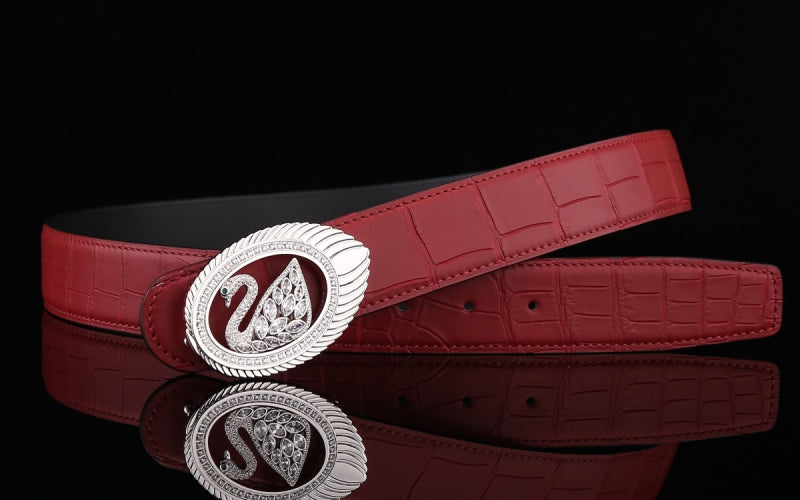
Photographs are where fakes shine and where you need to be most careful. Embossed fakes photograph beautifully under studio lighting — the stamped pattern looks sharp and uniform, which ironically is the tell. Real crocodile leather looks slightly irregular and textured in photos, with scale edges casting micro-shadows that vary across the surface.
Price is the most immediate filter. Taza Leather's alligator authentication guide notes that raw grade-1 crocodile belly skin alone costs more per centimetre than most "crocodile leather" belts sell for online. A finished belt with genuine Nile crocodile leather, quality hardware, and artisan construction cannot be profitably sold below $150 — and most quality pieces run $200–$500+. Our crocodile leather belt price guide breaks down exactly what drives these price points and what you should expect to pay for the real thing.
Check the Leather Working Group's certification registry when vetting suppliers — LWG-audited tanneries meet strict standards for traceability and responsible sourcing.
The Bottom Line
Spotting a real vs fake crocodile leather belt comes down to three layers: the leather itself (ISO pores, scale asymmetry, umbilical scar), the construction (hardware weight, stitching quality, edge finishing), and the paper trail (CITES traceability, brand reputation, returns policy). No single test is foolproof in isolation — but running all three layers takes less than two minutes and reliably filters out fakes.
The market for counterfeit exotic leather is large and sophisticated. The answer isn't to avoid crocodile leather — it's to buy from brands that source transparently, build with genuine materials, and back their products with real guarantees.
At BELTLEY, every crocodile and alligator belt is handcrafted from CITES-traceable hides, fitted with 316L stainless steel hardware, and covered by a 10-year warranty on materials and construction. No Brand Tax. No inflated markups. Just the real thing, fairly priced. Browse the full BELTLEY crocodile and alligator belt collection and buy with confidence.
Frequently Asked Questions
Q: Can you tell a real crocodile leather belt from a fake just by looking at it?
In many cases, yes — the scale asymmetry and ISO pore test are visible to the naked eye. However, high-quality embossed fakes can look convincing in photographs. Always combine the visual check with the tactile scale-edge test and the buckle weight test for a reliable result.
Q: What is the ISO pore and why does it prove the leather is real?
ISO stands for Integumentary Sensory Organ — a biological structure found on every scale of genuine crocodile leather. These tiny pores appear as irregular openings on each scale surface. No embossing or synthetic process can replicate their biological randomness, making them the most definitive physical proof of genuine crocodile leather.
Q: Is caiman leather the same as crocodile leather?
No. Caiman is a separate reptile species, and its leather is lower in quality and value than genuine crocodile or alligator leather. Caiman hides contain calcium rivets embedded in the scales that make them stiffer and less supple. Unscrupulous sellers sometimes market caiman as crocodile — knowing the difference protects your investment.
Q: What price should I expect to pay for a genuine crocodile leather belt?
A genuinely crafted crocodile leather belt with grade-1 or grade-2 Nile crocodile belly leather and quality hardware typically starts around $150 and can reach $500 or more depending on construction, width, and brand. Anything marketed as "genuine crocodile leather" for under $80–$100 is almost certainly embossed cowhide or synthetic.
Q: Do I need a CITES certificate when buying a crocodile leather belt?
For domestic purchases within the US, a CITES permit is not required at the consumer level — it operates at the import/export stage. However, a reputable seller should be able to trace their hide sourcing to a CITES-licensed tannery. For international travel with your belt, some countries may require documentation, so it's worth requesting traceability paperwork from your seller.
Q: What is the fastest single test to spot a fake crocodile belt?
The scale symmetry test: hold the belt flat under good lighting and look for repeating pattern clusters. Genuine crocodile leather never repeats — every section of the scale pattern is unique. Embossed fakes always show a regular repeat because the pattern was stamped from a single mold.