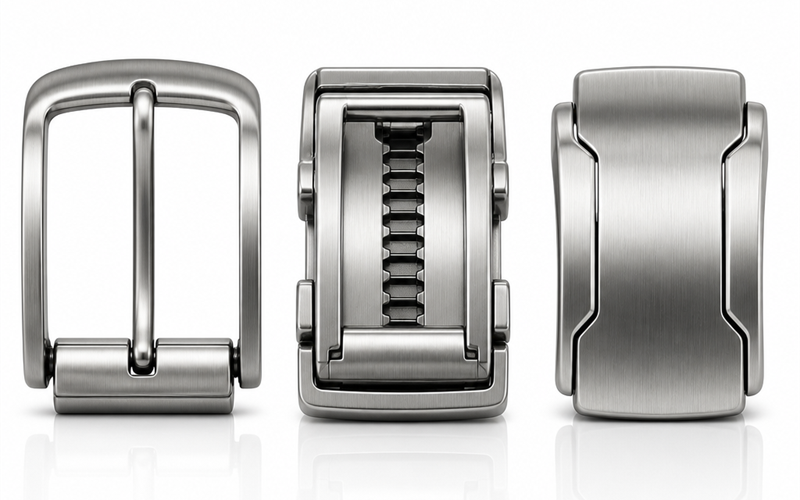
Magnetic Belt Buckles: Gimmick or Future?
Quick answer: Magnetic belt buckles are mostly a gimmick in 2026 — they solve a problem (visible prong holes) that traditional dress belts didn't really have, and they introduce new problems (lower holding force, magnet degradation, hardware bulk). The category that has legitimately advanced is ratchet buckles with internal track mechanisms, which deliver hole-free adjustment without relying on magnets. For dress contexts, a traditional prong or plaque buckle still beats both.
Last updated: May 2026 • By BELTLEY Editorial
TL;DR:
- Magnetic buckles use rare-earth magnets to hold the belt closed without prong holes — but the holding force is lower than a mechanical prong.
- Ratchet buckles (internal track, hole-free, mechanical lock) are the legitimately useful alternative — proven, durable, dress-appropriate.
- Traditional prong and plaque buckles remain the dress-belt standard because they're proven, low-maintenance, and read correct in formal contexts.
- For most wearers in 2026, the right answer is a quality traditional buckle. Magnetic is a niche solution to a manufactured problem.
The belt-closure category has seen real innovation in the last decade — ratchet buckles in particular have legitimately solved the "between sizes" adjustment problem, and several alternative closure mechanisms have hit the market. Magnetic buckles, which use rare-earth magnets to hold the belt face plate to the strap, are the most marketed but the least useful of these innovations. They solve a problem that traditional dress belts didn't have (visible prong holes were never a real aesthetic issue at dress-belt proportions) while introducing several real problems: lower holding force, magnet bulk, and degradation over years of wear. Wikipedia's belt buckle reference covers the broader category history — the prong-and-frame mechanism has been the standard for centuries because it works. Our dress belts, plaque buckle belts, and ratchet buckle belts collections cover the proven mechanisms.
Magnetic Temptation? Decide Here
The verdict by what you actually need:
| Your situation | Go with |
|---|---|
| Want hole-free micro-adjustment | Ratchet buckle — the category that genuinely solved this, no magnets needed. |
| Limited dexterity / accessibility need | Magnetic earns its place here — the one-handed close is a real feature. |
| Dress belt shopping | Traditional prong or plaque — magnets add bulk where formality wants slimness. |
| Tempted by the novelty | Wait a generation — current holding force and magnet degradation aren't there yet. |
Ratchet and classic builds proven for decades: BELTLEY's men's collection.
What is a magnetic belt buckle, and how does it work?
A magnetic belt buckle uses rare-earth magnets (typically neodymium) embedded in the buckle face plate to hold it to a metal-reinforced section of the belt strap. The closure has no prong, no holes, and no visible mechanism — just a face plate that snaps closed magnetically against the strap. The user "closes" the belt by aligning the face plate over the strap and letting the magnetic field do the work.

The promise: clean appearance, no prong holes visible on the belt, faster on-and-off. The reality: lower holding force than a mechanical prong (a magnet rated to hold 15 lbs of static load can fail under dynamic loads like running, lifting, or bending), magnet field degradation over years of use, and bulkier hardware to accommodate the magnet housing. For most users, the trade-offs don't favor magnetic in 2026.
Why are ratchet buckles different from magnetic?
Ratchet buckles use an internal mechanical track with small teeth on the belt strap that engage a spring-loaded pawl inside the buckle. The belt adjusts to any position along the track (typically with 0.25" precision), holds with mechanical force (not magnetic), and releases via a lever on the buckle face. This is a genuinely useful innovation: holes-free adjustment with full mechanical holding strength.

Ratchet buckles have been refined over roughly 15 years and are now durable enough for daily wear. The mechanism doesn't degrade the way magnetic fields do, and the holding force is comparable to a traditional prong buckle. Many wearers who initially tried magnetic buckles have switched to ratchet for the same hole-free benefit without the magnetic drawbacks. Browse our ratchet buckle belts collection for the proven mechanism.
Key stat: Neodymium magnets lose roughly 5% of their magnetic strength per decade at room temperature, and significantly more if exposed to high heat (above 175°F / 80°C) or strong opposing magnetic fields. A magnetic buckle that holds firmly at year 1 may hold marginally at year 10. Ratchet buckles, by contrast, retain mechanical strength indefinitely.
Where do magnetic buckles actually work?
Magnetic buckles work reasonably well in light-load casual contexts: wearing chinos for office work, dress trousers for indoor events, situations where the belt isn't carrying meaningful load and isn't subject to dynamic stress. For these uses, the magnetic closure holds securely and the no-hole aesthetic is genuinely cleaner than visible prong-hole wear.
Magnetic buckles don't work well for: heavy load contexts (anything with gear, holster, or trouser weight stress), active contexts (running, lifting, hiking, anything dynamic), long-term use (the magnet degrades), or formal dress contexts (the buckle profile is typically bulkier than a slim traditional plaque). For most professional and active wearers, the limitations outweigh the benefits. We covered the load logic in our off-duty police belt and field journalist belt guides — both contexts where magnetic buckles would fail outright.
Buckle mechanism comparison
| Mechanism | Holding force | Wear longevity | Best for | Avoid for |
|---|---|---|---|---|
| Traditional prong (single-tongue) | High | Decades | Dress, formal, daily | None (universal standard) |
| Plaque buckle (hook clasp) | High | Decades | Dress, business | Heavy load contexts |
| Ratchet buckle (internal track) | High | 10+ years | Versatile, hole-free | Black tie (reads modern) |
| Magnetic buckle | Moderate | 5–10 years (magnet degrades) | Light-load casual | Heavy load, active, formal |
| Plate buckle (multiple-hook military) | High | Decades | Military, heritage casual | Modern dress |
For the full taxonomy, see Wikipedia's belt buckle reference.
Will magnetic buckles improve in the future?
Probably yes at the margin, no in fundamentals. Magnet technology has improved incrementally (stronger neodymium grades, better mechanical housings), but the underlying physics doesn't change: magnetic force scales with field strength and contact area, and getting stronger magnets means getting bulkier hardware. There's no "Moore's Law" for magnetic force in compact applications.

The likely future trajectory: magnetic buckles become slightly thinner, hold slightly more weight, and find their niche in light-load casual contexts. They don't become the dress-belt standard because the traditional prong-and-plaque mechanism is already nearly perfect for the use case. For most belt buyers in most contexts, the answer in 2030 will be the same as it is in 2026: traditional buckle for dress, ratchet for hole-free versatility, magnetic as a niche option.
Are there durability concerns with magnetic buckles?
Yes — three specific concerns. Magnet degradation: neodymium loses field strength gradually under normal wear and faster under heat exposure (left in a hot car, near a high-heat work environment). Magnetic interference: strong opposing magnets (some EDC tools, certain electronic devices, MRI machines) can demagnetize the buckle quickly. Hardware longevity: the magnetic buckle's housing and metal-reinforced strap section have more failure points than a simple prong-and-leather construction.

For wearers in standard office and casual environments, these concerns are real but manageable — magnetic buckles typically last 5–10 years before degradation is noticeable. For wearers in heat-exposure jobs (welders, kitchen workers, outdoor laborers in hot climates) or in active EDC contexts, magnetic buckles fail faster. Traditional and ratchet buckles have no equivalent failure modes.
What about magnetic buckles for kids' belts?
This is actually one context where magnetic buckles arguably make sense — children's belts where the no-prong design makes the belt easier for younger kids to manage, and the typical light load doesn't stress the magnetic closure. The trade-off (lower holding force, eventual magnet degradation) matters less because children outgrow belts within 1–3 years anyway.

For adults who are buying belts intended to last decades, the math is different. The magnetic buckle that lasts 7 years isn't comparable to the traditional buckle that lasts 30. We covered the kids'-belt case in our ring bearer belt guide.
The Bottom Line
Magnetic belt buckles are mostly a gimmick in 2026 — they solve an aesthetic problem (visible prong holes) that wasn't really a problem on quality dress belts, while introducing real problems (lower holding force, magnet degradation, hardware bulk). The legitimately useful innovation in belt closures is the ratchet buckle, which delivers hole-free adjustment with mechanical (not magnetic) holding strength and decades-long durability. For dress contexts, the traditional prong or plaque buckle still wins on every metric except the manufactured "no holes" pitch. At BELTLEY, we make traditional prong, plaque, box-and-prong, and ratchet buckles in solid brass and stainless — the mechanisms that have actually proven themselves over decades or rigorous refinement over years. We don't make magnetic buckles. Browse our plaque buckle belts, ratchet buckle belts, and box & prong buckle belts collections.
Frequently Asked Questions
Q: Can a magnetic buckle fail open while you're wearing it?
In normal light-load wear, rarely. Under dynamic load (running, lifting, sharp twisting), or after magnet degradation, yes — failures do occur. The failure mode is uncomfortable but not dangerous. Traditional and ratchet buckles don't fail in this way under load.
Q: Are magnetic buckles safe near medical devices?
Strong neodymium magnets can interfere with some pacemakers, implanted defibrillators, and other implanted medical devices if held within a few inches of the device. Anyone with such a device should consult their cardiologist before using magnetic buckles. The risk is low but real.
Q: Is a ratchet buckle dress-appropriate?
For business-casual and most professional contexts, yes — ratchet buckles in slim profiles read clean and modern. For strict black-tie or traditional dress contexts (white-shoe law firms, traditional banking, formal events), traditional plaque or prong buckles still read more correct. See our ratchet buckle belts collection.
Q: How do I clean a magnetic buckle if it stops working?
Usually, weakened magnetic force is from degradation, not dirt — cleaning doesn't restore it. If the buckle has visible debris between the face plate and strap contact, a microfiber cloth can clean the contact surface and restore some performance. Most "stopped working" cases are permanent degradation, however.
Q: Can I retrofit a traditional belt with a magnetic buckle?
Generally no — magnetic buckles require a specific metal-reinforced strap section to mate with the magnet. Standard leather straps without that reinforcement won't hold magnetically. Retrofitting would require replacing both the buckle and the strap, which is essentially buying a new belt.
Q: Should I avoid magnetic buckles entirely?
For most adult wearers in most contexts, yes — the trade-offs don't favor magnetic. The exceptions are very specific light-load casual contexts where the no-prong aesthetic genuinely matters and the lower holding force is acceptable. For everything else, traditional or ratchet is the better choice.


%20that%20traditional%20dress%20belts%20didn't%20really%20have,%20and%20they%20introduce%20new%20problems%20(lowe...)