Magnetic Belt Buckles: Gimmick or Genius?
Quick answer: Magnetic belt buckles use embedded magnets to snap closed with one hand. They are genuinely useful for people with limited dexterity — arthritis, mobility issues, or one-handed use — but for general everyday wear they trade the proven security of a solid mechanical buckle for novelty. The verdict depends entirely on who is wearing it.
Last updated: May 2026 • By BELTLEY Editorial
TL;DR:
- Magnetic belt buckles close with a one-handed snap, no pin or threading.
- They are a real win for limited dexterity, accessibility, and kids' belts.
- For general use, they offer convenience but less hold than a solid mechanical buckle.
- Build quality matters more than the magnet — cheap versions fail fast.
The magnetic belt buckle promises a frustration-free close: line up the two halves and let the magnets snap them together. No threading a pin through a hole, no fumbling. It sounds clever — but is it genuinely useful or just a novelty looking for a problem? The honest answer is that it depends entirely on who is using it. This guide explains how magnetic buckles work, where they shine, where they fall short, and when a traditional buckle is the smarter call. For the full lineup of closures, see our types of belt buckles guide.

How does a magnetic belt buckle work?
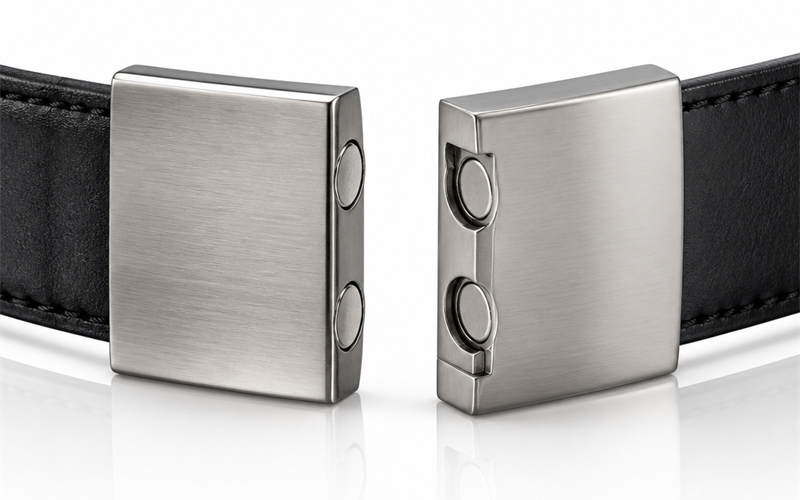
A magnetic belt buckle uses strong magnets embedded in the two buckle halves to pull them together and hold them closed. You bring the ends near each other, the magnets snap into alignment, and a small mechanical catch usually backs up the magnetic hold for security.

The magnet handles the alignment and the easy close; the catch handles the real load. Pure-magnet closures alone would not survive the tension a belt sees, so most quality designs pair the magnet with a mechanical lock. In that sense it is a convenience layer on top of a conventional buckle mechanism rather than a wholesale replacement for it. Understanding the job a buckle actually does — holding tension reliably — explains why the magnet alone is not enough.
Who actually benefits from a magnetic buckle?
People with limited hand dexterity benefit most — those with arthritis, tremors, mobility differences, or anyone who needs to fasten a belt one-handed. For these users, the easy magnetic snap is not a gimmick; it is genuine, meaningful accessibility.

Children are the other clear win. A magnetic or easy-close buckle lets a kid manage a belt independently, without wrestling a stiff pin through a hole. In both cases the magnet solves a real, specific problem. This is the heart of the gimmick-or-genius question: for the right person, a magnetic buckle is genuinely thoughtful design, not a marketing trick.
Key stat: About 21% of U.S. adults — 53.2 million people — have diagnosed arthritis, per the CDC's 2019–2021 data — a population for whom an easy, one-handed magnetic close is a real accessibility upgrade, not a novelty.
What are the downsides of magnetic belt buckles?
The main downsides are hold strength, durability, and longevity. A magnetic buckle generally does not grip as securely as a solid mechanical buckle under heavy tension, cheaper versions can pop open, and the magnet or catch can wear out faster than a simple, time-tested prong.

| Factor | Magnetic Buckle | Traditional Buckle |
|---|---|---|
| Closing ease | Excellent, one-handed | Requires two hands |
| Hold under load | Moderate (catch-dependent) | High, proven |
| Accessibility | Outstanding | Limited |
| Longevity | Varies, magnet can weaken | Decades when solid |
| Best for | Dexterity needs, kids | Everyday, heavy use |
There are also practical notes: strong magnets can interfere with some sensitive devices, and a magnetic buckle is rarely the right tool for a load-bearing or formal belt. For general wear, you are accepting a small security trade-off for convenience you may not need. Before swapping one onto a strap, our guide on whether you can put a buckle on any belt is worth a read.
Are magnetic belt buckles worth it?
Magnetic belt buckles are worth it if easy, one-handed fastening solves a real problem for you or someone you are buying for. For everyone else, a solid traditional buckle on quality leather offers better security, longevity, and looks for the same money or less.

This is where build quality decides everything. At BELTLEY we hold belts to a simple 3-Material Rule: full-grain leather, a solid stainless steel (304 or 316L) or brass buckle, and sealed edges. A belt built that way lasts a decade. A flimsy magnetic novelty with a hollow housing and a weak catch does not — and no magnet makes up for poor materials. Decide by the wearer's needs, then demand quality construction regardless of the closure.
The Bottom Line
So, gimmick or genius? Both — depending on who is wearing it. For people with arthritis, limited dexterity, or a child learning to dress, a magnetic belt buckle is genuinely smart, accessible design. For general everyday wear, it is a convenience that trades a little security and longevity for an easy snap, where a solid mechanical buckle would serve better. Match the closure to the actual need, and never let the magnet distract you from what really determines a belt's lifespan: the leather and the hardware. Explore BELTLEY's belt buckles collection for closures built to last.
Frequently Asked Questions
Q: Are magnetic belt buckles strong enough to hold your pants?
Quality magnetic buckles pair the magnet with a mechanical catch that handles the real load, so they hold for normal everyday wear. They are not ideal for heavy or load-bearing use, where a solid mechanical buckle is more secure. Build quality is the deciding factor.
Q: Are magnetic buckles safe for people with pacemakers?
Strong magnets can interfere with some sensitive medical devices, so anyone with a pacemaker or similar implant should consult their doctor before wearing a strongly magnetic accessory near the body. For most people without such devices, magnetic buckles pose no concern.
Q: Do magnetic belt buckles wear out?
They can. The magnet itself is durable, but cheap catches and hollow housings wear faster than a simple solid prong buckle. A well-made magnetic buckle lasts reasonably well; a flimsy one fails early. As with any belt, materials and construction determine longevity.
Q: Are magnetic buckles good for kids?
Yes. Easy, one-handed magnetic closures are excellent for children learning to dress themselves, since they remove the struggle of threading a pin through a hole. Look for a version with a secure backup catch and durable construction so it survives daily use.