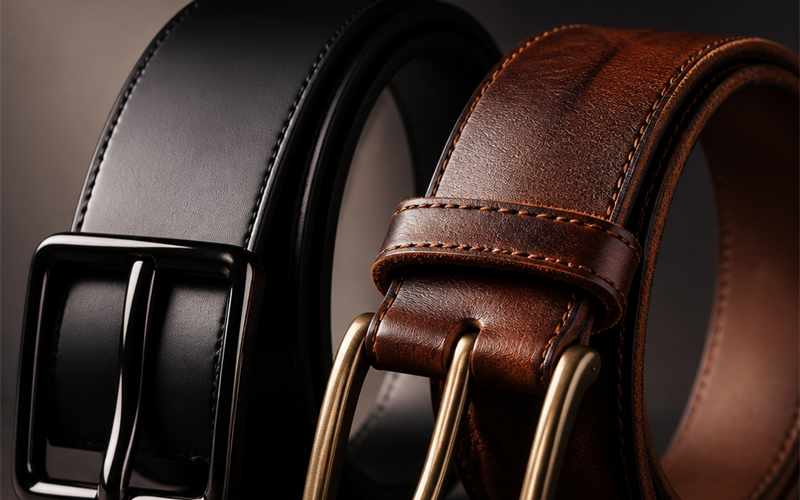
Italian Leather Belt vs French Calf Belt: Tannery vs Finishing Style
TL;DR:
- Italian belts emphasize tannery tradition — slow vegetable tanning, soft aging, warm character.
- French calf belts emphasize finishing precision — chrome-tanned box calf, glassy gloss, micro-uniform grain.
- One is a story belt. The other is a status belt. Both are world-class.
- Pick Italian for casual and heritage. Pick French calf for formal dress and luxury house aesthetic.
If Italian and Spanish belts are siblings, Italian and French belts are cousins — related, recognizably similar from a distance, but raised on completely different family rules.
Italian leather culture worships the tannery. Tuscany has built a 1,000-year identity around the slow, plant-based transformation of raw hide into vegetable-tanned belt strap. The leather itself is the hero.
French leather culture worships the finish. French calf — especially the boxed calfskin that comes out of legendary tanneries like Tannerie d'Annonay and Tannerie Haas — is engineered to look like a freshly waxed concert grand piano. The leather is the canvas. The finish is the painting.
This post compares both head to head. For wider Italian context, our why Italian leather belts cost more post is a useful starter, along with Are Italian Leather Belts Worth Anything? for the value-and-resale angle.
Story Belt or Status Belt: Your Pick
The two-country question by what you wear:
| Your situation | Go with |
|---|---|
| Formal dress, luxury-house gloss | French calf — the glassy box-calf finish is the dress-belt apex. |
| Heritage casual, warm character | Italian veg-tan — the story belt that ages into yours. |
| Patina priority | Italian — French box calf is engineered to resist change, Italian to embrace it. |
| Either aesthetic, fair price | Judge the finish in hand and skip the provenance premium — DTC calfskin runs $100–$148. |
Both finishes, no geography tax: BELTLEY's men's collection.
What's the Real Difference Between an Italian Belt and a French Calf Belt?
The real difference between an Italian leather belt and a French calf belt is what each tradition optimizes for. Italian belts optimize for material character — vegetable-tanned hide that ages, patinas, and tells a story. French calf belts optimize for finish character — chrome-tanned calfskin processed and polished to a glassy, uniform, almost lacquer-like surface.

A simple way to remember it:
- Italian belt: the leather is what you notice.
- French calf belt: the finish is what you notice.
Wikipedia's tanning (leather) article explains the chemistry of both processes if you want the deep version. Both produce excellent leather. Both are at the top of the European craft pyramid.
What Is French Calf Leather, Exactly?
French calf leather is high-grade chrome-tanned calfskin produced primarily in French tanneries that specialize in calf hide for luxury goods. The most famous types are box calf (the standard French finish, smooth and polished), French pebble grain (textured), and Crispe calf (a slightly more rustic finish). The leather comes from young cattle (under 6 months) and is prized for its tight grain, smoothness, and ability to take a deep gloss.
The legendary names in French calf:
- Tannerie d'Annonay — supplies many top luxury shoe and goods houses
- Tannerie Haas — owned by LVMH, supplies many of the group's brands
- Tannerie Du Puy — historic tannery, prized for box calf
These tanneries don't just sell leather — they produce specific named finishes that luxury brands then build collections around. "Box calf from Du Puy" is a real product line you can find at high-end shoemakers and belt makers. Wikipedia's Annonay article covers the French town that gave Tannerie d'Annonay its name — leather-making has been the local industry there for centuries. For more on how calfskin specifically differs from adult cowhide, Wikipedia's calfskin entry is a solid quick read.
What Makes Italian Leather Different at the Hide Level?
Italian leather — especially the vegetable-tanned Tuscan style — uses adult cattle hide (typically 18–24 months) tanned slowly with plant tannins for 30–60 days. The result is denser, thicker, and more characterful than calfskin. It's also more rigid out of the box, and it develops patina much more visibly over time.

Side-by-side at the hide level:
| Trait | Italian Veg-Tan | French Calf |
|---|---|---|
| Animal age | 18–24 months | Under 6 months |
| Hide thickness | 3.5–5mm | 1.5–3mm |
| Tanning method | Vegetable (plant tannins) | Chrome (chromium salts) |
| Process time | 30–60 days | 1–3 days |
| Day-one feel | Stiff, dense | Soft, supple |
| Day-one gloss | Matte to satin | High gloss |
| 5-year change | Soft, patinated | Mostly unchanged |
| Best for | Casual, heritage, belts | Dress, formal, shoes |
The Britannica leather entry covers both the calf and adult hide grades, and how age and species drive the leather's behavior. Calf is simply a different raw material than full-grown cowhide — neither is better, but they suit different products. For the long-form Italian-perspective answer on this distinction, see our What Is a Vegetable-Tanned Leather Belt? and Full Grain Leather vs Top Grain Leather.
Why Do French Belts Look So Glossy?
French calf belts look glossy because the finishing process applies multiple layers of pigment, sealants, and a final glazing pass that compresses the surface fibers under heated rollers. The result is a near-mirror surface that catches light evenly and uniformly. It's a finishing tradition that comes out of French luxury footwear, where high-gloss dress shoes have always been the standard.
The typical French calf finishing sequence:
- Tanning with chrome salts (1–3 days)
- Splitting to target thickness
- Dye drum for color saturation
- Sealant coat (transparent acrylic)
- Pigment coat for top color
- Glazing — leather is pressed under polished rollers at 80–100°C
- Wax finish for final depth
This is dramatically different from how Italian vegetable-tanned belts are finished. Italian finishing emphasizes wax, hand-burnishing, and edge work — it lets the leather speak. French finishing emphasizes layers, sealants, and pressed gloss — it makes the leather speak louder.
Both approaches are correct for what they're trying to achieve. They're just different artistic choices.
Which Country Is Better for Dress Belts?
For pure formal dress belts — the kind that pair with a tuxedo, a navy suit, or a polished oxford shoe — French calf is the historical gold standard, with Italian box calf as a very close second. Both produce dress belts of essentially equivalent quality, but French calf has the slight aesthetic edge for formal occasions because the high-gloss finish matches dress shoe finishing tradition.

When to lean French calf for dress:
- Pairing with high-gloss oxford or wholecut shoes
- Black tie or formal business contexts
- Plaque-buckle dress belts in black or dark brown
- Reversible dress belts where finish uniformity matters
When to lean Italian for dress:
- Pairing with brogues, derbies, or pebble-grain dress shoes
- Smart casual to business casual
- Brown leather across multiple shades
- Where you want a hand-finished feel over machine gloss
Our dress belts collection includes Italian-style dress pieces that hit the formal mark without going full French-calf gloss.
Which One Is Better for Casual and Heritage Belts?
Italian leather wins comfortably for casual and heritage belts. The vegetable-tanned hides used in Italian production are made for the kind of belt that gets worn with jeans, chinos, and weekend shirts — pieces that should age, soften, and pick up scars as wear marks. French calf casual belts exist, but they're a niche; the leather wants to stay sharp, which fights the casual aesthetic.
Casual styles where Italian leather shines:
- Vintage brass-buckle belts — see our brass buckle belts collection
- Pull-up leather casual belts — example: Italian Brutti pull-up belt
- Bridle-style casual belts with hand-burnished edges
- Distressed and raw-edge designs — see our vintage dark brown distressed belt
For French calf to work in a casual context, it usually has to be paired with very specific outerwear (tailored coat, dressy denim, leather sneakers). It's possible, but it requires intent.
How Do Prices Compare?
French calf belts and Italian leather belts cost roughly the same at the workshop tier — both are premium European production — but French calf often retails higher because of luxury house branding. Identical-quality construction can carry a 50–100% retail premium on French calf simply because it's associated with French maisons.

Rough price comparison:
| Tier | Italian Belt | French Calf Belt |
|---|---|---|
| Workshop direct | $150–$300 | $200–$400 |
| Mid-market luxury | $300–$600 | $400–$900 |
| Top luxury house | $600+ | $900+ |
The wholesale cost of French calf hide itself is about 20–30% higher than equivalent Italian vegetable-tanned leather, mainly because calfskin yields fewer usable square feet per hide. But that wholesale difference rarely accounts for the full retail gap. Most of the price spread is branding and distribution.
DTC brands — like BELTLEY — can offer Italian-style construction at workshop-direct prices because the middlemen are removed. Our full-grain leather belts collection is priced on that model.
Which Belt Ages Better Over Time?
Italian vegetable-tanned belts age dramatically over years — they darken, soften, develop patina, and pick up character with every wear. French calf belts age subtly — they stay close to how they looked on day one for the first 5–7 years, then slowly show edge wear and finish softening. Italian belts get more interesting with age. French calf belts get older without getting different.
What "aging better" means depends on what you want:
- You want a belt that tells a story: Italian wins.
- You want a belt that stays sharp for events: French calf wins.
- You want a belt that survives daily abuse: Italian wins.
- You want a belt that pairs with formal wear at year 5 the same as year 1: French calf wins.
Wikipedia's chrome tanning section explains why chrome-tanned leather is more stable in finish over time — the chromium-fiber bond is essentially permanent, so the leather doesn't continue to evolve the way vegetable-tanned leather does. The patina article covers why some buyers actively want that evolution, and our vegetable-tanned vs chrome-tanned leather belt comparison breaks down both sides for the buying decision.
How Do You Spot Real French Calf Versus Italian-Made-to-Look-French?
You spot real French calf by the combination of glassy gloss, fine tight grain, and an extremely uniform surface with no visible character marks. Italian "French-style" belts often use chrome-tanned Italian calf with similar finishing, which is excellent but slightly less uniform — you may see tiny grain variations a true French calf belt won't have.

Three quick tells of authentic French calf:
- Surface gloss is mirror-uniform — no waves, no hand-finish variation.
- Grain is microscopically tight — almost no visible pores at arm's length.
- Tannery marking on the back — premium French tanneries often emboss a small mark on the flesh side.
Italian calf chrome-tanned belts are an excellent alternative when French calf is out of budget — same general aesthetic, same use case, 30–50% less expensive at retail.
The Bottom Line
Italian vegetable-tanned belts are about the leather. French calf belts are about the finish. Both are world-class. Both deserve their reputations. Neither is universally better — they answer different questions.
If you're shopping for a belt that ages with you, develops character, and reads as quietly confident across every casual and business-casual context — Italian is the answer. If you're shopping for a belt that lives next to your tuxedo and stays mirror-perfect for a decade — French calf is the answer.
At BELTLEY, we work with Italian workshops because the patina-and-aging story matches the kind of brand we want to build. Browse our handmade belts collection for the Italian craft approach, or our dress belts collection for formal pieces that go head-to-head with French calf at lower retail.
Frequently Asked Questions
Q: Is French calf leather actually French?
Mostly — the famous "French calf" tanneries (Annonay, Haas, Du Puy) source calfskin from across Europe but tan and finish it in France. The "French" designation refers to the tanning and finishing location, not always the hide origin.
Q: What's box calf and is it different from regular French calf?
Box calf is a specific finishing style of French calf — boxed, glazed, and polished to a high gloss with tight grain. It's named after the 19th-century French shoemaker who popularized the finish. "French calf" is a broader category; "box calf" is the most famous sub-style.
Q: Can Italian tanneries produce French-style calf leather?
Yes. Italian tanneries — particularly in the Veneto and Toscano regions — produce excellent chrome-tanned calf finishes that compete directly with French calf. The leather is sometimes labeled "Italian calf" or "Italian box calf" and can be visually nearly indistinguishable from French production.
Q: Why are French calf belts so expensive?
Three reasons: calfskin is a more limited raw material than adult cowhide, French finishing involves more processing steps and skilled labor, and French luxury houses charge a brand premium on top of the production cost. Workshop-direct French calf belts are still expensive but not nearly as much as branded versions.
Q: Does French calf leather develop a patina?
Very lightly compared to vegetable-tanned leather. Chrome-tanned calf may darken slightly at high-wear spots and lose a small amount of finish gloss over years, but it doesn't develop the rich color depth or character marks that Italian veg-tan leather does.
Q: For an exotic leather belt, does country of origin matter as much?
Less so. For crocodile, alligator, elephant, and other exotic leathers, the skin source and craftsmanship matter far more than the tanning country. Both Italian and French workshops produce world-class exotic belts. See our exotic leather belts collection for examples.