Is It Worth Buying an Expensive Belt?(Detailed Answer by BELTLEY)
Quick answer for busy readers:
- Yes — but only if the price reflects material quality, not brand logos. A $100 full-grain leather belt worn daily for 10 years costs $0.027 per wear. A $20 bonded belt replaced every 6 months costs $0.11 per wear — four times more expensive.
- The three specs that justify an expensive belt: full-grain leather, solid brass or stainless steel buckle, and hand-finished edges. Without all three, the price premium is paying for marketing.
- Designer belts priced at $400-$600 often use the same corrected-grain leather as $50 department store belts. Price alone guarantees nothing — specs do.

Is it worth buying an expensive belt? The answer depends entirely on what "expensive" is buying you. If it's buying full-grain cowhide, solid metal hardware, and saddle-stitched construction, then yes — the math overwhelmingly favors the pricier belt. If it's buying a logo stamped onto mediocre leather with a zinc-alloy buckle, you're paying a premium for a product that will fail just as fast as the cheap version.
Most people who ask this question have already been burned. They've cycled through $15-$30 belts that crack, peel, or snap within a year, and they're wondering if spending more would actually solve the problem. The short answer is yes — but only if you spend on the right specs. Here's a framework for understanding exactly what separates a quality leather belt worth its price from one that isn't.

How Much Should You Actually Spend on a Belt?
A well-made belt that lasts 10+ years typically costs between $60 and $150 for full-grain cowhide, and $150-$300 for exotic leathers like crocodile or alligator. Below $60, manufacturers are cutting corners on at least one critical component — usually the leather grade.
This price range isn't arbitrary. Effortless Gent's leather belt analysis breaks down the cost structure of quality belt production: full-grain hides cost 3-5x more than bonded or corrected-grain leather, solid brass hardware costs 4-6x more than zinc alloy, and hand-burnished edges require skilled labor that adds time to every unit. When you see a belt priced at $80-$120, those costs explain where the money goes.
Below $40, the leather is almost certainly bonded (ground-up scraps glued together with polyurethane) or corrected-grain (sanded and embossed to hide defects). Both grades have a dense collagen fiber network that's been compromised or destroyed — meaning they will crack, peel, or delaminate within months. For a detailed comparison, read our guide on full-grain leather vs. genuine leather.

The Cost-Per-Wear Calculation
The real cost of a belt isn't the price tag — it's the price divided by the number of times you wear it before it fails. This cost-per-wear metric, used by financial publications like Business Insider for clothing purchases, flips the cheap-vs-expensive debate on its head.
Here's the math across five common belt types:
| Belt Type | Price | Lifespan | Daily Wears | Cost Per Wear |
|---|---|---|---|---|
| Bonded leather | $20 | 6 months | ~180 | $0.11 |
| "Genuine" leather | $35 | 18 months | ~540 | $0.065 |
| Top-grain leather | $65 | 5 years | ~1,825 | $0.036 |
| Full-grain leather | $100 | 10 years | ~3,650 | $0.027 |
| Full-grain double-layer | $130 | 15+ years | ~5,475 | $0.024 |
Over a decade, the person buying $20 belts spends $400 (replacing every 6 months). The person who buys one $100 full-grain leather belt spends $100. That's $300 saved — and the full-grain belt looks better at year 10 than the bonded belt did at month 3.
This durability gap is structural, not cosmetic. According to leather researchers at Szoneier Leather, full-grain leather's intact collagen fiber matrix gives it 3x the tensile strength of corrected-grain leather. It flexes without fracturing, absorbs and releases moisture naturally, and develops a patina rather than deteriorating.

What Specs Actually Justify a Higher Price?
Not all expensive belts are worth the money. A $500 designer belt with corrected leather and a plated zinc buckle isn't a better product than a $90 full-grain belt with solid brass hardware — it's just a more expensive one. The specs that justify paying more are specific and verifiable.
1. Full-grain leather (not "genuine" or "real" leather)
The leather grade is the single most important factor. Full-grain means the outermost hide surface is intact — unaltered, unsanded, uncoated. This layer contains the densest concentration of collagen fibers, giving it maximum strength and natural water resistance. Terms like "genuine leather," "real leather," and "100% leather" are legally permitted labels for the lowest usable grades, including bonded scraps.
2. Solid brass or 316L stainless steel buckle
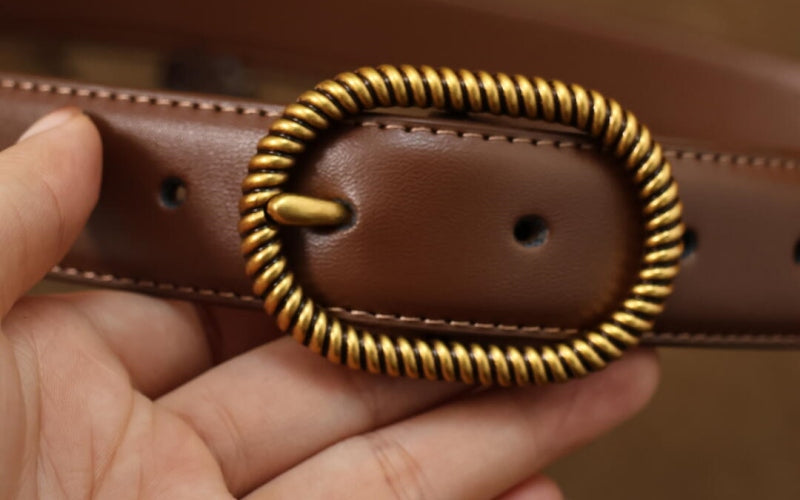
Pick up the buckle. If it's light and hollow-sounding, it's die-cast zinc alloy — brittle, corrosion-prone, and likely to bend or snap within a year. A solid brass buckle weighs 80-120g and has a warm, dense feel. 316L stainless steel — the same surgical-grade alloy used in watch cases — is heavier still and virtually immune to corrosion. According to GearJunkie's belt testing, buckle weight is the fastest quality indicator a consumer can check in-store.
3. Hand-burnished edges
Run your thumb along the belt's edge. Painted edges feel uniform but crack and flake within months, exposing raw fibers. Burnished edges feel slightly waxy and rounded — created by hand-rubbing with friction and beeswax until the leather fibers fuse together. This seal prevents delamination from starting at the perimeter, which is the most common failure point on cheap belts.
4. Saddle stitching or double-stitched seams
Machine lockstitching uses a single continuous thread — one break unravels the entire seam. Saddle stitching passes two threads through the same holes from opposite sides, making each stitch structurally independent. A saddle-stitched belt will hold its edges together even if several stitches are cut.

Are Designer Belts Worth the Premium?
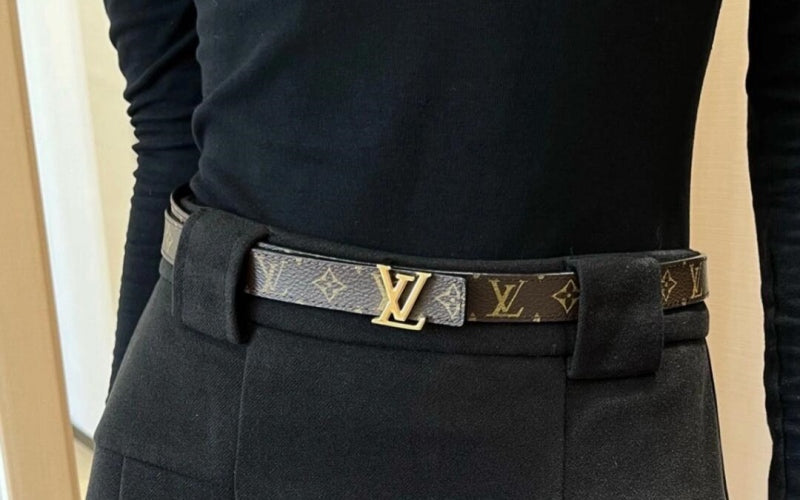
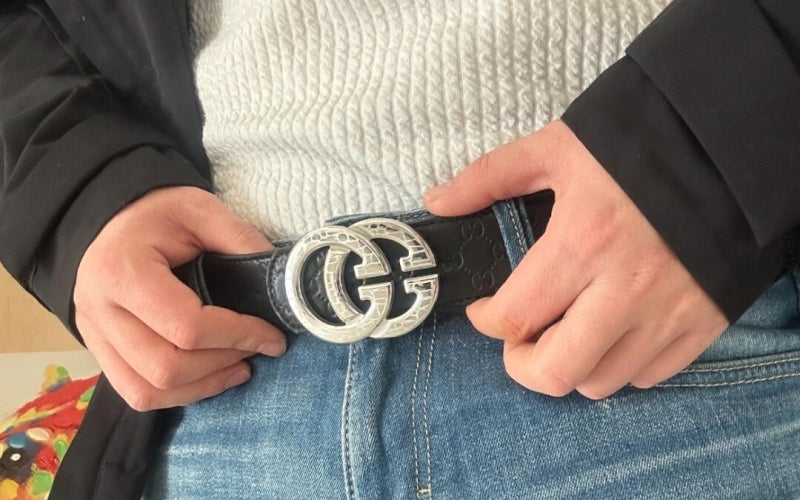
Designer belts from luxury houses like Hermès, Gucci, and Louis Vuitton typically cost $400-$700 — sometimes more. The question isn't whether these belts are nice-looking (they are) but whether the materials and construction justify a 4-7x markup over a well-made artisan belt.
The answer is usually no — from a durability standpoint. As Buckle My Belt's quality analysis points out, many designer belts use corrected-grain or coated canvas rather than full-grain leather, and their buckles are often plated zinc alloy rather than solid brass or steel. The premium pays for brand recognition, retail distribution costs, and marketing — what the industry calls the "Brand Tax."
That said, designer belts serve a different purpose for some buyers: signaling, gifting, and personal satisfaction. Those are valid reasons to buy. Just don't assume a $500 price tag means 5x the durability of a $100 belt. Our comparison of designer belt brands vs. luxury belt brands breaks down exactly where the money goes for each tier.

How to Tell If an Expensive Belt Is Worth It Before You Buy
Five checks you can perform in under 60 seconds — in-store or from product listing photos:
- Read the leather label. If it says "full-grain," you're on track. If it says "genuine leather," "real leather," or doesn't specify, assume it's a lower grade. Learn the full hierarchy in our leather types guide.
- Weigh the buckle. Solid metal buckles feel heavy and dense. Zinc alloy feels light and hollow. A quality buckle weighs at least 80g.
- Check the edges. Burnished edges are slightly rounded and waxy. Painted edges are flat and uniform — they'll flake.
- Smell the leather. Real full-grain leather smells earthy and organic. Bonded leather smells like chemicals or plastic.
- Flex the belt. Full-grain leather bends smoothly without creasing. Bonded leather wrinkles or cracks at the fold point immediately.
According to Last State Leather's buying guide, consumers who learn to identify full-grain leather stop cycling through cheap belts entirely — because the first quality belt they buy outlasts every previous belt combined.

The Bigger Picture
At BELTLEY, we've watched the belt market split into two lanes that barely acknowledge each other. Lane one: mass-produced accessories optimized for shelf appearance and impulse price points, built from bonded scraps and die-cast zinc, designed to be replaced seasonally. Lane two: handcrafted leather goods built by artisans who understand that the hide selection, the tanning process, the edge burnishing, and the buckle fitting each determine whether a belt serves you for one year or fifteen.
We price our belts at $58-$299 because we sell direct — no retail middlemen, no Brand Tax — and back every piece with a 10-year warranty. Not as a marketing gesture, but because we know the materials. A full-grain cowhide belt with a solid brass buckle and saddle-stitched seams doesn't need a warranty claim — it needs a will, because it'll outlast its owner.

The Bottom Line
Is it worth buying an expensive belt? Yes — if the money buys full-grain leather, solid metal hardware, and hand-finished construction. No — if it buys a designer logo on mediocre materials. The cost-per-wear math is unambiguous: a $100 quality belt costs less than a $20 disposable belt over any timeframe longer than two years.
Skip the logo tax. Check the specs. Buy once. Browse BELTLEY's handmade belt collection — full-grain leather, 316L stainless steel or solid brass buckles, backed by a 10-year warranty, with free worldwide shipping and 30-day hassle-free returns.

Frequently Asked Questions
Q: How long should an expensive belt last?
A full-grain leather belt with solid hardware should last 10-15 years with regular daily wear and basic conditioning 2-3 times per year. Handmade vegetable-tanned belts can last 20+ years. If your belt fails in under 2 years, the materials are the problem — not your care routine. See our full breakdown of leather belt durability.
Q: Is a $100 belt really better than a $30 belt?
In almost every case, yes — but the reason is materials, not price. A $100 belt made from full-grain leather with a solid buckle uses components that cost 3-5x more than those in a $30 belt. The durability difference is structural: full-grain leather has an intact collagen fiber matrix that resists cracking for a decade, while bonded leather delaminates within months.
Q: Do expensive belts hold their value?
Utility belts don't hold resale value the way watches or handbags do. But they hold functional value — a belt that lasts 10 years and still looks good at year 8 has delivered more per dollar than almost any other clothing purchase. Exotic leather belts (crocodile, alligator) can appreciate if they're from recognized makers with provenance.
Q: What's more important — the leather or the buckle?
The leather. A great buckle on bad leather still results in a cracked, peeling belt within a year. Start with full-grain leather, then verify the buckle is solid brass or stainless steel. Both matter, but leather grade determines the belt's lifespan ceiling.
Q: Are expensive belts worth it for women too?
Yes — the material science is identical. Full-grain leather lasts longer than bonded leather regardless of belt width, color, or style. Women's belts in thinner widths (1" or 1.25") benefit even more from quality leather because thinner straps experience more stress per unit of surface area. Browse our women's belt collection for options in every width and color.