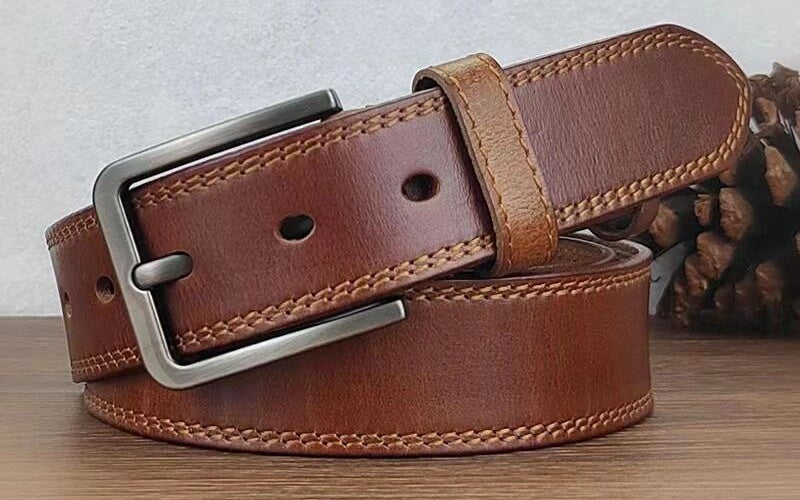
Is Full Grain Leather Good for Belts? The Brutally Honest Truth (Spoiler: Yes, But…)
TL;DR: Quick Answer
- Full-grain leather is the single best material for belts. Its intact fiber structure delivers the highest tensile strength (often exceeding 20 MPa), natural moisture resistance, and a lifespan of 10-20+ years.
- The leather develops a rich patina over time — darkening, softening, and gaining character that makes it more attractive with age, not less.
- The only real downsides are a 2-4 week break-in period and a higher upfront cost — both of which are worth it for a belt that outlasts every alternative by years.

You're shopping for a belt that will actually last, and every buying guide points you toward full-grain leather. But is full-grain leather genuinely the best choice for belts — or just the most marketed one?
The short answer: full-grain leather isn't just good for belts — it's the gold standard. The material properties that make full-grain the highest leather grade are the exact properties a belt needs: tensile strength to resist daily flexing, fiber density to hold its shape against body pressure, and a surface that improves rather than degrades with wear. Below, we break down the specific material advantages, the few legitimate downsides, and how full-grain compares to every other leather option. For a broader comparison of all leather types used in belts, start with our guide on what type of leather is best for belts.

What Makes Full-Grain Leather Ideal for Belts?
Full-grain leather is the outermost layer of an animal hide with the natural grain surface completely intact — no sanding, buffing, or correction. This unaltered surface contains the hide's most tightly packed collagen fibers, which is precisely what gives full-grain its exceptional performance as a belt material.
According to Craft and Antler Co.'s full-grain belt guide, these intact grain fibers deliver "maximum tensile strength (often >20 MPa) and natural resistance to moisture and abrasion." In practical terms, that means a full-grain belt can flex repeatedly at the buckle crease — the point where most belts fail — without cracking, splitting, or developing surface tears.
The natural grain also acts as a protective barrier. Buckle My Belt's leather analysis explains that the unaltered surface resists cracking, peeling, and surface damage far better than sanded or corrected alternatives. When you remove the outermost grain layer — as with top-grain or corrected-grain processing — you remove the strongest structural component of the hide.

How Does Full-Grain Compare to Other Belt Leathers?
Here's how full-grain stacks up against every major leather type used in belts, based on data from Obscure Belts' definitive leather guide and Torino Leather's durability comparison:
| Leather Type | Durability | Patina | Flexibility | Lifespan | Best For |
|---|---|---|---|---|---|
| Full-Grain | Highest | Rich, deepening | Stiff initially, softens with wear | 10-20+ years | Daily wear, dress, casual — all-purpose |
| Top-Grain | Good | Minimal | Softer out of the box | 3-10 years | Dress belts, office wear |
| Bridle Leather | Very high | Moderate (wax-finished) | Firm, heavy | 15-25+ years | Heritage, equestrian, heavy-duty |
| Corrected-Grain | Low-moderate | None (coating peels) | Soft but weakens | 2-5 years | Budget dress belts |
| Genuine/Split | Low | None (cracks) | Thin, floppy | 1-3 years | Disposable fashion belts |
| Bonded | Very low | None (delaminates) | Stiff then fails | 6-18 months | Avoid entirely |
Full-grain wins on overall balance — it's the only grade that delivers high durability, beautiful aging, and all-purpose versatility. Bridle leather matches or exceeds it on pure toughness, but it's heavier, less available, and typically limited to heritage or workwear styles.
For a detailed comparison of the two most commonly confused grades, our full-grain vs. top-grain leather guide covers every measurable difference.

Does Full-Grain Leather Get Better with Age?
Yes — and this is one of its most distinctive advantages for belts. Full-grain leather develops patina: a gradual deepening of color and luster caused by absorbing oils from your skin, friction from clothing, and exposure to light. The leather darkens, softens, and gains a warmth that synthetic and coated leathers can never replicate.
Proven Hands' work belt comparison notes that "the aesthetic improvement that comes with full grain patina development means the belt becomes more attractive over time, unlike top grain options that may simply show wear." A five-year-old full-grain belt has character. A five-year-old corrected-grain belt has damage.
This aging process is why full-grain leather holds its value — both aesthetically and financially. A patina'd belt looks intentional, lived-in, and refined. It tells a story without trying.

What Are the Downsides of Full-Grain Leather for Belts?
Full-grain leather has genuine drawbacks — though none that outweigh its advantages for most buyers.
Break-in period. Full-grain belts start stiff. The dense fiber structure that makes the leather so durable also means it needs 2-4 weeks of daily wear before it flexes comfortably around your waist. According to Szoneier Leather's thickness guide, this initial stiffness actually indicates quality — the fibers haven't been weakened by sanding or chemical treatment.
Higher cost. Full-grain belts typically cost $80-$200, compared to $20-$50 for genuine leather. The price difference reflects the material quality and construction — not markup. Our guide on are full-grain leather belts worth it breaks down the cost-per-year math that makes full-grain the cheaper option long-term.
Weight. A thick full-grain belt (4mm+) has noticeable heft — more than a thin genuine leather belt. Most people find this reassuring rather than bothersome, but if you prefer ultralight accessories, it's worth noting.
Moisture sensitivity. Full-grain leather needs prompt care if soaked — leather conditioner applied within 24 hours prevents water stains from setting. It's not fragile, but it does require more attention than a nylon belt.
Natural markings. Full-grain retains the hide's natural scars, insect bites, and grain variations. Some buyers want uniformity — but most learn to appreciate these marks as proof of authenticity. According to Leathersmith Designs' belt leather guide, natural markings are the signature of genuine full-grain and distinguish it from corrected or embossed alternatives.

What Thickness Should a Full-Grain Belt Be?
For everyday belts, a full-grain leather thickness of 3.5-4.0mm (8-9 oz) hits the optimal balance between durability and comfort. This range provides enough substance to hold its shape and support a buckle without the break-in struggle of thicker cuts.
According to American Bench Craft's quality checklist, high-quality belt leather is typically cut from a "double butt" section of the hide — the densest, most consistent area — at 8.5-9.5 oz thickness.
Here's a quick reference:
| Thickness | Oz Weight | Best Use | Break-In Time |
|---|---|---|---|
| 2.5-3.0mm | 6-7 oz | Dress belts, slim profiles | 1-2 weeks |
| 3.5-4.0mm | 8-9 oz | Everyday, casual, all-purpose | 2-4 weeks |
| 4.5-5.5mm | 10-13 oz | Heavy-duty, work, gun belts | 4-6 weeks |
At BELTLEY, our full-grain leather belts are cut at the 8-9 oz range — thick enough for a decade of daily wear, but refined enough to pair with a suit or jeans without looking bulky. Each belt is paired with a 316L stainless steel buckle rated for the same lifespan as the leather itself.
The Bigger Picture
Every leather grade exists because a market demands it. Genuine leather serves buyers who need the cheapest possible "real leather" label. Top-grain serves brands that want a more uniform product for retail display. Corrected-grain serves factories that need to disguise low-quality hides.
Full-grain serves a different buyer: the one who cares about what's actually in the product. The intact grain is a promise — nothing was removed, nothing was masked, nothing was substituted. The belt you receive is the hide as it naturally exists, shaped and finished by an artisan who didn't need to cover up the material. At BELTLEY, we've built our entire product line around this principle. We know our leather well enough to guarantee it for 10 years, and we know our customers well enough to trust that they can tell the difference. Full-grain isn't just good for belts — it's the standard everything else is measured against.

The Bottom Line
Full-grain leather is the best material available for belts — period. It delivers the highest tensile strength, longest lifespan (10-20+ years), most beautiful aging (patina development), and best overall durability of any leather grade. The only trade-offs — a brief break-in period, a higher upfront cost, and basic moisture care — are minor compared to the decades of performance you get in return.
When shopping for a full-grain belt, look for 3.5-4.0mm thickness, solid brass or 316L stainless steel hardware, burnished edges, and a manufacturer warranty of 10+ years. These specs confirm that the brand trusts its own materials.
Explore BELTLEY's full-grain leather belt collection — handcrafted by artisans, backed by a 10-year warranty, and shipped free worldwide with 30-day hassle-free returns.

Frequently Asked Questions
Q: Is full-grain leather the best type of leather for belts?
Yes. Full-grain leather is the highest grade available, with the strongest fiber structure, longest lifespan, and best aging characteristics. It's the gold standard recommended by leatherworkers and belt makers for both dress and casual belts. For a full comparison, see our guide on the best leather types for belts.
Q: How long does a full-grain leather belt last?
With basic care, a full-grain leather belt lasts 10-20 years of regular daily wear. With attentive conditioning and proper storage, 25+ years is achievable. This dramatically exceeds top-grain (3-10 years) and genuine leather (1-3 years) alternatives.
Q: Does full-grain leather need to break in?
Yes — expect 2-4 weeks of daily wear before a full-grain belt reaches optimal comfort. The initial stiffness reflects the dense fiber structure that makes the leather so durable. The belt will gradually mold to your body shape while maintaining its structural integrity.
Q: How can you tell if a belt is real full-grain leather?
Check for natural grain variation (not perfectly uniform), visible fiber structure at the cut edge, a rich natural leather scent, noticeable weight, and resilience on the bend test (no white crack lines). Our detailed guide on how to tell if a belt is full grain leather walks through each test.
Q: Is full-grain leather waterproof?
No — full-grain leather is naturally moisture-resistant but not waterproof. The intact grain surface repels light splashes, but prolonged soaking can cause staining. If your belt gets wet, blot with a dry cloth and condition within 24 hours. See BELTLEY's leather care guide for detailed maintenance instructions.
Q: What's the difference between full-grain and top-grain leather for belts?
Full-grain retains the hide's complete natural surface, including the strongest fibers. Top-grain has that surface sanded and coated for a more uniform look — sacrificing durability and patina potential. Full-grain lasts 10-20+ years; top-grain lasts 3-10 years. Our full-grain vs. top-grain comparison covers every detail.
,%20natural%20moisture%20resistan...)