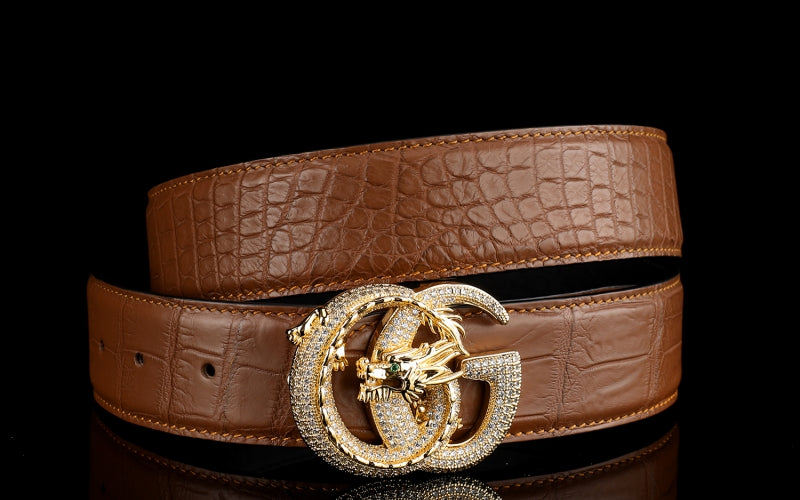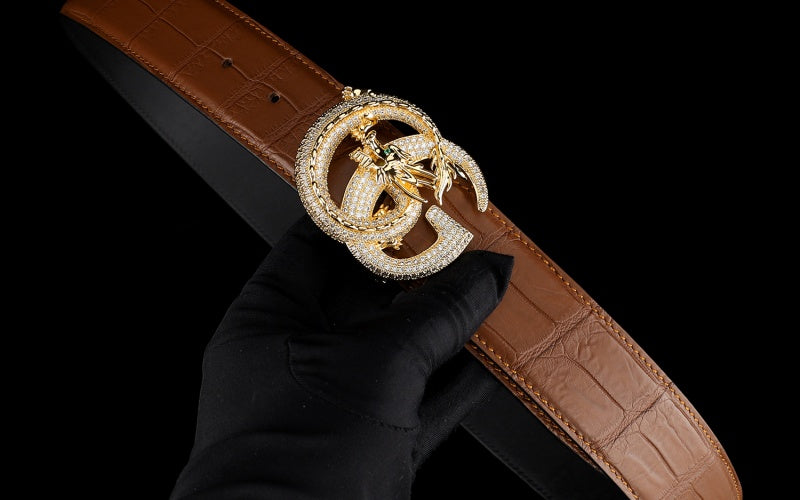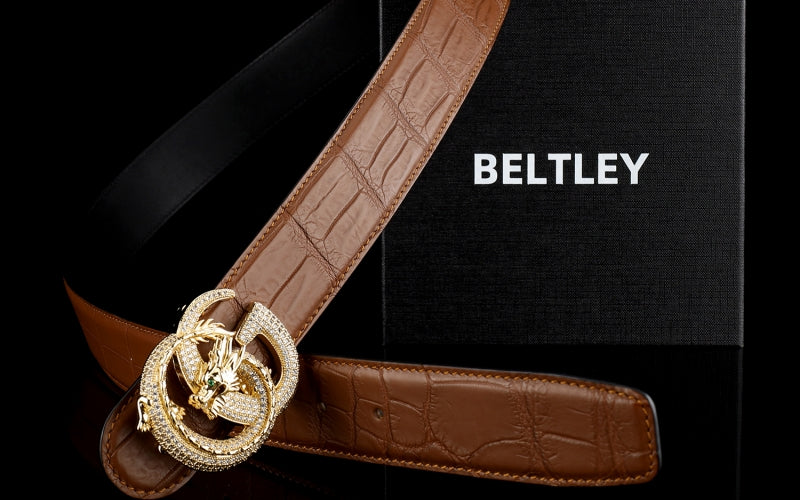
How to Store a Crocodile Belt — Hang, Coil, or Box?
TL;DR:
- Hang it. A vertical hang with the buckle pointing down is the gold standard for crocodile and alligator belts — it lets scales relax and prevents creasing.
- Loose coil (one large loop, not a tight roll) is acceptable for short-term drawer storage. Tight rolls crack scales.
- Box storage only for travel or off-season — and only with acid-free tissue, a cotton dust bag, and 45–55% humidity.
- Keep crocodile leather away from direct sunlight, radiators, plastic bags, and attics or basements.
Quick Facts
- Best long-term storage: hang vertically, buckle down, on a wide belt loop.
- Ideal humidity: 45–55% RH; ideal temperature: 60–70°F (15–21°C).
- Acceptable short-term: loose coil, scale-side out, no pressure on the buckle.
- Avoid: tight rolls, plastic sleeves, direct sunlight, attics, basements.
- Dust bag: 100% unbleached cotton. Never store crocodile in plastic.
- Cedar: keep blocks near the belt — never touching the leather.
In our Guangzhou workshop, the first thing we tell new clients after their belt arrives is this: how you store a crocodile belt for the next ten years matters more than how you wear it next Tuesday. We've cut down belts customers stored badly for a decade — scales lifted, edges curled, a permanent kink right where it was rolled around the buckle. All of it preventable. This guide is the same one we send with every BELTLEY crocodile belt, distilled from twenty-six years of working with exotic hides.

Storage Decision: Match Your Space
Hang, coil, or box — settled by your setup:
| Your situation | Go with |
|---|---|
| Closet rail available | Hang, buckle down — the gold standard; scales relax, no crease forms. |
| Drawer-only storage | Loose single coil, 3"+ diameter, never tight-rolled — tight rolls crack scales. |
| Off-season or travel | Box with acid-free tissue inside a cotton dust bag, 45–55% humidity. |
| Sunny closet or radiator nearby | Relocate the belt — UV and heat dry exotic hide faster than any neglect. |
Care details by leather type: BELTLEY's leather care guide.
What's the single best way to store a crocodile belt?
Hang it vertically, with the buckle pointing down, on a wide, padded belt loop or a smooth wooden peg. Crocodile and alligator scales need to lie flat and relaxed. A vertical hang lets gravity do the work, prevents creases across the scale rows, and keeps the buckle's weight from torquing the leather.
We use simple cedar pegs in our showroom — wide enough that the belt loop doesn't pinch into a sharp fold, smooth enough that the leather doesn't catch. A standard tie rack works too, as long as the rod is at least 1.5 inches wide. Avoid thin metal hooks; they create a pressure point right where the keeper loop sits, and over a year that becomes a visible dent. If your closet runs warm or sunny, hang the belt inside its cotton dust bag — covered, but still vertical.

Why is hanging better than coiling or rolling?
Crocodile leather is built from thousands of individual scales, each set into a flexible matrix of collagen fibers. Hanging keeps every scale in its neutral position. Coiling — and especially tight rolling — forces the outer scales to stretch while the inner ones compress, which over time lifts edges and creates micro-cracks at the scale boundaries.
The damage is cumulative. One weekend in a rolled-up suitcase pocket won't ruin a belt. Six months on a shelf, rolled tight around the buckle, will. The most expensive repair we see — and the one we can rarely fix invisibly — is a permanent kink at the buckle fold. That's why all our exotic leather belts ship flat in a long presentation box, never pre-coiled. According to a Wikipedia overview of crocodile leather, the value of an exotic hide is largely in the integrity of its scale pattern — which is exactly what bad storage destroys first.

Is loose coiling ever okay?
Yes — for short-term drawer storage or travel under two weeks, a loose coil is fine. The rule: one large loop, scale-side facing outward, with no pressure on the buckle and no fold sharper than a coffee mug's diameter (roughly 3 inches). Never wrap the strap around the buckle itself.
This is how we recommend storing a belt you're rotating in and out of weekly. Lay the belt flat, then form a single relaxed circle — the keeper end tucks loosely under the buckle end. If you can see a visible crease line when you pick it up, your coil is too tight. For deeper care guidance, our full leather care guide walks through cleaning, conditioning, and seasonal rotation.

Should I keep my crocodile belt in a box?
Box storage works only for travel or true off-season storage (3+ months), and only when done correctly: an acid-free tissue wrap, a cotton dust bag over that, and a rigid box that lets the belt lie flat — never folded. The box's job is to block light, dust, and accidental pressure, not to compress the belt.
A box is the worst choice for a belt you wear monthly, because every retrieval flexes the leather more than necessary. But for a winter belt going into summer storage, a long flat box (the original BELTLEY presentation box is sized for this) is excellent. Standard guidance from museum textile conservation repeats the same principle: dark, dry, ventilated, undisturbed. That's a box's strength.
Key Takeaways (mid-post)
- Hang for daily and long-term — buckle down, wide peg, inside a dust bag if light is an issue.
- Loose coil for short-term and travel — one circle, no buckle wrap, no tight folds.
- Box flat only for off-season — acid-free tissue, cotton bag, never folded in half.
- Humidity matters more than most people realize: aim for 45–55% RH.

What humidity and temperature does crocodile leather need?
Crocodile and alligator hides are happiest at 45–55% relative humidity and 60–70°F (15–21°C). Below 40% RH the leather dries out and scales begin to curl at the edges. Above 65% RH you risk mold spotting along the suede backing — a problem we see often in coastal closets without dehumidifiers.
A $15 hygrometer in your closet pays for itself the first year. If you live somewhere humid — Florida, Singapore, Hong Kong — run a small dehumidifier or drop in silica gel packets and refresh them quarterly. If you live somewhere dry — Phoenix, Denver, the Middle East — a small bowl of water in the closet, or simply storing the belt inside a cotton dust bag, helps buffer moisture loss. Conservation literature consistently flags climate control — specifically relative humidity — as the single most overlooked factor in long-term hide preservation.
Why does the dust bag matter so much?
A 100% unbleached cotton dust bag does three things at once: it blocks UV light (which fades dye and stiffens collagen), it lets the leather breathe (unlike plastic, which traps moisture and grows mold), and it cushions the belt against accidental scuffs from neighboring items. It's the cheapest, highest-leverage piece of belt care equipment you own.
Every BELTLEY belt ships with one. If you've lost yours, an old white pillowcase works in a pinch. Never substitute a plastic dry-cleaning bag — we've seen plastic-stored belts develop a sticky, milky bloom across the scales within eighteen months, and that damage is permanent. For the buckles themselves, especially our polished stainless steel hardware, a separate microfiber pouch prevents the metal from scratching adjacent leather.

Where should I put a cedar block — on the belt or near it?
Cedar belongs near your crocodile belt, never touching it. Cedar oil is excellent for repelling moths and absorbing ambient moisture, but direct contact transfers tannins and resins that can stain exotic leather, especially lighter colors like cognac, ivory, or natural tan.
We hang cedar blocks on the closet rod 6–12 inches from the belt, or place them on a shelf below. Refresh them with a light sanding every six months to reactivate the oils. The same rule applies to lavender sachets and other natural moth repellents — proximity good, contact bad.
How should I store a crocodile belt off-season?
For a belt you won't wear for 3+ months, store it flat in its original long box, wrapped in acid-free tissue, inside a cotton dust bag, in a dark closet at 45–55% RH. Add a silica gel packet if humidity runs high. Never use the attic, basement, or garage — temperature swings and humidity spikes ruin exotic leather faster than daily wear.
We also recommend a "wake-up" routine before you put the belt back into rotation: unwrap it, hang it vertically for 48 hours so the leather re-relaxes, then apply a thin coat of exotic-leather conditioner before the first wear. If you need a refresher on conditioning frequency, our crocodile belt care deep-dive covers it in detail. BELTLEY belts are made-to-order with a 2–3 day handcraft window before they ship — but once one is yours, its longevity is in your hands.
What are the most common crocodile belt storage mistakes?
The five we see most often: rolling the strap tightly around the buckle (creates a permanent kink), storing in a plastic bag (traps moisture, causes bloom), keeping it on a sunny dresser (UV fade), folding it in half in a drawer (sharp crease), and using the attic or basement (temperature and humidity chaos). All five are completely avoidable.
A bonus mistake: stacking heavy items on top of a boxed belt. Even inside a rigid box, sustained pressure compresses the scales. Keep the belt's box on the top shelf, not the bottom of a pile. For travel, our customers often use a dedicated belt travel case — but in a pinch, rolling the belt loosely inside a rolled-up shirt protects it better than any zippered pocket.
The Bottom Line
Storing a crocodile belt well isn't complicated — it's just consistent. Hang vertically for daily use, loose-coil for short trips, box-flat for off-season — and obsess about humidity more than anything else. Crocodile leather rewards patience: a belt stored properly for ten years often looks better than the day it shipped, because the natural oils settle and the scales develop a quiet, lived-in patina that no factory finish can replicate.
At BELTLEY, every belt is handcrafted in small batches and held in stock, so when you order you'll have yours in hand within 2–3 days of order — but the relationship you build with that belt over the next decade depends almost entirely on how you store it between wears. Browse our full collection of crocodile and alligator belts, or read our 10-year warranty terms to see exactly what we stand behind.
Frequently Asked Questions
Q: Can I store my crocodile belt in the original shipping box long-term? A: Yes — the BELTLEY presentation box is acid-free, long enough for the belt to lie flat, and rigid enough to prevent crushing. Just store it on a top shelf, not under heavier items, and check humidity in the closet.
Q: How often should I take a stored belt out to "air"? A: Every 4–6 weeks, unwrap the belt and hang it vertically for 24–48 hours. This lets the leather re-relax and prevents stagnant air pockets inside the dust bag.
Q: Is it bad to store a crocodile belt buckled into pants? A: Yes. Leaving the belt threaded through belt loops creates sharp folds at every loop and compresses the leather around the buckle. Always remove the belt from pants before hanging or coiling.
Q: Will silica gel packets dry out my crocodile leather? A: Not at normal household humidity. Silica gel buffers excess moisture without pulling humidity below the 40% RH danger threshold. Replace or recharge the packets every three to six months.
Q: Can I use a regular leather conditioner before storage? A: Use only a conditioner formulated for exotic leather, and apply a very light coat 24 hours before storing. Heavy cowhide conditioners can leave residue that attracts dust and clouds the scales.
By the BELTLEY artisan team — handcrafting exotic leather belts since 1999. Last updated: May 10, 2026.